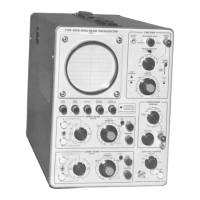
Circuit Description— Type 544/RM544
emitter circuit. Zener diode D1018 sets the operating points
of the termination transistors on both ends of the delay line.
The rc networks in the collectors of Q1014, Q1024, Q1144,
Q1154, and in the emitter leads of Q1034 and Q1044 set the
individual transistor operating points to achieve thermal bal
ance. The 5-turn center-tapped coils at the input of the delay
line and the collector-base capacitance of the delay-line
driver transistors form a T-section matching network. Cl 029
provides a means of varying the impedance of the T section.
Vertical Output Amplifier. The vertical output amplitier
must properly terminate the delay line and provide broad
band amplification of the vertical signals. Proper termina
tion of the delay line is obtained by connecting forward-
termination transistors in a common-base configuration. The
common-base configuration also operates well in broad
band amplifier applications. To help meet the broad-bond
requirement, the collector load circuit of the termination
transistors contains rc low-frequency compensation netwoiks,
and in addition, Ir networks in the collectors of transistors
Q1034 and Q1044 compensate for losses due to skin effect
within the delay line.
Following the forward-termination amplifier is a wide
band amplifier stage consisting of Q1074 and Q1084 and
associated elements. High-frequency compensation in this
stage is provided by shunt peaking coils LI072 and LI082 in
the collector circuits. The high-frequency response is varied
by adjusting C1076, which provides variable high-frequency
degeneration in the emitter circuit of Q1074 and Q1084.
The output stage of the vertical amplifier is a transistorized
equivalent of a push-pull cascode amplifier. This circuit con
figuration is used to match the low impedance of the trans
istorized vertical-amplifier system to the higher impedance
required at the crt vertical deflection plates. High-frequency
compensation is provided by rc networks between the col
lector of the driving transistor and the emitter of the driven
transistor on each side. Cl 105 and Cl 106 provide a means
of varying the high-frequency response of the output stage.
The outputs from Q1114 and Q1134 are connected to the
deflection plates of the crt via series-peaking coils LI 115
and L1135.
Trigger-Pickoff Circuit. The trigger-pickoff circuit provides
reverse termination for the delay line as mentioned in the
preceding paragraphs. The input stage of the trigger-pickoff
circuit, which provides the delay-line reverse termination, is a
common-base circuit. The output stage of the trigger-pickoff
circuit is a push-pull emitter-follower amplifier that not only
provides trigger signals to the time base, but supplies the
VERT SIG OUT jack with a vertical signal and drives position-
indicator amplifier V1184.
Time Base Generator
The Time Base Generator consists of the sweep trigger and
the sweep generator circuits. The sweep trigger circuit is a
wide-band hybrid amplifier driving a tunnel diode. The
sweep trigger circuit includes controls for selecting the type,
source, and level of the trigger to be used, and circuit ele
ments for regenerating the selected trigger into a pulse suit
able for triggering the sweep generator. The sweep gen
erator provides sweep out and -fgate out signals to front-
panel connectors, ramp voltages for the horizontal deflection
system, and unblanking pulses to the crt.
Trigger Generator. The input to the sweep trigger circuit
(see Sweep Trigger schematic) is selected by SOURCE switch
SW201 from the trigger-pickoff circuit in the vertical ampli
fier, the trigger output of the vertical plug-in preamplifier,
the power transformer for line triggering, or from the front-
panel TRIGGER INPUT connector. COUPLING switch SW205
permits further selection of the type of triggering signal; either
ac, ac with low frequencies rejected, or dc. Once the type
and source of triggering signal has been selected, the slope
on which triggering is desired is selected by SLOPE switch
SW210. The level of the triggering signal required by the
sweep trigger circuit is selected by adjusting TRIGGERING
LEVEL control R215. After this triggering signal has been
selected by the foregoing controls and switches, it is applied
to trigger input amplifier V224.
In operation, V224A and V224B form a push-pull amplifier
which drives a push-pull input, single-ended output amplifier
consisting of Q234 and Q244. Tunnel diode D245 is biased
at its low-voltage state (see Fig. 3-2 for trigger tunnel-diode
curve) by current flow through the voltage divider consisting
of R244, R245, R247, and R248. When the desired slope of
the triggering signal selected arrives at the grids of V224,
V224B and Q244 are biased into conduction. The conduction
of Q244 increases the current flow through D245, and D245
switches to its high-voltage state. The sudden voltage
change across D245 as it switches to its high-voltage state
produces a uniform fast-rising tiigger pulse which is used to
trigger the sweep generator.
Low-Voltage
^ State .
High-Voltage
« - ^ e >■
Fig. 3-2. Typical tunnel-diode characteristic curve.
Sweep Generator. For purposes of explanation, assume
that the HORIZONTAL DISPLAY switch is in the NORMAL (XI)
position, the SINGLE SWEEP switch is in the NORMAL posi
tion, the TRIGGERING MODE switch is in the TRIG position,
and that no trigger is being applied. Under these conditions,
V345B in the holdoff multivibrator is conducting and V345A
is cut off. The paths for the current in V345B are from the
—150-volt supply through R364 and D363 in parallei with
3-6


 To Next Page
 Loading...