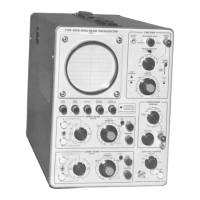
Circuit Description— Type 544/RM544
R363. When V345B is conducting and no trigger is being
received from the trigger generator, D285 is in its low-volt-
age state since the dc current supplied from the +100-volt
supply through R282 and R281 is less than the peak current
of D285. Under these conditions, Q284 is cut off. Thus, the
collector voltage of Q284 is positive, forward biasing D286,
D283 and Q303. Miller tube V291 is conducting. The ciicuit
is now ready to be triggered.
Assuming that a trigger pulse is now applied, the positive
trigger from the sweep trigger circuit is coupled through C256
to 1256 and D257. C256 and L256 form a differentiating net
work that narrows the trigger pulse to approximately 4 nsec
in width. The sharpened trigger pulse passes through D259
to tunnel diode D285 and causes D285 to switch to its high
state, where it remains after the trigger pulse decays to zero.
When D285 switches to its high state, Q284 is biased into
saturation and the voltage change across Q284 applies for
ward bias to Q373 and reverse biases Q289, Q303, and
D286. When D286 is reverse biased, the voltage on the grid
of V291 goes negative and the Miller circuit starts to run up.
As the voltage on the cathode of V293A goes positive, it
starts to charge timing capacitor C290 through D298. At
high sweep rates, boot-strap capacitor C294 couples the ris
ing cathode voltage to the plate circuit of V291 and effec
tively increases the plate supply voltage for V291, compen
sating for losses introduced by stray capacitance. In addi
tion, the positive-going cathode voltage of V293A forward
biases D329 and starts putting a positive voltage on the grid
of V345A in the holdoff multivibrator. At a point determined
by sweep-length resistor R325, the rising positive voltage
biases V345A into conduction, and the holdoff multivibrator
changes state, cutting off V345B. When V345B cuts off, its
cathode voltage drops to —20 volts and reverse biases D285
and Q284. As current flow through Q284 ceases, the voltage
increase across it again forward biases D286. When D286
becomes forward biased, it applies a positive-going voltage
to the grid of V291 which resets the Miller circuit and ends
the sweep.
Disconnect diode D300 ensures that the sweep starts from
the same voltage point each time. Q303 is included in the
circuit to reduce the amount of current that D300 ha;, to
switch, and thereby improves the linearity at the start of
the sweep.
When the sweep ends, V345A has control of the holdoff
multivibrator, and remains in control until the charge on
holdoff capacitor C330 discharges through R330. During the
time that V345A has control of the holdoff multivibrator,
tunnel diode D285 cannot be triggered; but when the hold
off capacitor discharges to the point where V345B can again
assume control, D285 is again biased to a point where it can
accept another trigger.
Automatic Stability Circuit. Q265, Q275, and associated
circuit components form a monostable multivibrator that < on-
trols the stability of the sweep generator. When the trigger
MODE switch is in the TRIG position, the switch grounds the
collector of Q275 and disables the automatic stability feature
of the Type 544. When the triggering MODE switch is in
the AUTO STABILITY position, the sweep generator free tuns
if no trigger pulses are received from the trigger generator.
In normal operation Q265 is conducting due to the posi
tive voltage applied to its base. Q275 is normally cut off due
to its base being grounded through R269. When the trigger
MODE switch is set to the AUTO position, C276 starts to
charge through R276. When the voltage across C276 ex
ceeds the breakdown of Zener diode D277, D277 breaks
down and provides an additional current path for tunnel
diode D285. The additional current through D285 causes it
to switch to its high state and start the sweep. When the
sweep ends and the holdoff multivibrator switches, the volt
age on the cathode of V345B drops to approximately —20
volts, reverse biasing D285. When the holdoff period ends,
the cathode voltage of V345B goes slightly positive, and the
current through D277 again switches D285. If no trigger is
applied, the cycle repeats only if the trigger MODE switch
is in the AUTO position.
When a trigger pulse is received at T252, a negative out
put from the secondary is applied to the base of Q265 and
causes the monostable multivibrator to switch. With Q265
now cut off, its collector voltage goes more positive, and
C267 charges through R269, applying a positive voltage to
the base of Q275. The positive voltage on the base of Q275
biases it to saturation, and Q275 provides a low-resistance
path that discharges C276 and reverse biases D279 and D277.
With the collector of Q275 below the D277 breakdown volt
age, the collector circuit does not provide switching current
for tunnel diode D285, so the only way D285 can be switched
is by application of a trigger pulse. If no further trigger
pulses are received, Q275 is kept in saturation until the
charge current for C267 decays and removes the positive
voltage from the base of Q275.
During the charge time of C267, Q265 is kept cut off by
the forward voltage drop across D271. When the decaying
charge current removes saturation bias from Q275, the volt
age drop across D271 decreases and permits Q265 to con
duct, and the multivibrator switches back to its normal state.
If no further trigger pulses are received, C276 charges through
R276 and R275 until D277 again breaks down and provides
switching current for D285.
Unblanking Circuit. Except when the HORIZONTAL DIS
PLAY switch is set to the EXT positions, an unblanking pulse
is generated and applied to the crt unblanking circuit during
sweep time. The unblanking pulse is initiated when tunnel
diode D285 switches to its high state and biases Q284 into
conduction. When Q284 conducts, its collector voltage drops
and removes the cutoff bias from Q373, biasing Q373 into
conduction. When Q373 conducts, it puts a positive-going
voltage on the grids of cathode followers V393A and V393B.
The positive-going voltage on the cathode of V393B is coupled
to the crt unblanking supply. The output of V393A is applied
to the + GATE OUT connector on the front panel.
Single-Sweep Circuit. When single-sweep operation is de
sired, NORMAL - SINGLE SWEEP - RESET switch SW135 is set
to the SINGLE SWEEP position. When SW135 is pushed to
the RESET position, it operates switch SW369 which dis
charges C369 (see Sweep Generator schematic) through R369,
R368, and R367, generating a positive pulse which is applied
through C366 and D364 to the cathode of holdoff tube
V345A. The positive pulse on the cathode of V345A causes
the holdoff multivibrator to switch, and V345B biases sweep
tunnel diode D285 to the ready point as previously explained.
Since Q284 and V345A are both cut off, the positive voltage
on the collector of Q284 and the voltage on the plate of
V345B combine through R287 and R342 and produce turn-on
bias for Q289. When Q289 conducts, it completes the circuit
for the NE-23 READY lamp (B289). With the application of a
trigger pulse, Q284 conducts and the voltage on its collector
® T
3-7


 To Next Page
 Loading...