Main Analysis:
The main called-party analysis is carried out on the called-party prefixes resulting from
the pre-analysis. Up to 16-digit-long prefixes may be analyzed. It is possible to define
the minimum and maximum digits for starting the analysis. This analysis is date- and
time-dependent, i.e., for different days of the week and different times of the day, the
analysis may result in different outcomes:
• Route
• Called-party number replacement (up to 32 digits)
• Call class to be used for detailed CMDR
• Authorization level necessary to realize the routing
• Tariff
The route that is decided on after this analysis may be:
• A local termination (i.e., subscriber)
• A trunk group from which the call is to be routed outward
• A physical address of a digital/analog subscriber/trunk port available in the switch
• A remote H.323 gatekeeper
• A remote SIP registrar
• A subscriber service
• A system service for maintenance and administrative purposes
• A system resource like integrated voice mail, message-storage hardware etc.
• A tone or a system message stored in the switch
Outgoing A-Party Analysis (optional):
Outgoing A-party (calling-party) analysis is the last (optional) step in the routing
procedure. It is applied to the terminating or outgoing interface. In order to facilitate
this analysis, an outgoing A-party analysis table is assigned to the called
subscriber/outgoing trunk. The outgoing A-party analysis is done by analyzing the
calling party's number (up to 32 digits), Category, Nature of address, Numbering Plan,
Presentation Status, Screening Status, etc. and, additionally, the Called-Party's Nature of
Address, after which any or all of these parameters may be translated.
SYSTEM MANAGEMENT AND BILLING
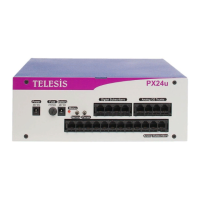
The Telesis PX24U/PX24M Hybrid IP PBX can managed over IP. System programming
and updating the Xymphony operating system can easily be managed either on site or
remotely, through a WEB browser connection to web server integrated into the system.
All system-management operations are performed without interrupting the functions of
the system. The integrated web server allows:
• Subscriber administration
• Routing administration
• Trunk-circuit administration
• Call-charging administration
Furthermore, the Telesis XPort utility allows:
• Detailed monitoring of signaling
• Traffic measurement including collecting detailed call-data records
• Downloading conversation records
A powerful feature of Xymphony concerns call charging. It is capable of prefix digit
analysis of up to 16 digits. Destination-based tariff tables can be constructed to define:
• Unit-charge periods depending on destination
• Unit-charge periods depending on the day of the week and time of day
• Vacations and other special days for separate unit-charge periods
• Fixed-charge calls
• Charge-free calls
All unit-charge periods are specified in multiples of 100 msec (milliseconds). Hence, a
unit-charge period may take a value from 100 msec to several minutes in multiples of
100 msec. Furthermore, call-charging information generated by far-end equipment can
also be used.
A subscriber service (such as call forwarding, reminder) can have a separate fixed fee
charge for using, activating, deactivating, or querying the service.
Call charging is processed in real time during the call. Pre-paid status within a certain
amount of credit can be defined for each subscriber.
9


 To Next Page
 Loading...