
 Need help?
Do you have a question about the Telesis PX24U and is the answer not in the manual?
Acknowledges purchase and expresses hope for satisfaction with the product.
Details the components included with the system based on specifications.
Highlights key hardware and software elements of the system.
Provides a concise summary of the system's capabilities and target users.
Lists the core hardware and software features included with the PX24U model.
Lists core hardware/software features for the PX24M model.
Outlines additional hardware and software available for PX24U.
Explains the types and usage of memory in the PBX system.
Details the 10/100 BaseT Ethernet connectivity and its applications.
Describes the leading-edge operational software of the PBX system.
Explains the system's non-blocking switching matrix and DSP capabilities.
Details the four-step algorithm for routing TDM and VoIP calls.
Outlines the optional analysis of calling party details for routing.
Describes the optional process to truncate or reject called-party prefixes.
Covers IP-based management, programming, and updates via web server.
Explains the system's ability to manage call charging based on various criteria.
Lists various system features, parameters, and user services available for activation.
Details how tones inform users of system states and are programmable.
Lists specific editable tones like Dial tone, Busy, Confirmation, etc.
Lists examples of predefined messages used for auto-attendant, VMail, etc.
Explains monitoring TDM interfaces by decoding signaling or protocol.
Identifies Telesis XPort utility as the MMI for the protocol analyzer.
Lists what the signaling analyzer can analyze, including primitives and interfaces.
Details analog E&M trunk card features and signaling options.
Explains analog subscriber interfaces and Caller ID support.
Describes how Telesis digital sets connect via ISDN interfaces.
Covers detection of DC feed, polarity reversal, and charge pulses.
Notes optional support for Basic Rate ISDN types.
Lists supported ISDN supplementary services.
Covers H.323 standards, applications, physical layer, and options.
Details available audio codecs and echo cancellation features.
Explains defining routes and grouping them into routesets with priority.
Details routing calls from TDM to IP based on dialed digits and calling party info.
Lists supported H.450.x series supplementary services for H.323.
Covers SIP standards, applications, layers, and audio codecs.
Explains the use of 256-bit AES for encrypting media in VoIP calls.
Details secure registration between systems using authentication.
Covers AES-256 encryption and Diffie-Hellman key exchange.
Discusses coexistence and interoperability of H.323 and SIP protocols.
Lists extended services available with xSIP protocol and capable phones.
Lists part numbers and their corresponding short descriptions for PX24U.
Lists optional hardware like battery cables and rack adapters for PX24U.
Details licenses for DVR channels, VoIP channels, and encryption for PX24U.
Lists part numbers and their corresponding short descriptions for PX24M.
Lists optional hardware like analog/digital subscriber cards and E&M cards for PX24M.
Details licenses for DVR channels, VoIP channels, and encryption for PX24M.
Advises on suitable installation locations and environmental parameters.
Specifies power connection, grounding, and safety warnings.
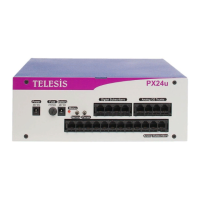
Identifies and describes connectors and indicators on the PX24U front panel.
Identifies and describes connectors and indicators on the PX24M front panel.
Explains how to use holes and the footprint sheet for wall mounting.
Details the process of attaching rack adapters for 19-inch rack installation.
Explains connecting the power converter and using batteries for backup.
Outlines steps to disconnect power and remove panels before installing cards.
Details the process of disconnecting power and replacing a blown fuse.
Covers installation and configuration of the DEM analog E&M card.
Explains the installation and configuration of the DDL ISDN card.
Provides default IP, port, and access details for system connection.
Guides users to find online help and embedded documents for system programming.
Explains how to reset web server settings to factory defaults.
Covers system reboot procedures and management of programmed parameters.
Introduces the executive digital telephone set and its features.
Describes the IP version of the DTS821, supporting xSIP protocol.
Details the PC-based softphone with xSIP protocol.
Describes the mobile softphone supporting xSIP protocol.
Explains the API server for telephony tasks like dialing and call transfer.
Details integration with SugarCRM via XCom for customer relations management.
Lists freeware utility functions for CMDR, call reports, and archiving.
Covers quotation validity, payment terms, and limitation of seller liability.
Explains XOP license file generation, delivery, and refund policy.
Outlines licensing for optional parts and agreement to terms.
Details buyer's rights to use software and seller's copyright protection.
Lists general specifications like operational software, voltage, and CPU type for PX24U.
Details PBX applications, interfaces, and subscriber/trunk counts for PX24U.
Covers various TDM signaling methods supported by the PX24U.
Lists IP telephony standards, codecs, and capabilities for PX24U.
Lists general specifications like operational software, voltage, and CPU type for PX24M.
Details PBX applications, interfaces, and subscriber/trunk counts for PX24M.
Covers various TDM signaling methods supported by the PX24M.
Lists IP telephony standards, codecs, and capabilities for PX24M.
 General
| DISA | Yes |
|---|---|
| Caller ID | Yes |
| Conference Calling | Yes |
| Music on Hold | Yes |
| Expandable | Yes |
| Power Failure Protection | Yes |
| Dimensions | 370mm x 280mm x 100mm |
| Weight | 3.5kg |

 To Next Page