GENERAL
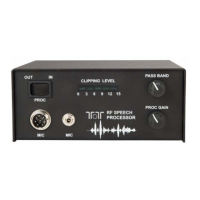
Model 715 RF Speech Processor is a high performance true
RF-type speech processor designed to operate with most
modern HF Amateur Radio transceivers. RF speech processing
is a superior system to traditional AF clipping, AF
compression, or RF compression found in a typical HF
transceiver for achieving the highest ratio of average-to-peak
power from an SSB transmitter.
The purpose of a speech processor is to increase the
readability of your signal at the other end of a QSO. Speech
processors do not increase peak power; they increase average
power output. An up to 6 dB increase in average power output
in SSB service can be achieved with the proper use of this
device. This can mean the difference between a signal buried
under band noise or an intelligible, copyable signal.
The clipping function of the RF speech processor removes
low energy, high amplitude peaks which do not contribute to
articulation while leaving lower level speech components
unaltered.
Model 715 mixes an input audio signal from the
microphone with a local oscillator to output a 455 kHz DSB
suppressed carrier signal. Filters remove the opposite
sideband. The resulting signal is amplified and clipped,
generating harmonic distortion and intermodulation distortion.
The harmonics are removed by a clean-up filter. This is unlike
an AF clipper where it is not possible to remove or change
either harmonic distortion or intermodulation distortion. Of the
two, harmonic distortion tends to be more “grating” than IM
distortion. The resulting amplified and clipped 455 kHz SSB
signal is then converted back to audio for output to the
transceiver.
Unlike conventional clipper or compressor systems which
use a single level control to determine output characteristics,
the model 715 provides the capability to tailor the low
frequency response of the system for optimum processor
punch.
PACKING KIT
Included with your model 715 RF Speech Processor are the
following items:
#21195 - 110 VAC wall transformer
#74425 - Instruction manual
#74430 - W6JES January 1969 QST article
SPECIFICATIONS
Power requirements: 12-20 VDC
Microphone Input Impedance: Max 50k ohms.
Microphone Input Sensitivity: 1 mv or greater
Polarizing Voltage: +9 VDC at input pin 2
Low Freq Response: With passband control centered, -3 dB @
800 Hz. Max low frequency with passband control full
clockwise, -3 db at 450 Hz. Minimum with control full
counterclockwise -3 dB @ 1300 Hz. All specified without
clipping. Low frequency response will vary with the amount
of clipping added.
High Frequency Response: -3 dB @ 4500 Hz.
Part # 74425
Revision 1
January 2009


 To Next Page
 Loading...