EasyManua.ls Logo

Tenma 72-455 - Applications; Sine Wave Oscillator Applications; Amplifier Gain Measurement; Phase Characteristic Measurement

Tenma 72-455
15 pages
Print Icon
To Next Page IconTo Next Page
To Previous Page IconTo Previous Page
Loading...
APPLICATIONS
of
the
amplifier
is
50dB
below
2V.
Therefore,
the
gain
obtained
is
as follows:
1. Using as
Sine
Wave
Oscillator
The
instrument
can
be used as a sine wave
oscillator
as
outlined
below.
1.1
Since
the
unit
features
low
distortion
factor,
it.
can
be used
for
measurement
of
distortion
characteristic
of
amplifier.
1.2
Since
the
unit
features
wide
bandwidth,
it can be
used
for
measurement
of
frequency
characteristic
of
amplifier.
1.3
The
built-in high
accuracy
attenuator
permits
measurement
of
amplifier
gain.
1.4 Can be used as a signal
source
of
impedance
bridge.
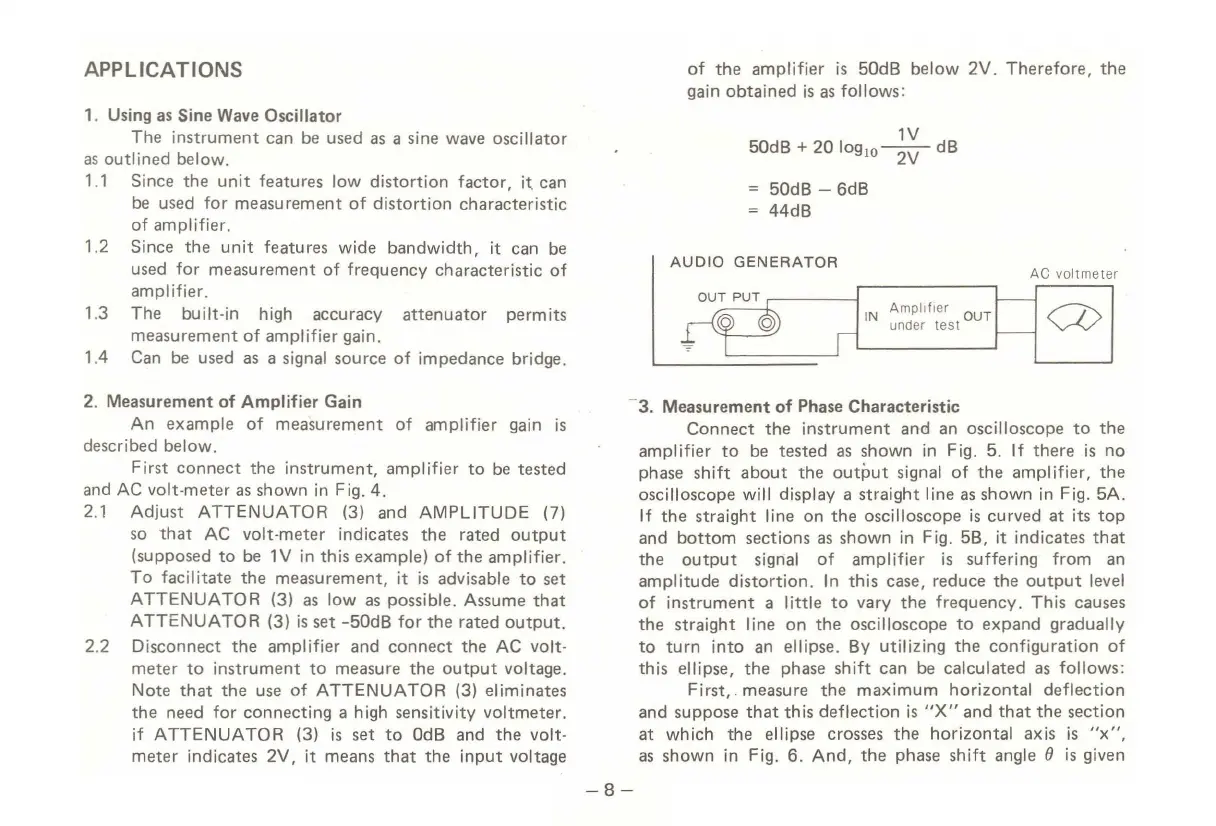
1V
50dB
+
20
IOg10
~
dB
50dB
-
6dB
44dB
AUDIO
GENERATOR
IN
Amplifier
OUT
under test
AC
voltmeter
2.
Measurement
of
Amplifier
Gain
An
example
of
measurement
of
amplifier
gain
is
described
below.
First
connect
the
instrument,
amplifier
to
be
tested
and AC
volt-meter
as
shown
in
Fig.
4.
2.1
Adjust
ATTENUATOR
(3)
and
AMPLITUDE
(7)
so
that
AC
volt-meter
indicates
the
rated
output
(supposed
to
be 1V in
this
example)
of
the
amplifier.
To
facilitate
the
measurement,
it
is
advisable
to
set
ATTENUATOR
(3) as low as possible.
Assume
that
ATTENUATOR
(3)
is
set
-50dB
for
the
rated
output.
2.2
Disconnect
the
amplifier
and
connect
the
AC volt-
meter
to
instrument
to
measure
the
output
voltage.
Note
that
the
use
of
ATTENUATOR
(3)
eliminates
the
need
for
connecting
a high sensitivity
voltmeter.
if
ATTENUATOR
(3)
is
set
to
OdB
and
the
volt-
meter
indicates
2V,
it
means
that
the
input
voltage
-3.
Measurement
of
Phase
Characteristic
Connect
the
instrument
and
an
oscilloscope
to
the
amplifier
to
be
tested
as
shown
in
Fig.
5.
If
there
is
no
phase
shift
about
the
output
signal
of
the
amplifier,
the
oscilloscope
will display a
straight
line as
shown
in
Fig.
5A.
If
the
straight
line
on
the
oscilloscope
is
curved
at
its
top
and
bottom
sections
as
shown
in
Fig. 5B, it
indicates
that
the
output
signal
of
amplifier
is
suffering
from
an
amplitude
distortion.
In
this
case,
reduce
the
output
level
of
instrument
a little
to
vary
the
frequency.
This
causes
the
straight
line
on
the
oscilloscope
to
expand
gradually
to
turn
into
an ellipse. By utilizing
the
configuration
of
this
ellipse,
the
phase
shift
can
be
calculated
as
follows:
First,.
measure
the
maximum
horizontal
deflection
and
suppose
that
this
deflection
is
"X"
and
that
the
section
at
which
the
ellipse crosses
the
horizontal
axis
is
"x",
as
shown
in Fig.
6.
And,
the
phase
shift
angle
()
is
given
-8-

Related product manuals