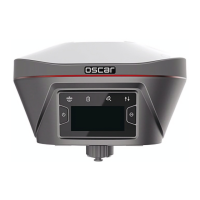
The Oscar GNSS Receiver is a new generation GNSS RTK system designed for high-accuracy and stable signal detection in various field applications. It comes in three versions: Ultimate, Advanced, and Basic, offering flexibility based on user requirements.
Function Description:
The Oscar GNSS Receiver supports multi-constellation and multi-frequency GNSS, providing high accuracy and stable signal detection. A key feature is its calibration-free tilt compensation, which is immune to magnetic disturbances, eliminating the need for a leveling pole. The Ultimate and Advanced versions include a 1.54-inch interactive screen for easy configuration. The device is equipped with a high-performance antenna to speed up Time To First Fix (TTFF) and improve anti-jamming capabilities. It features a built-in large-capacity, detachable battery system, with two batteries providing up to 16 hours of field work in 4G/3G/2G network and Rover radio mode. An integrated UHF radio module enables long-distance communication. The rugged housing, with an IP68 rating, ensures durability in harsh environmental conditions. Additionally, it offers free subscription to Tersus Caster Service (TCS) for transmitting correction data from an Oscar Base to a Rover.
Important Technical Specifications:
- Supported Constellations & Frequencies: GPS L1C/A, L2C, L2P, L5; GLONASS L1C/A, L2C/A; BeiDou B1, B2, B3 (supports BDS-3); Galileo E1, E5a, E5b; QZSS L1C/A, L2C, L5.
- Channels: 576.
- Position Accuracy (RMS):
- Single Point Positioning: 1.5m (Horizontal), 3.0m (Vertical)
- DGPS Positioning: 0.25m (Horizontal), 0.5m (Vertical)
- High Precision Static: 2.5mm+0.1ppm (Horizontal), 3.5mm+0.4ppm (Vertical)
- Static & Fast Static: 2.5mm+0.5ppm (Horizontal), 5mm+0.5ppm (Vertical)
- Post Processed Kinematic: 8mm+1ppm (Horizontal), 15mm+1ppm (Vertical)
- Real Time Kinematic: 8mm+1ppm (Horizontal), 15mm+1ppm (Vertical)
- Network Real Time Kinematic: 8mm+0.5ppm (Horizontal), 15mm+0.5ppm (Vertical)
- Observation Accuracy (zenith direction): C/A code 10cm, P code 10cm, Carrier phase 1mm.
- Time To First Fix (TTFF): Cold start <35s, Warm start <10s.
- Reacquisition: <1s.
- Tilt Compensation Accuracy (within 60°): ≤2cm.
- Timing Accuracy (RMS): 20ns.
- Velocity Accuracy (RMS): 0.03m/s.
- Initialization (typical): <10s.
- Initialization Reliability: >99.99% for Ultimate, >99.9% for Advanced and Basic.
System & Data:
- Operating System: Linux.
- Storage: Built-in 16GB/8GB.
- Data Format: CMR, CMR+ (GPS only), RTCM 2.X/3.X, RINEX, NMEA-0183, Tersus Binary.
Communication:
- UHF Radio: 410-470MHz, Half-duplex, 0.5W/1W/2W transmit power, >5km typical distance.
- Network: 4G (LTE/TD-SCDMA/WCDMA/GPRS/GSM), Wi-Fi (802.11b/g), Bluetooth (V4.1), NFC.
- Ports: USB 2.0 x1 (OTG), RS232 x1 serial port.
- COM Baud Rate: Up to 921600bps.
Electrical:
- Input Voltage: +9 ~ 28V DC.
- Lithium Battery: 7.4V 6400mAh x2.
- Battery Life: Up to 16 hours (two batteries) in 4G/3G/2G network and Rover radio mode.
Physical:
- Display: 1.54'' OLED (Ultimate & Advanced versions).
- Dimensions: 157157103 mm.
- Weight: ≈ 1.2kg (without battery), ≈ 1.4kg (with a battery).
- Screw Hole for Assembly: 5/8”x11UNC-2B.
- Vibration: MIL-STD-810G,FIG.514.6C-1.
- Dustproof & Waterproof: IP68.
Environmental:
- Operating Temperature: -40°C to +70°C.
- Storage Temperature: -55°C to +85°C.
- Relative Humidity: 100% not condensed.
Usage Features:
- Button Configuration: Two buttons (Power ON/OFF and Function) are used for various operations, including power control, menu navigation, static survey activation, and GNSS module reset. The specific functions vary slightly between the Ultimate/Advanced and Basic versions.
- LED Indicators: Four LEDs (Satellite, Tilt Compensation, Correction Data, Battery) and an OLED display (Ultimate/Advanced) or six LEDs (Basic) provide visual feedback on the receiver's operating status, battery level, and solution status.
- Configuration:
- Via Buttons: Direct configuration of modes (Single, Base, Rover), data formats (RTCMv2.3/3/3.2, RTD, CMR), radio protocols (TRANSEOT, TT450, SOUTH, SATEL, TRIMMK3), air baud rates, channels, and frequencies.
- Via TC20 Controller (Nuwa App): Connects via NFC or Bluetooth. The Nuwa app allows for comprehensive configuration of base and rover modes, including startup options, data links (Receiver Network, PDA Network, Internal Radio, External Radio), and detailed protocol settings. It also supports electronic bubble calibration and registration.
- Web UI: Oscar can act as a Wi-Fi hotspot, allowing configuration, firmware upgrades, and monitoring of positioning and satellite information via a web browser on a computer or smart terminal.
- Data Download: The receiver functions as a USB storage device when connected to a computer, allowing easy download of static data (RINEX and Tersus binary format) and debug information from the F:\record and F:\debug folders.
- Firmware Upgrade: Supports both wired (via Mini-USB OTG cable and USB flash drive) and wireless (via Wi-Fi web upgrade or Nuwa app) methods.
- Battery Change Mode: Ultimate and Advanced versions can be configured to maintain the current working mode (base or rover) and coordinates during a battery change, ensuring seamless operation.
- Tilt Survey and Stakeout (Ultimate version only): Features calibration-free tilt compensation. Initialization occurs automatically by walking forward a few meters. The tilt status, direction, angle, heading, and quality index are displayed, enabling accurate survey and stakeout even with a tilted ranging pole.
Maintenance Features:
- Battery Care: Rechargeable Lithium-ion batteries require careful handling. Users are advised not to use or charge damaged batteries, expose them to fire or high temperatures, immerse them in water, or drop/puncture them. Proper disposal according to local regulations is emphasized.
- TC20 Controller Care: Although rugged, the TC20 controller should be kept dry and protected from extreme temperatures, moisture, and corrosive substances to ensure stability and longevity.
- Radio Antenna Installation: It is crucial to install the radio antenna before switching the radio transceiver to transmit mode to prevent overheating and potential damage to the radio module.
- Troubleshooting: The manual provides solutions for common issues such as inability to receive satellite signals, internal UHF radio not transmitting data, CORS network login failures, and communication problems between Nuwa and Oscar. It also details how to calibrate the e-Bubble and apply Geoid model files.
- Technical Support: Users are encouraged to log a technical support ticket or email support if problems persist after consulting the documentation.

 Need help?

 To Next Page
 General