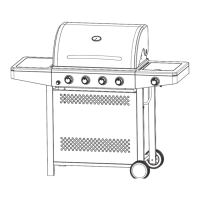
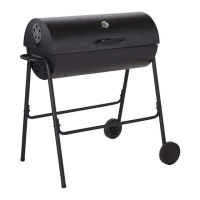
This document provides assembly and usage instructions for the Tesco Outdoor 2 Burner Gas BBQ, model KS17065A.
Function Description
The Tesco Outdoor 2 Burner Gas BBQ is a gas barbecue designed for outdoor use, specifically for preparing foods suitable for barbecue cooking. It operates with LPG (liquid petroleum gas) bottled gas, offering both grill cooking and roasting hood cooking options. For grill cooking, burners heat a flame tamer, which in turn heats the food on the grill. Natural food juices vaporize upon contact with the hot flame tamer, basting the food with smoke for a unique barbecued flavor. For roasting, the hood can be closed to create an "oven" effect, suitable for baking or roasting joints of meat or whole chickens. This indirect cooking method is achieved by placing food on a metal baking tray on one side of the cooking grill, with the burner directly underneath turned off and other burners set to a low to medium position. The barbecue is designed for private use only.
Important Technical Specifications
- Model Number: KS17065A
- Pin Number: 2575DL0359BU1015
- Product Size: L925 x W480 x H920 mm
- Gas Category: I3+(28-30/37) for GB and IE; I3B/P(30) for CZ, SK and HU.
- Gas Pressure: 28-30 mbar, 37 mbar, 30 mbar (depending on destination country).
- Injector Size (main burner): 0.75 mm
- Gas Type: Butane, Propane, or Butane/Propane/LPG mix.
- 2 Burner Heat Input: 4.7 kW
- Gas Consumption: 335 g/h
- Recommended Gas Bottle Size: 5-15 kg, with a maximum dimension of 31.5 cm diameter and 58 cm height.
- Hose: Must comply with EN16436-1, with a length not exceeding 1.5 meters.
- Regulator: Suitable for low-pressure butane or propane gas, certified to EN16129. The barbecue is set to operate with a 28-30 mbar regulator for butane gas or a 37 mbar regulator for propane gas. The version for GB and IE is fitted with a gas hose and 37 mbar regulator for propane gas use only.
Usage Features
Safety Warnings:
- Outdoor Use Only: This appliance must never be used indoors.
- Unattended Operation: Never leave a lit barbecue unattended.
- Flammable Materials: Keep the barbecue on a safe, level surface, well away from flammable items (e.g., wooden fences, tree branches) and at least 1 meter from any combustible surface. Minimum clearance from sides and back to combustible construction is 3 feet.
- Hot Surfaces: Accessible parts become very hot during operation. Always wear heat-proof gloves and keep children and pets away.
- Gas Leaks: Perform a leak test after each tank refill or first use after a long period, and annually. Use a soap solution (1/2 water and 1½ liquid detergent/soap) to check all gas system joints. Never use an open flame for leak testing.
- Gas Bottle Placement: Never place the gas bottle on the lower shelf or directly underneath the barbecue. Always site it at the left-hand rear or side of the appliance, as far away as possible without straining the hose.
- Fat Fires: In case of a fat fire, turn all control knobs to 'off,' turn off the gas supply at the bottle, keep everyone at a safe distance, and wait for the fire to burn out. Do not close the hood or douse with water. Use a powder-type extinguisher if necessary.
- Overheating: Do not use with more than 50% of the cooking area as a solid plate (including baking dishes) as this can cause excessive heat build-up and damage.
- Carbon Monoxide Hazard: Never light or let the product smolder or cool down in confined spaces due to the danger of carbon monoxide poisoning.
Operation:
- Preparation: Before cooking, apply a light coat of cooking or vegetable oil to the cooking surface using a long-handled brush. Line the drip pan with aluminum foil for easier cleanup.
- Lighting Main Burner: Open the hood, ensure knobs are off, open the gas control valve, then push and turn control knobs to "Max." Press the ignition button rapidly until the burner lights. If it fails, turn knobs off, close the gas valve, wait 5 minutes, and repeat.
- Manual Ignition: Insert a lit match through the match-lighting hole, push and turn the control knob anti-clockwise to "Max."
- Preheating: After ignition, burn the burner at the high position for 3-5 minutes with the hood open before each cooking session.
- Cooking: Turn burners down to a lower position for best cooking results. When roasting with the hood closed, use low to medium heat and avoid lifting the hood unnecessarily.
- Flare-Up Control: Trim excess fat from meat, use cooking sauces sparingly, and cook on low heat to prevent excessive flare-ups. Baking soda or salt can extinguish flare-ups.
- Turning Off: Turn all control valves fully clockwise to "Off," then switch off the gas supply at the bottle. Wait until the barbecue is cool before closing the hood.
Maintenance Features
Regular Cleaning:
- Clean the barbecue regularly between uses and after extended storage periods. Ensure it is cool before cleaning.
- Cooking Surfaces: Clean with hot soapy water and a mild cream cleaner on a non-abrasive pad. Rinse well and dry thoroughly. Use a soft brass wire brush for surface rust.
- Flame Tamer: Remove food residue with a plastic or wooden scraper or brass wire brush. Clean with hot soapy water.
- Drip Tray: Empty and clean after every use using a plastic or wooden scraper. Failure to keep it clean can lead to fat fires.
- Barbecue Body: Remove excess grease/fat with a cloth wrung out in hot soapy water. Use a soft plastic or wooden scraper for food debris inside the body. Do not immerse gas controls or manifold in water.
- Burners: Remove and clean annually, or when heavy build-up is found, to ensure portholes and air inlet are clear of obstructions (use a pipe cleaner). Check that the burner neck fits over the valve outlet when refitting. Use a soft brass wire brush for surface rust.
- Hood/Lid: Clean with a non-abrasive cloth or pad and hot, soapy water.
- Trolley: Wipe with a cloth wrung out in hot soapy water and dry.
- Fixings: Regularly check and tighten all screws and bolts.
Storage:
- Ensure the barbecue is completely cooled before covering or storing.
- Store in a cool, dry place. Regular inspection is needed to prevent damage from damp or condensation.
- If stored indoors, the gas bottle must be disconnected and left outside in a dry, well-ventilated area, away from heat or ignition sources.
- Cover burners with aluminum foil to prevent obstructions.
- Treat any rust not in contact with food with a rust inhibitor and barbecue paint.
- Coat cooking grills with cooking oil.

 Need help?

 To Next Page
 General