Maintaining Tire Pressures
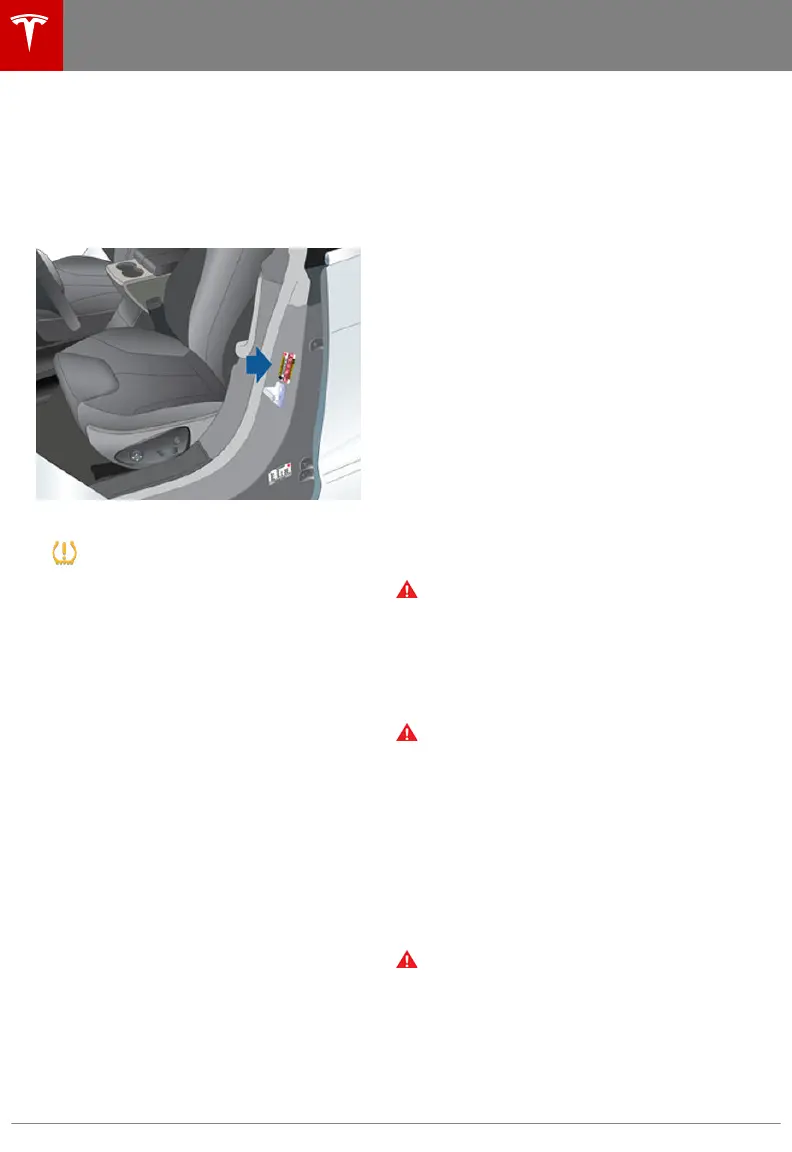
Keep tires inflated to the pressures shown on
the Tire and Loading Information label, even if
it diers from the pressure printed on the tire
itself. The Tire and Loading Information label is
located on the center door pillar and is visible
when the driver’s door is open.
The Tire Pressure indicator light on
the instrument panel alerts you if
one or more tires is under- or over-
inflated.
The Tire Pressure indicator light does not
immediately turn o when you adjust tire
pressure. After
inflating the tire to the
recommended pressure, you must drive over
15 mph (25 km/h) for more than 10 minutes to
activate the Tire Pressure Monitoring System
(TPMS), which turns
o the Tire Pressure
indicator light.
If the indicator light flashes for one minute
whenever you power on Model S, a fault with
the Tire Pressure Monitoring System (TPMS) is
detected (see TPMS Malfunction on page
150).
Checking and Adjusting Tire Pressures
Follow these steps when tires are cold and
Model S has been stationary for over three
hours:
1. Remove the valve cap.
2. Firmly press an accurate tire pressure
gauge onto the valve to measure pressure.
3. If required, add or remove air to reach the
recommended pressure.
4. Re-check pressure by removing and re-
attaching the tire gauge.
5. If you added too much air, release air by
pressing the metal stem in the center of
the valve.
6. Recheck the pressure with the tire gauge
and adjust if necessary.
7. Replace the valve cap to prevent dirt from
entering. Periodically check the valve for
damage and leaks.
On newer vehicles, you can display tire
pressures on the instrument panel by
choosing to display Car Status using the right
or left steering wheel buttons (see Using Left
Steering Wheel Buttons on page 41 or Using
Right Steering Wheel Buttons on page 42).
Warning: Under-inflation is the most
common cause of tire failures and can
cause a tire to overheat, resulting in
severe tire cracking, tread separation, or
blowout, which causes unexpected loss of
vehicle control and increased risk of
injury. Under-inflation also reduces the
vehicle's range and tire tread life.
Warning: Check tire pressures using an
accurate pressure gauge when tires are
cold. It takes only about one mile (1.6 km)
of driving to warm up the tires suciently
to aect tire pressures. Parking the
vehicle in direct sunlight or in hot weather
can also aect tire pressures. If you must
check warm tires, expect increased
pressures. Do not let air out of warm tires
in an attempt to match recommended
cold tire pressures. A hot tire at or below
the recommended cold tire
inflation
pressure is dangerously under-inflated.
Warning: Do not use any tire sealant
other than the type provided in a Tesla
tire repair kit. Other types can cause tire
pressure sensors to malfunction. If your
Model S did not include a tire repair kit,
you can purchase one from Tesla.
Tire Care and Maintenance
146 Model S Owner's Manual



 To Next Page