6
7
with an air pump and a suitable air stone at night
to help promote the growth of beneficial bacteria.
l
Nitrate (NO
3
-
)
The nitrate test helps you to reliably determine the
level of contamination in your aquarium water. The
measured nitrate value shows when and how much
water needs to be changed. Organic nitrogenous
substances, such as fish excreta, food remains
and dead plant parts, are decomposed in stages by
special micro-organisms: nitrate, a plant nutrient, is
harmful to your fish in concentrations of more than
50 mg/l, and encourages unsightly algae growth.
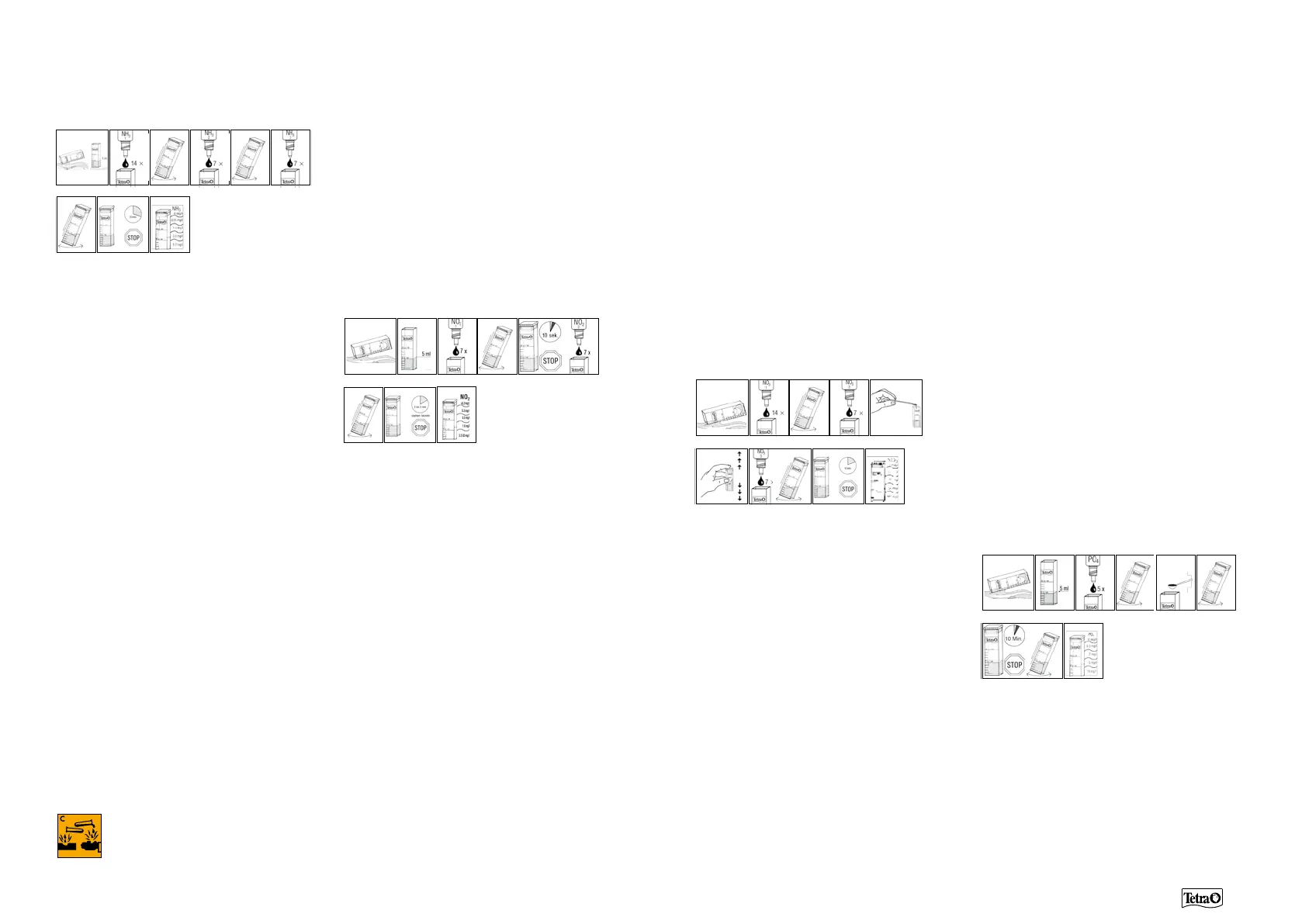
The test procedure
Please read this section carefully before starting
the test. The test measures values of nitrate
ranging from 0 mg/l to 100 mg/l. The illustrations
below should simplify the procedure.
1. Rinse the test vial with the sample water and fill
it up to the 5 ml mark with more sample water.
2. Hold reagent bottle 1 upside down and add
14 drops to the test vial.
3. Shake the test vial gently.
4. Hold reagent bottle 2 upside down and
add 7 drops to the test vial; shake gently.
5. Add 1 spoon of the powder to the test vial using
the enclosed dosage spoon.
6. Close the test vial; shake vigorously for 20 seconds.
7. Hold reagent bottle 3 upside down and
add 7 drops to the test vial; shake gently.
8. Allow 10 minutes for the colour to develop.
9. Hold the test vial approximately 1 cm (a finger‘s
breadth) from the white area on the colour chart
and match the shade of the test solution to the
colour it comes closest to on the colour chart.
Read the value.
After each test, rinse the vial thoroughly with
tap water.
What action shall I take if...
...the nitrate content is too high?
If the content is over 50 mg/l, we recommend
changing at least 30% of the aquarium water.
Flammable. Keep out of the reach of children. If swallowed, seek medical
advice immediately and show this container or label.
Use Tetra Gravel Cleaner to remove plant
and food remains from the bottom of the
aquarium. Always condition the replacement
tap water with Tetra AquaSafe to neutralise
dissolved chlorine and heavy metals.
Use either Tetra NitrateMinus or Tetra EasyBalance
regularly. These products encourage the
growth of anaerobic bacteria, responsible for
the reduction of nitrate in the aquarium. Also
ensure lush plant growth, because plants remove
large quantities of nitrate from the water.
l
Phosphate (PO
4
)
Natural waters usually contain only very small
quantities of phosphate. Organic, phosphoric
substances, such as fish, food and plant remains
that have settled on the bottom of the aquarium,
are decomposed into phosphate by specific
micro-organisms. Phosphate is an important
plant nutrient that continually accumulates in the
water. Combined with high nitrate values, too high
phosphate may lead to unwanted algae growth. The
phosphate content in the aquarium water should
be as low as possible, preferably under 2 mg/l.
The test procedure
Please read this section carefully before starting
the test. The test measures phosphate contents
ranging from 0 mg/l to 10 mg/l. The illustrations
below should simplify the procedure.
1. Rinse the test vial with the sample water.
2. Fill the test vial up to the 5 ml mark with sample
water.
3. Hold the bottle with the liquid test reagent
upside down and add 5 drops to the test vial.
4. Shake the test vial gently.
5. Add one level measuring spoon of the powder
from the tin to the test vial.
6. Shake the test vial gently.
7. Allow 10 minutes for the colour to develop.
Shake the vial gently several times in between
to make sure the power dissolves completely.
8. Shake the test vial gently and match the shade
Flammable. Contact with water liberates extremely flammable gases.
Vapours may cause drowsiness and dizziness. Keep out of the reach
of children. If swallowed, seek medical advice
immediately and show this container or label.
The test procedure
Please read this section carefully before starting
the test. The test measures quantities of ammonium/
ammonia ranging from 0 mg/l to 5.0 mg/l. The
illustrations below should simplify the procedure.
1. Rinse the test vial with the sample water. Fill
the test vial up to the 5 ml mark with sample
water. Important: The temperature of the
sample water must be between 20° and 30°C.
2. Hold reagent bottle 1 upside down and add
14 drops to the test vial.
3. Close the test vial and shake gently.
4. Open the test vial, hold reagent bottle 2 upside
down and add 7 drops to the test vial.
5. Shake the test vial gently.
6. Hold reagent bottle 3 upside down and add
7 drops to the test vial.
7. Shake the test vial.
8. Allow 20 minutes (at room temperature)
for the colour to develop.
9. Shake the test vial gently and match the shade
of the test solution to the colour it comes
closest to on the colour chart. Read the value by
holding the test vial approximately 1 cm (a finger‘s
breadth) from the white area on the colour chart.
After each test, rinse the vial thoroughly with
tap water.
What action shall I take if...
...the total ammonia content is too high?
Carry out a partial water change until the total
ammonia content is no more than 0.25 mg/l. Use
a Tetra Gravel Cleaner and siphon off at least
30% of the water. The Gravel Cleaner will remove
impurities, such as food remains, from your
aquarium. Always condition the replacement tap
water with Tetra AquaSafe. Add Tetra SafeStart to
the aquarium water to biologically condition the
water and to break down ammonia. Aerate with
an air pump and a suitable air stone at night to
help promote the growth of beneficial bacteria.
l
Nitrite (NO
2
-
)
In the second degradation stage of the nitrate
cycle, bacteria such as Nitrospira break down
toxic nitrite into harmless nitrate. Nitrite is a
nitrogen compound formed in the aquarium in the
course of degradation processes. High values are
an indication of a defective biological filtration
system. Ideally, the nitrite content should be less
than 0.3 mg/l, i.e. it should not be detectable.
It is necessary to check your aquarium water
weekly so that dangerous concentrations of
nitrite can be detected at an early stage.
The test procedure
Please read this section carefully before starting
the test. The test measures values of nitrite
ranging from less than 0.3 mg/l to 3.3 mg/l. The
illustrations below should simplify the procedure.
1. Rinse the test vial with the sample water.
2. Fill the test vial up to the 5 ml mark with sample
water.
3. Hold reagent bottle 1 upside down and add
7 drops to the test vial.
4. Close the test vial and shake gently.
5. Let the test vial stand for 10 seconds, then add
7 drops from reagent bottle 2 to the test vial.
6. Shake the test vial again.
7. Allow 2 to 5 minutes for the colour to develop.
8. Shake the test vial gently and match the shade
of the test solution to the colour it comes
closest to on the colour chart. Read the value by
holding the test vial approximately 1 cm (a finger‘s
breadth) from the white area on the colour chart.
After each test, rinse the vial thoroughly with
tap water.
What action shall I take if...
...the nitrite content is too high?
Carry out a partial water change until the nitrite
content is no more than 0.3 mg/l. Use a Tetra Gravel
Cleaner and siphon off at least 30% of the water. The
Gravel Cleaner will remove impurities, such as food
remains, from your aquarium. Always condition the
replacement tap water with Tetra AquaSafe. Add
Tetra SafeStart to the aquarium water to biologically
condition the water and to break down nitrite. Aerate
Flammable. Contact with acids liberates toxic gas. Causes burns.
Harmful to aquatic organisms, may cause long-term adverse effects in
the aquatic environment. Vapours may cause drowsiness and dizziness.
Keep locked up and out of the reach of children. Avoid contact with
skin and eyes. In case of contact with eyes, rinse immediately with
plenty of water and seek medical advice. In case of accident or if you
feel unwell, seek medical advice immediately (show the label where
possible). Contains lithium hydroxide, sodium hypochlorite.
Corrosive



 To Next Page
 Loading...