

EasyManua.ls Logo

The t.mix xmix 802 USB - User Manual

The t.mix xmix 802 USB
24 pages
Print Icon
To Next Page IconTo Next Page
Loading...
xmix 802 USB
mixer
user manual
Question and Answer IconNeed help?

Do you have a question about the The t.mix xmix 802 USB and is the answer not in the manual?

Summary

General Information

Further Information

Details how to access additional product information and support resources via the Thomann website.

Notational Conventions

Explains the use of specific formatting, like brackets and italics, for controls and labels within the manual.

Symbols and Signal Words

Outlines the meaning of various signal words (DANGER!, CAUTION!, NOTICE!) and warning signs used for safety alerts.

Safety Instructions

Intended Use

Defines the proper application of the mixer and warns against misuse, which could lead to damage or injury.

Safety Warnings

Consolidates critical safety warnings, including dangers to children, electric shock hazards, and short-circuit risks.

Hearing and Fire Safety

Covers warnings regarding potential hearing damage from high volumes and fire risks associated with ventilation and heat.

Operating Conditions and Power

Details environmental operating conditions and essential power supply precautions to prevent damage and ensure safe operation.

Short Circuit Prevention

Specifically addresses the danger of short circuits related to phantom power and unbalanced XLR cables.

Features

Mixer Specifications

Lists the key features and capabilities of the xmix 802 USB mixer, such as channel count, EQ, and connectivity options.

Installation and Starting Up

Initial Setup Precautions

Guides users on unpacking, checking for damage, and initial setup steps, including volume control settings.

Floor Protection Advisory

Warns about potential floor staining from rubber feet and suggests protective measures.

Connections and Controls

Mono Channel Strip

Details all controls and connections for each mono channel, including MIC/LINE inputs, EQ, AUX, and PAN.

Stereo Channel Strip

Explains the controls and connections specific to the stereo channel strip, including inputs, EQ, and balance.

Effects and AUX Section

Covers the controls for the FX SEND, FX RETURN, and AUX SEND functions, used for external effects and monitor mixes.

Master Section Overview

Identifies the ports and outputs in the master section, such as AUX SEND, FX SEND, PHONES, and CR OUT.

Master Controls and Indicators

Describes the master controls like [+48V] switch, power indicator, master faders, and level metering LEDs.

Rear Panel Connections

Details the physical connectors on the rear panel, including main outputs and the IEC power connector.

Connection Diagrams

Provides visual examples of typical connection setups for different scenarios like club gigs and home recording.

Technical Specifications

Performance Data

Lists detailed technical specifications including output levels, distortion, frequency response, and signal-to-noise ratio.

Electrical and Physical Details

Covers input levels, impedances, EQ ranges, effects, power supply, dimensions, and weight.

Plug and Connection Assignment

Transmission Principles

Explains the concepts of balanced and unbalanced signal transmission and their susceptibility to interference.

1;4 Phone Plug Pinouts

Details the pin assignments for 1/4" TS and TRS phone plugs used for mono, balanced, and stereo connections.

XLR and RCA Pinouts

Describes the pin assignments for balanced and unbalanced XLR plugs, as well as RCA connections.

Protecting the Environment

Packaging Disposal

Instructs users on the proper disposal and recycling of the product's packaging materials.

Old Device Disposal

Provides guidance on the environmentally responsible disposal of the old device according to WEEE regulations.

Overview

The provided document is a user manual for the the t.mix xmix 802 USB mixer.

Here's a description of the device based on the manual:

The the t.mix xmix 802 USB mixer is an 8-channel audio mixer designed for amplification, mixing, and playback of signals from musical instruments and microphones. It features a built-in power supply and a USB port for digital audio integration.

Function Description:

The mixer allows users to combine multiple audio input signals, adjust their levels, equalization, and panning, and route them to various outputs. It supports both mono and stereo input channels, with dedicated controls for each. The USB port enables the mixer to function as an audio interface, allowing digital audio signals to be fed in or the sum signal to be output digitally.
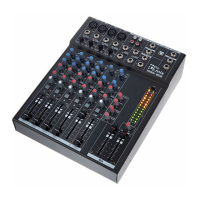
Key Features:

  • 8-channel mixer: Provides ample inputs for various setups.
  • 4 mono channels (MIC, line): Each mono channel includes a balanced XLR input for microphones and a 1/4" phone input for line-level audio sources (e.g., keyboards, drum modules). These channels offer 3-band EQ (treble, mids, bass), switchable 48V phantom power, and a low-cut filter.
  • 2 stereo channels: These channels feature balance control for stereo imaging.
  • AUX control per channel: A dedicated AUX control allows users to send a portion of the channel signal to the [AUX SEND] output, useful for creating monitor mixes. This control is switchable between PRE (unaffected by channel fader) and POST (subject to channel fader).
  • FX control per channel: A rotary control to send a portion of the channel signal to the [FX SEND] output for external effects processing.
  • Master outputs: The main stereo output is available via two XLR connectors and two 1/4" phone sockets.
  • CTRL room output: A stereo 1/4" phone socket for connecting control room monitors.
  • Additional RCA connections: Stereo RCA inputs ([STEREO IN]) for connecting stereo sources and stereo RCA outputs ([REC OUT]) for connecting recording devices.
  • Headphones output: A separately controllable 1/4" phone socket for stereo headphones, adjustable together with the Control room output.
  • 48V phantom power: Globally switchable for condenser microphones.
  • USB port: For feeding in digital audio signals or for digital output of the sum signal, unaffected by the master faders.
  • PFL (Pre-Fader Listen) function: Allows monitoring of individual channel signals before the fader and internal effects, useful for setting input levels. An LED indicates when PFL is active.
  • Peak indicators: LEDs on each channel and the master section to indicate signal overload, prompting users to reduce input or output levels.
  • Built-in power supply: Simplifies setup by eliminating the need for an external power adapter.

Important Technical Specifications:

  • Max. output level (1% THD @ 1 kHz):
    • MAIN OUTPUT (XLR & 1/4" phone, balanced): +26 dBu ± 1 dBu
    • Headphones output (1/4" phone, stereo): 150 mW ± 5 mW @ 32 Ω
  • Distortion (THD + N): <0.025% @ +14 dBu ± 0.5 dBu
  • Frequency response: 20 Hz ~ 20 kHz ± 2 dB
  • Signal-to-noise ratio:
    • Mic Equivalent intrinsic noise: 128 dB ± 5 dB
    • Residual noise: 86 dB ± 5 dB
  • Input level:
    • MIC input: +4 dBu ± 1 dBu max.
    • Stereo line input: +21 dBu ± 1 dBu max.
  • Impedances:
    • MIC input: balanced: 6 kΩ, unbalanced 3 kΩ ±200 Ω
    • Line input: balanced: 44 kΩ, unbalanced 22 kΩ ±2 kΩ
    • All unbalanced outputs: 100 Ω
    • All balanced outputs: 200 Ω
  • Signal gain mono channel:
    • Mic input: 44 dB adjustable (−16 ~ -60 dB)
    • Line: (−10 dB ~ +34 dB)
  • EQ (3-band):
    • Treble: +/- 10 dB, ± 1.5 dB @ 12 kHz shelving
    • Mids: +/- 10 dB, ± 1.5 dB @ 1 kHz shelving
    • Bass: +/- 10 dB, ± 1.5 dB @ 80 Hz shelving
  • Effects (16 in total): 8 × reverb, 4 × delay, 2 × chorus, 1 × flanger, 1 × phaser
  • Common mode rejection: 62 dB ± 3 dB @ Gain fader max.
  • Phantom voltage: 48 V ± 2 V
  • Operating supply voltage: 100 – 240 V ~ 50/60 Hz
  • Fuse: 5 mm x 20 mm, 1.6 A, 250 V, slow-blow
  • Power consumption: 40 W
  • Dimensions (W x H x D): 265 x 100 x 340 mm
  • Weight: 3.2 kg

Usage Features:

  • Intuitive controls: Clearly labeled rotary controls and switches for input gain, EQ, AUX send, FX send, pan/balance, and channel faders.
  • Visual feedback: LEDs for phantom power, power on, PFL activation, and peak indication help users monitor signal status and prevent clipping.
  • Flexible connectivity: A wide array of input and output options including XLR, 1/4" phone, RCA, and USB, catering to various audio equipment.
  • Balanced and unbalanced transmission: The manual provides guidance on using both balanced and unbalanced cables, highlighting the advantages of balanced transmission for long distances and noise reduction.
  • Application examples: Connection patterns are provided for typical scenarios like a "club gig" and "PC home recording," illustrating how to integrate the mixer into different setups.

Maintenance Features:

  • Fuse replacement: The device includes an IEC chassis plug with a fuse holder, allowing users to replace a defective fuse with a new one of the same type using a small screwdriver.
  • Packaging for transport/storage: Users are advised to keep the original packaging for protection against vibration, dust, and moisture during transport or storage.
  • Disposal information: The manual provides instructions for environmentally friendly disposal of packaging materials and the device itself, adhering to the European Waste Electrical and Electronic Equipment Directive (WEEE).
  • Safety instructions: Comprehensive safety guidelines are provided, covering intended use, danger for children, electric shock prevention, hearing damage prevention, fire risk, operating conditions, and power supply precautions. This includes a specific warning about connecting unbalanced XLR cables when phantom power is on, as this can damage the device.

The t.mix xmix 802 USB Specifications

General IconGeneral
BrandThe t.mix
Modelxmix 802 USB
CategoryMixer
LanguageEnglish