
 Need help?
Do you have a question about the THERMEx Nova Series and is the answer not in the manual?
The Thermex electric storage water heater (EWH) is designed to provide hot water for household and industrial facilities that have a cold water supply pipeline. It is intended for operation in closed heated rooms and not for continuous flow mode.
The EWH consists of a casing, a heating element, a thermostat, a relief valve, and a protective cover with control elements. The casing houses a steel tank, thermally insulated with environmentally friendly polyurethane foam. Two threaded pipes connect to the water supply system: a cold water inlet pipe (with a blue ring) and a hot water outlet pipe (with a red ring). The inner tank features a special glass-porcelain coating for reliable protection against chemical corrosion.
Mounted on a removable flange (3, Fig. 1) inside the tank are the dry heating element EcoDryHeat (HE) (7), a thermostat (8), and a magnesium anode (9). The HE is responsible for heating the water, while the thermostat allows for temperature adjustment up to +70°C (±5°C). The magnesium anode neutralizes electrochemical corrosion on the inner tank.
Water temperature in the inner tank is adjusted using the thermostat handle (10) on the water heater's protective cover. The thermostat also includes a thermal switch, a safety device that disconnects the HE from the power supply if the water temperature exceeds +93°C (±5°C). The EWH casing may heat up during operation, which is not a malfunction. To restore operation after thermal protection activation, press the thermoswitch rod located under the protective cover (Fig. 3).
The relief valve serves as a non-return valve, preventing water from flowing back into the main water supply in case of pressure drops or increased tank pressure during heating. It also acts as a safety valve, releasing excess pressure from the tank when water is heated strongly.
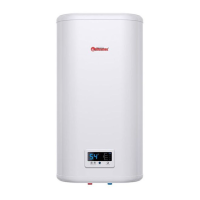
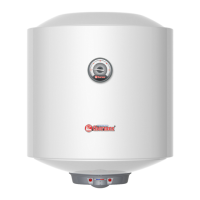
Depending on the EWH model, the protective cover (4) may have one or two control lamps indicating operation or power selection keys. For models with a single lamp, it lights up during heating and turns off when the set temperature is reached. For models with two lamps, the "Heating" lamp indicates heating (lights up during heating, turns off at set temperature), and the "Power" lamp is constantly lit, indicating connection to the power supply. Models with power selection keys use backlit keys as indicators, lighting up during heating and turning off when the set temperature is reached.
The EWH's electric cord is equipped with a Residual Current Device (RCD), which disconnects the EWH from the power supply if a leakage current occurs on grounded electrical components.
The manufacturer reserves the right to change the design and characteristics of the water heater without prior notice. The manufacturing date is encoded in the unique thirteen-digit serial number on the identification plate at the bottom of the product: the third and fourth digits represent the year of issue, the fifth and sixth the month, and the seventh and eighth the day.
Placement and Installation: It is recommended to install the EWH as close as possible to the hot water usage point to minimize heat loss in pipes. When choosing an installation site, consider the total weight of the EWH when filled with water. Walls and floors with low load-bearing capacity or porous materials must be reinforced. When drilling holes, account for existing cables, channels, and pipes. The EWH is suspended by its casing brackets on anchor hooks fixed in the wall. The manufacturer is not responsible for falls due to incorrect installation. Hooks must prevent spontaneous movement of the EWH. For maintenance, a minimum distance of 0.5 meters from the protective cover to the nearest surface in the direction of the removable flange axis is required.
To prevent property damage from a faulty hot water supply system, install the EWH in rooms with waterproof floors and drainage to the sewage system. Do not place non-waterproof items under the EWH. In unprotected areas, a protective tray (not included) with drainage to the sewage system should be installed. If installed in hard-to-reach areas for maintenance (e.g., mezzanines, alcoves), installation and removal are at the customer's expense.
Connection to the Water Supply System: Cold water must be supplied to the EWH through a pre-treatment filter with a purification degree of at least 200µm. Install the relief valve (16, Fig. 1) at the cold water inlet (20) (blue ring pipe) with 3.5-4 turns, ensuring a tight seal with appropriate material (flax, thread-fill tape).
During operation, water may leak from the relief valve's outlet pipe to release excess pressure, a safety feature. The discharge pipe must remain open to the atmosphere and directed downwards. It is advisable to attach a rubber or silicone tube to the drainage hole for water diversion. Regularly (at least once a month) drain a small amount of water through the relief valve discharge pipe into the sewage system to remove calcareous sediments and check valve functionality. The handle (17) opens the valve (18); ensure it is in the closed position during operation to prevent water drainage.
Connect to the plumbing system (Fig. 1) using copper/plastic pipes or flexible plumbing rated for at least 100°C at maximum operating pressure. Do not reuse flexible connectors. Plumbing and locking accessories must meet water supply network parameters and have quality certificates. Avoid excessive force during installation to prevent damage to pipe threads or the inner tank's glass-porcelain finish.
CAUTION! Do not operate the EWH without a relief valve or with a valve from another manufacturer.
After connecting, ensure the cold water shutoff valve (23) is open and the hot water shutoff valve (24) is closed. Open the cold water inlet faucet (21), the hot water outlet faucet (22), and the hot water faucet on the mixer to allow air to escape. When the EWH is full, water will flow continuously from the mixer faucet. Close the hot water faucet, check the flange for leaks, and tighten bolts if necessary.
If connecting the EWH in areas without running water, it can be supplied from an auxiliary reservoir using a pump station, or from a reservoir placed at least 5 meters above the EWH's top.
Connection to the Power Supply Network: Before switching on, ensure the EWH's electrical parameters match its technical specifications.
CAUTION! Before switching on the power supply, ensure the EWH is filled with water!
The water heater must be grounded for safe operation. The EWH comes with a standard power cord (with or without a europlug) and an optional RCD. The electrical socket must have a grounded terminal, be protected from moisture, or meet IPX4 requirements.
It is crucial to monitor the EWH after initial powering. If any parameters are mismatched (heating, temperature, indication, thermostat failure), contact the maintenance department.
Periodic maintenance and timely replacement of the magnesium anode are essential for long-term EWH operation. Failure to comply voids the warranty. Maintenance and anode replacement are not covered by manufacturer's or seller's warranty.
During maintenance, check the magnesium anode's condition and for scale on the HE. Simultaneously, remove any sediment accumulated at the bottom of the EWH. The magnesium anode should be replaced at least once a year, or every six months if water contains many chemical impurities. Scale formation on the heating element can cause failure, which is not a warranty case and not covered by warranty. Scale can be removed with descaling agents or mechanically. When removing sediment, avoid excessive force and abrasive cleaners to prevent damage to the inner tank's protective coating.
The first maintenance is critical for determining future maintenance schedules based on scale and sediment formation intensity and anode consumption, extending the EWH's lifespan. Failure to meet these requirements shortens the EWH's life, increases failure probability, and terminates warranty liabilities.
To perform maintenance and replace the magnesium anode:
If maintenance is performed by a specialized organization, a corresponding mark and stamp must be made in the warranty certificate. If the customer replaces the anode, a sales receipt for the anode purchase must be attached to this manual.
Possible Malfunctions and Remedies: In case of malfunction, disconnect the EWH from the power supply and shut off the water supply.
The above malfunctions are not defects and are to be eliminated by the customer or a specialized organization at their expense. If these recommendations do not resolve the issue, or if other problems arise, contact the service center listed in the manual.
Manufacturer's Warranty: The manufacturer provides a 1-year warranty for the water heater.
The temperature indicator on the EWH casing is not an accurate measuring device; it indicates the heating or cooling process. Incorrect operation of the temperature indicator is not a reason for warranty replacement. The warranty period starts from the date of sale. If the date of sale or store stamp is missing or corrected, the warranty period starts from the EWH's release date. Warranty claims are accepted with a warranty certificate bearing the dealer's marks and the identification plate on the EWH casing.
For commercial use (e.g., production, catering, saunas, gyms), the warranty period is 6 months.
CAUTION! A faulty relief valve or power cord is not an EWH malfunction and does not warrant EWH replacement. Responsibility for installation and connection rules lies with the buyer (if self-installed) or the installation organization.
Disposal: Subject to proper installation, operation, maintenance, and water quality, the manufacturer sets a service life of 7 years from the purchase date. All components are made of materials allowing for environmentally safe disposal, in accordance with the regulations of the country where the water heater is used.
 General
| Brand | THERMEx |
|---|---|
| Model | Nova Series |
| Category | Water Heater |
| Language | English |


 To Next Page