
 Need help?
Do you have a question about the thermo-hydro STC-9200 and is the answer not in the manual?
Sets the time delay for the fan's operation relative to the compressor and defrosting cycles.
Defines fan operation modes, including startup, continuous running, and delayed starts based on specific conditions.
Specifies the defrost sensor temperature threshold that triggers the fan to start.
Specifies the defrost sensor temperature threshold that triggers the fan to stop.
Sets the upper room temperature limit that will trigger an alarm notification.
Sets the lower room temperature limit that will trigger an alarm notification.
Defines the time delay for room sensor readings before triggering an alarm.
Calibrates the temperature reading to match the actual measured temperature.
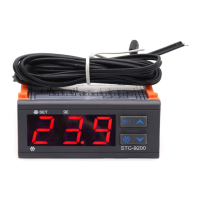
The STC-9200 Thermostat is a digital temperature controller designed for refrigeration devices, particularly suitable for freezer rooms. It effectively manages the refrigeration unit, defrosting unit, and the evaporator fan, offering comprehensive control over the cold storage environment. This thermostat is designed to maintain precise temperature conditions, prevent frost buildup, and ensure efficient operation of the refrigeration system.
The core function of the STC-9200 is to regulate temperature within a specified range. Users can set a target temperature (SP) and a temperature hysteresis (Return Difference) to define the operational boundaries. When the room temperature rises above the set point plus the hysteresis, the compressor engages to cool the environment. Conversely, when the temperature drops to or below the set point, the compressor stops.
A critical aspect of the STC-9200's functionality is its defrosting capability. The device supports various defrosting modes, including electric-heating and hot gas defrosting from the compressor. Defrosting is initiated based on specific conditions, such as a preset interval time (Defrosting Cycle) or when the real-time passes a certain duration. The thermostat also incorporates a defrosting lasting/running time to ensure thorough frost removal. To prevent over-defrosting, a defrosting stop temperature is configurable. During defrosting, the device can manage water dripping time, allowing for proper drainage of melted frost.
The STC-9200 also controls the evaporator fan, which plays a crucial role in circulating cold air and ensuring even temperature distribution. The fan's operation can be linked to the compressor's status or controlled independently based on temperature. For instance, the fan can start earlier than the compressor or stop when defrosting begins, optimizing energy consumption and preventing the fan from blowing warm air during defrost cycles. The fan output modes are flexible, allowing for continuous working, or starting/stopping based on specific temperature thresholds or in conjunction with the defrosting process.
Furthermore, the thermostat includes an alarm function to alert users to abnormal temperature conditions. Both upper and lower temperature limits can be set for the room, triggering an alarm if the temperature falls outside these boundaries. A time delay for the room sensor can also be configured to prevent nuisance alarms from transient temperature fluctuations. The alarm function is primarily based on the room sensor, but it also works with the evaporator sensor, providing a comprehensive monitoring system for the refrigeration unit.
The STC-9200 offers a user-friendly interface for setting and adjusting its various parameters. The setup process involves navigating through a menu list, where each parameter is identified by a specific code (e.g., F1 for Temperature Set-Point, F2 for Temperature Hysteresis). Users can access the Admin Interface by holding the [SET] key for a specified duration, allowing them to modify these settings. The values for each parameter can be easily changed using up/down keys, and the new data is saved by pressing the [SET] key again. The system is designed to automatically quit the setting mode and return to normal status after a period of inactivity, ensuring ease of use and preventing accidental changes.
The thermostat provides clear indicators for its operational status. The display mode when defrosting can show the room sensor temperature, allowing users to monitor the internal conditions even during a defrost cycle. This transparency in operation helps users understand the device's current state and make informed decisions regarding their refrigeration system.
The STC-9200 incorporates several intelligent features to optimize performance and protect the compressor. For instance, a delay time for the compressor is configurable, preventing frequent starts and stops that can reduce the compressor's lifespan. This protective value ensures the compressor operates within safe limits, contributing to the longevity of the refrigeration unit. Similarly, the fan control logic, which allows the fan to start earlier or stop during defrosting, is designed to enhance efficiency and prevent unnecessary energy consumption.
While the STC-9200 is primarily an operational controller, its design incorporates elements that contribute to system maintenance and longevity. The protective values for compressor operation, such as the delay time and the "last stops moment" parameter for hot gas defrosting, are crucial for preventing wear and tear on the compressor. By avoiding frequent cycling and ensuring proper defrosting, the thermostat helps extend the life of the refrigeration components.
The alarm system serves as an early warning mechanism for potential issues. If the room temperature deviates significantly from the set limits, or if the evaporator sensor is broken, the alarm will activate. This allows users to promptly identify and address problems, preventing further damage to the stored goods or the refrigeration unit itself. Regular monitoring of alarm triggers can indicate underlying issues that require maintenance attention.
The ability to configure different defrosting modes and parameters allows users to tailor the defrosting process to their specific environmental conditions and usage patterns. This flexibility ensures that frost buildup is effectively managed, which is essential for maintaining the efficiency of the evaporator coil and preventing ice accumulation that can impede airflow and heat exchange. Proper defrosting reduces the need for manual intervention and helps maintain optimal system performance.
The STC-9200's digital display and clear parameter codes simplify troubleshooting. If an issue arises, users can easily check the current settings and operational values to diagnose the problem. For example, checking the "defrosting mode" or "fan output modes" can help determine if the device is configured correctly for the observed behavior. This diagnostic capability empowers users to perform basic troubleshooting before requiring professional assistance, potentially saving time and costs.
 General
| Relay Contact Capacity | 10A/250VAC |
|---|---|
| Power Supply | 24V |
| Input Power | 3W |
| Humidity Range | 0% to 99% RH |
| Sensor | One temperature sensor and one humidity sensor, 2m length |

 To Next Page