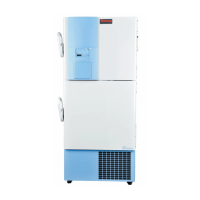
This document describes the Forma Model 900 and 5900 Series -86C ULT Upright Freezer, an ultra-low temperature freezer designed for laboratory use. It is intended for general purpose laboratory storage of samples and inventory between -50°C and -86°C. The freezer is a Class I medical device, 510(K) exempt, and is designed to comply with European Union's Waste Electrical & Electronic Equipment (WEEE) Directive 2002/96/EC.
Function Description
The Forma Model 900 and 5900 Series freezers are designed to maintain ultra-low temperatures for the storage of biological samples and other temperature-sensitive materials. The freezer features a cascade refrigeration system with two compressors (High Stage and Low Stage) to achieve and maintain temperatures down to -86°C. It includes a control panel with a keypad, displays, and indicators for setting and monitoring operating parameters. An optional Back Up System (BUS) is available, which can inject liquid nitrogen (LN2) or carbon dioxide (CO2) to maintain temperature in case of a power failure or system malfunction. The freezer also supports an optional temperature recorder or datalogger for continuous monitoring.
Important Technical Specifications
The freezers come in various models with different capacities and electrical configurations.
Temperature Range: -50°C (-58°F) to -86°C (-123°F) in an 18°C to 32°C (64.4°F to 89.6F) ambient.
Capacity: Available in 13.0 cu. ft. (368.1 liters), 17.3 cu. ft. (489.9 liters), and 23.0 cu. ft. (651.3 liters) for both single and double door units.
Insulation: Non CFC, foamed-in-place urethane, 5.0" (12.7cm) cabinet; 4.5" (11.4cm) door.
Refrigeration: Two 1 HP (2545 BTUH each) compressors.
Electrical (nominal voltage ±10%):
- 230VAC, 50 Hz, 12.0 FLA (Operating Range: 208VAC-240VAC)
- 120VAC, 60 Hz, 16.0 FLA (Operating Range: 108VAC-130VAC)
- 208-230VAC, 60 Hz, 12.0 FLA (Operating Range: 208VAC-240VAC)
Breaker Requirements: 15 Amp or 20 Amp, Dedicated Circuit, 15 Amp Time Delay Breaker or 20 Amp Time Delay Breaker, depending on the model.
Shipping Weight: Varies by model, e.g., 696 lbs. (316 kg) for 13 cu. ft. units, 763 lbs. (346 kg) for 17.3 cu. ft. units, and 900 lbs. (408 kg) for 23 cu. ft. units.
Water-cooled Condenser (optional):
- Water Pressure: Not to exceed 150 psig
- Water Temperature Range: Not to exceed 29.4C (85F)
- Inlet/Outlet Connection: 0.5" compression
- Flow Rate Required: 3.0 gallons (11.4 liters) per minute
- Drain Required: No (return line is required)
Usage Features
Installation and Start-up: The freezer should be installed on a dedicated grounded service. After unpacking, it must remain upright for 24 hours before start-up. The unit should be placed on a firm, level surface in an area with an ambient temperature between 18°C and 32°C, ensuring proper ventilation with a minimum clearance of 5" at the rear and top and 8" on the side of the freezer.
Control Panel Operation: The control panel allows users to set the operating temperature, low temperature alarm, and high temperature alarm. The "Mode" key is used to navigate through settings, and "Up/Down Arrows" adjust values. The "Enter" key saves changes. The "Silence" key silences audible alarms.
Run Mode: This is the default mode, displaying the cabinet temperature. It also allows display of the high stage heat exchange temperature by pressing arrow keys. The display reverts to operating temperature after 10 seconds of inactivity.
Calibration: The control probe can be calibrated using a type T thermocouple reader. Calibration frequency depends on use, ambient conditions, and accuracy required, but an annual calibration check is recommended. Temperature stabilization periods are 12 hours for startup and at least 2 hours for already operating units after calibration.
Alarms: The freezer includes various alarms such as Power Failure, High Temperature, Low Temperature, Door Open, Wrong Power, Low Battery, Low BUS Battery (optional), Hot Condenser, High Stage Failure, and Micro Board Failure. These alarms have specific delays and ringback times, and some activate remote alarm contacts.
Optional Back Up System (BUS): The BUS can be configured for LN2 or CO2 supply. It activates automatically if the freezer temperature rises above the set point due to power failure or system malfunction, injecting cryogen to maintain temperature. A "Press-To-Test" button allows verification of BUS operation.
Maintenance Features
Cleaning:
- Cabinet Exterior: Wipe with soap and water and a general purpose laboratory disinfectant.
- Air Filter: Cleaned four times a year. Open the front lower door, grasp the grille, pull it out, wash with water and mild detergent, dry, and reinstall.
- Condenser: Cleaned once per year. Open the front lower door, grasp the grille, and use a vacuum cleaner to clean the condenser fins. More frequent cleaning may be needed in dusty environments.
- Water-cooled Condenser (optional): Cleaned-in-place using a CIP procedure. This involves draining, flushing with fresh water, filling with cleaning agent, circulating, draining, rinsing, and reconnecting.
- Defrost Chamber: Remove all product and disconnect power. Turn off the battery switch. Open all doors and place towels. Allow frost to melt, remove with a soft cloth. Clean interior with non-chloride detergent.
- Door Gasket: Cleaned monthly. Remove any frost build-up to ensure proper sealing.
Vacuum Relief Port: Routine maintenance is required to prevent ice build-up. The port should be cleaned if it becomes iced over. Failure to maintain the port can result in excessive ice build-up and difficulty opening the door.
Battery Check and Replacement: Check batteries every 2 years. Turn off the battery power switch, disconnect the red and black wires, and use a voltmeter to check voltage. If below 10.8 volts, replace. The battery is located in the lower door of the compressor compartment.
Preventive Maintenance Schedule:
- Monthly: Verify ambient temperature (<90°F), adjust door handle for firm latching.
- Quarterly: Check and clean probe cover, gaskets, hinges, and lid(s).
- Annually: Check air filter, clean or replace. Check alarm backup battery. Check condenser fan motor for unusual noise or vibration. Verify and document calibration. Clean condenser compartment and wipe off condenser.
Minimize Ice Build-up: Locate the freezer away from drafts or heating/cooling vents, keep the number of door openings to a minimum, minimize the length of time the door is open, and make sure door latches securely after opening.
Safety Precautions:
- General: Always use proper protective equipment (clothing, gloves, goggles). Dissipate extreme cold or heat. Follow good hygiene practices.
- Electrical: Only qualified persons should perform procedures associated with electrical hazards.
- Temperature: Use special handling equipment or wear protective clothing for extreme temperatures.
- Hot Surfaces: Hot surfaces may cause burns; use caution.
- WEEE Compliance: Dispose of electrical and electronic equipment according to EU WEEE Directive 2002/96/EC.
- Liquid Nitrogen/CO2: Handle with extreme caution. Contact with liquid nitrogen or cold gas can cause severe freezing (frostbite). Spilled liquid can cause suffocation if the area is not well ventilated. Always use proper protective equipment, including face shield or safety goggles, insulated gloves, and high-top shoes. Ensure adequate ventilation. Never allow unprotected parts of the body to touch objects cooled by liquid nitrogen. Do not overfill containers. Never use hollow rods or tubes as dipsticks.
- First Aid (Liquid Nitrogen/CO2 Exposure): If a person becomes dizzy or loses consciousness, move to a well-ventilated area. If breathing has stopped, apply artificial respiration. If breathing is difficult, give oxygen. Call a physician. For skin exposure, restore tissue to normal body temperature (98.6°F) as rapidly as possible. Do not rub the frozen part. Do not smoke or drink alcohol.

 Need help?
 General



 To Next Page