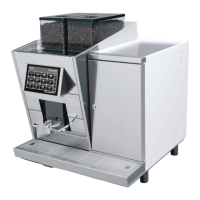
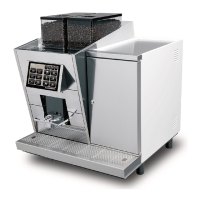
This document is a technical manual for the Thermoplan Aguila AG440 coffee machine, focusing on troubleshooting. It provides detailed information about the machine's components, their functions, and how to diagnose and resolve common issues.
Function Description
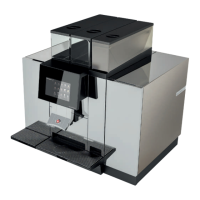
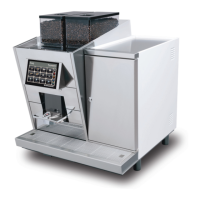
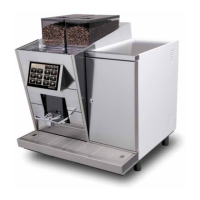
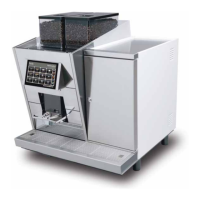
The Thermoplan Aguila AG440 is a Swiss-quality coffee equipment designed for preparing a variety of coffee and milk-based beverages. It features multiple brewing units, coffee boilers, and a milk system, allowing for the simultaneous preparation of different drinks. The machine is equipped with a control board (CPU) and a power board (power PCB) that manage all electrical components, including valves, sensors, pumps, and heating elements. A key feature is its service menu, which allows technicians to perform input and output tests to check the functionality of individual components.
Important Technical Specifications
- Boilers: The machine includes multiple coffee boilers and a tea/milk boiler, each with NTC (Negative Temperature Coefficient) sensors for temperature monitoring. Coffee boilers are designed to reach specific operating temperatures, while the tea/milk boiler handles hot water and steam for milk-based drinks.
- Pumps: It incorporates a water pump for coffee and tea preparation, and a milk pump for dispensing milk. The water pump's pressure is critical for brewing, typically reaching 14.5 bar during coffee preparation.
- Valves: Numerous valves control water and milk flow, including water inlet valves, brewing chamber valves, brew valves, tea valves, exhaust valves, milk cleaning valves, milk rinsing valves, cold milk valves, milk outlet valves, milk drain valves, milk air valves, cleaning tablet valves, and venting valves.
- Sensors: The machine is equipped with flowmeters (Flowmeter 1 and Flowmeter 2) to measure water flow, NTC sensors for monitoring boiler and refrigerator temperatures, and milk level sensors (upper and lower) to detect milk quantity in the container. Reed switches are used for detecting the presence of the cleaning key and cleaning tablets, as well as the capsule container. Microswitches monitor the status of the brewing chambers.
- Heating Elements: Dedicated heating elements are present in the coffee boilers, tea/milk boiler, and a cup heater.
- Refrigerator: An integrated refrigerator with a compressor and fan maintains milk temperature, typically below 12 °C for optimal milk product preparation. An NTC sensor monitors the refrigerator's internal temperature.
- Control System: The machine is controlled by a CPU and power PCB, which feature various connectors for components and LEDs for status indication. It uses a CF card for software and data storage.
- Power Supply: The system operates with a 24V power supply for control circuits and 230V (or 208V for America models) for high-power components like pumps, compressors, and heaters.
Usage Features
The Aguila AG440 is designed for ease of use in a professional setting.
- Product Preparation: Users can select and prepare various coffee and milk products.
- Capsule System: The machine uses a capsule system, requiring users to insert capsules correctly into the brewing unit.
- Cleaning Key: A dedicated cleaning key is used to initiate cleaning cycles, often involving cleaning tablets.
- Energy Saving Mode: An energy save button allows users to activate standby mode, reducing power consumption.
- Display Messages: The machine provides clear display messages to guide users and technicians, indicating status, required actions (e.g., "Insert capsule drawer!", "Empty capsule drawer!", "Change water filter"), and error conditions (e.g., "Flowmeter # error", "NTC # short-circuit", "Milk pump error").
Maintenance Features
The manual emphasizes several maintenance and troubleshooting features:
- Service Menu Access: A programming key allows technicians to access a service menu, which is crucial for diagnostics. This menu opens the water inlet valve upon entry and closes it upon exit.
- Input and Output Tests: Within the service menu, "Input Test" allows technicians to check the status of sensors (e.g., NTC temperatures, flowmeter impulses, milk level sensors, microswitches), while "Output Test" enables activation and testing of outputs (e.g., valves, pumps, heaters, refrigerator fan). This helps pinpoint faulty components.
- Pressure Gauge/Bypass Adjustment: A pressure gauge allows monitoring of water inlet pressure (2-4 bar) and brewing pressure (14.5 bar). A bypass mechanism can be adjusted to fine-tune brewing pressure if it deviates from the required values.
- Cleaning Channel: The machine has a dedicated cleaning channel and cleaning tablet valve, facilitating automated cleaning processes. Regular cleaning is essential, with display messages prompting users when cleaning is required.
- Component Replacement: The manual provides solutions for various problems, often involving checking connections, cleaning components (e.g., coffee outlet, lip valve, nozzle), or replacing defective parts (e.g., NTC sensors, flowmeters, brewing unit, milk pump, relays, display, keyboard print, CF card, battery).
- Software Updates: In case of software problems, updating the software via the CF card is a recommended solution.
- Error Trace Examination: Technicians are advised to examine error traces to identify and eliminate recently occurred errors.
- Preventive Maintenance (PM): The machine tracks the number of brews and time since installation/last PM, prompting for service when due. Resetting service counters is part of the PM procedure.

 Need help?
 General

 To Next Page