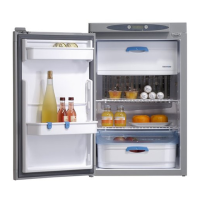
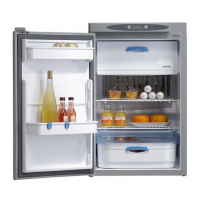
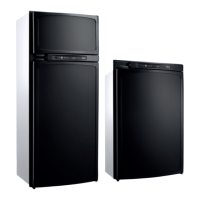
The Thetford N4000 series is a range of absorption refrigerators designed for use in mobile leisure vehicles, offering operation on three different power sources: gas, 12V, and 230V. The refrigerator automatically selects the most suitable power source for efficient cooling.
Function Description
The primary function of the Thetford N4000 series refrigerator is to cool and keep food frozen. It is specifically designed for mobile leisure vehicles and camping use. The appliance features various compartments, including fresh food compartments and frozen food compartments, to store different types of perishables. Some models include specialized features like vegetable bins, slide-out boxes, and drawer dividers for organized storage.
Important Technical Specifications
The N4000 series offers various models with different capacities and energy consumption figures:
| Model |
Display |
Total volume (L)* |
Volume frozen food comp. (L) |
Energy consumption (kWh/24h) |
Energy consumption gas (g/24h) |
Net weight (kg) |
| N4080 |
LED+ |
71 |
9.8 |
2.6 |
270 |
22.5 |
| N4090 |
LED+ or LCD |
78 |
10.8 |
2.9 |
300 |
22.5 |
| N4141 |
LED+ or LCD |
135 |
15.3 |
4.5 |
468 |
38 |
| N4142 |
LED+ or LCD |
137 |
15.3 |
4.5 |
468 |
37 |
| N4145 |
LED+ or LCD |
136 |
25.9 |
4.3 |
437 |
37 |
| N4150 |
LED+ or LCD |
145 |
27.4 |
4.3 |
437 |
37.5 |
| N4170 |
LED+ or LCD |
156 |
29.2 |
4.3 |
437 |
39 |
| N4175 |
LED+ or LCD |
165 |
30.7 |
4.3 |
437 |
39.5 |
*Total volume and energy consumption have been calculated according to IEC 62552-2020.
The refrigerant used is ammonia, and insulation blowing gases consist of cyclopentane (C5H10). The refrigerator is equipped with electronics to ensure optimal cooling performance at input voltages between 210 V and 250 V when operating on mains power.
Usage Features
The refrigerator offers flexible control through either an LED control panel or an LCD touchscreen, depending on the model.
- Power Sources: The N4000 series can operate on gas, 12V (battery of the vehicle), and 230V (mains). The appliance automatically selects the best available power source. When running on 12V, operation is effective only when the vehicle's engine is running. For caravans, a D+ signal from the towing vehicle is required for 12V DC mode while traveling. Gas operation requires the gas bottle valve to be open and the control panel to be powered by the battery or AA batteries (for stand-alone models). The refrigerator runs on liquid gas (propane, butane, or a mixture).
- Control Panel:
- LED Control Panel: Features an on/off button, confirmation button, arrow buttons for selection, energy source indicators, cooling level indicators, anti-condensation function, and an optional battery empty indicator.
- LCD Touchscreen: Includes an on/off button, energy source button, cooling level button, anti-condensation button, and an error code display.
- Switching On: To switch on, press and hold the on/off button for 1 second. The button will light blue, and the last selected settings will be displayed.
- Selecting Energy Source: On LED models, press and hold the confirmation button for 2 seconds until energy source symbols blink, then use arrow buttons to select and confirm with a quick touch. On LCD models, press the energy source button repeatedly until the desired source is selected. It is advised to always use gas or 230V to start up and cool.
- Selecting Cooling Level: The recommended cooling level is 3 for ambient temperatures between 15 °C and 25 °C. On LED models, press and hold the confirmation button for 2 seconds, then press it again until cooling level indicators blink. Use arrow buttons to select the desired level and confirm. On LCD models, press the cooling level button repeatedly until the desired level is selected.
- Anti-condensation Function: This function is automatically switched on to prevent condensation on the control panel. It can be manually switched off (and on again) by pressing the arrow buttons simultaneously for 2 seconds on LED models, or by pressing the anti-condensation button on LCD models.
- Battery Empty Indicator (N4000-E+ series, stand-alone model): Stand-alone models can be powered by 6 × 1.5V AA/LR6 batteries when no mains or vehicle battery power is available. These batteries provide approximately 7 days of operation with gas supply. A blinking red symbol indicates low batteries, requiring replacement within 24 hours. Rechargeable batteries are not recommended for this function.
- Storage Compartments:
- Fresh Food Compartment: The maximum load for a large shelf is 12 kg, and for a small shelf, it is 6 kg. The maximum storage capacity of the drawer is 15 kg. Shelves, drawer dividers, and door bins can be moved for customized organization.
- Frozen Food Compartment: Used for storing perishable foodstuffs or frozen foods for short periods. The temperature cannot be guaranteed below 10°C vehicle interior temperature, which may cause defrosting.
- While Driving: Ensure all products are secured to prevent movement. Use bottle retainers, drawer dividers, and shelf food retainers. The door locks automatically when pushed closed. Models with a travel lock offer additional security against accidental opening.
- Winter Use: For outside temperatures below 6°C, a suitable winter cover should be installed to protect the refrigerator and ensure optimal performance. The cover must be removed when temperatures rise above 6°C.
- Automatic Defrost System: The refrigerator is equipped with an automatic defrost system to reduce ice formation on cooling fins, which can decrease cooling capacity and durability. Manual defrosting is also possible by removing food, switching off the refrigerator, opening doors, and placing towels to catch leakage water.
Maintenance Features
Thetford recommends an annual inspection service by an approved service center for optimal performance.
- Cleaning:
- Regularly clean the refrigerator.
- Immediately remove spills or contamination with a mild household cleaner and a soft cloth.
- Remove shelves, door bins, and vegetable bins for thorough cleaning of the interior and loose parts.
- Clean the exterior with a damp soft cloth.
- Ensure outside vents are dust-tight.
- Secured Storage Shelf (Model B only):
- Removal: Remove the screw near the shelf clamp (1). Turn plastic clamps upwards (2), lift the left side, and remove the shelf.
- Replacement: Place the right side (without clamp) into the refrigerator wall (3), then the other side (with clamp) into its groove. Turn the plastic clamp downwards (3) and replace the screw.
- Slide-out Box System (Model C1 and C2):
- Removal: Open the fresh food compartment door, slide the rail system to the right, and remove the slide-out box.
- Replacement: After cleaning, place the system back in reverse order until it snaps into place.
- Slide-out Box System (Model B):
- Removal: Open the fresh food compartment door, locate the two clips at the back of the rail system (1), pull them upwards and forwards, lower the front, slide the rail system forward (2), and remove the box.
- Replacement: After cleaning, place the system back in reverse order until a click is heard. For left-turning doors, place the system into the slots on the right-hand side. Ensure the system locks into place.
- Drawer (Model C1):
- Removal: Pull the drawer to its stop, push it back slightly, push guide locks backward, pull the drawer further forward, and lift wheels over curves. Remove and clean.
- Replacement: After cleaning, pull out guides until they snap into place, then place the drawer back in reverse order.
- Storage: For long periods of non-use, empty, defrost, and thoroughly clean the refrigerator. Install a winter cover over vents. Keep both fresh food and frozen food compartment doors open during storage.
- Door Open for Storage:
- Models A and B: Rotate the storage lock and secure it using the strike plate.
- Models C1 and C2: Rotate the storage lock.
- To use after storage, rotate the storage lock back to its original position.
Safety and Environmental Considerations
- Safety: The manual emphasizes reading safety instructions carefully. It warns against serious injury risks (burns, explosion, suffocation, electrocution, fire, poisoning) and appliance damage. Children aged 8 and older, and persons with reduced capabilities, may use the appliance only under supervision and with proper instructions. Children younger than 8 must be under constant supervision. Ventilation openings must be kept clear. Explosive substances and carbonated liquids should not be stored.
- Electricity Safety: Ensure the supply cord is not trapped or damaged. Damaged cords must be replaced by qualified personnel. Do not use multiple portable socket-outlets at the rear of the appliance.
- Gas Safety: Only run on gas while driving if the vehicle has a safety closing device. In case of gas smell, close the gas bottle valve, extinguish naked flames, avoid electrical devices, open windows, and contact customer service. Do not use gas indoors. A filter prescribed by a qualified technical person must be used with LPG. Only use gas specified on the serial label. Change gas bottles in open air, away from ignition sources. Do not obstruct gas bottle ventilation.
- Environmental Protection: The appliance contains ammonia (refrigerant) and cyclopentane (insulation blowing gases). Servicing and disposal must be done by a qualified person. Discarded electric appliances are recyclable and should be returned to collection centers.

 Need help?
 General

 To Next Page