Need help?
Do you have a question about the Thies CLIMA 4.387 Series and is the answer not in the manual?
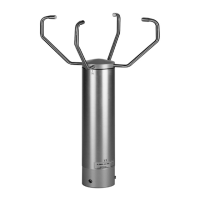
The Ultrasonic Anemometer 2D compact is a device designed to measure wind velocity and wind direction, as well as virtual temperature. It is suitable for various applications including industrial automation, regenerative power generation (wind power plants), building automation, traffic engineering/control systems, and maritime and offshore applications. The device is designed to detect horizontal components of wind velocity and wind direction in two dimensions, with a particular focus on sturdy design.
The Ultrasonic Anemometer 2D compact utilizes four ultrasonic transducers, arranged in pairs, to measure wind velocity and direction. The measurement principle relies on the time of flight of ultrasonic signals between the transducers. The electronic control system selects the respective measurement path and performs measurements in all four directions of the measurement paths in a basic measuring cycle of one millisecond. The measured values are worked out from the four individual measurements of the path directions and used to make further calculations. The time required for a measuring sequence is approximately 10.0 ms (8 ms measuring sequence +2 ms analysis) at the maximum measuring speed.
The device supports various output formats including analogue, ASCII (THIES format), and binary (MODBUS RTU protocol). It features digital and analogue interfaces for electrical isolation from supply and housing potential, ensuring reliable communication even under interference currents or voltages on the output signals. The MODBUS RTU protocol is implemented for extended standardized communication.
The device can be configured for different operating modes, including full duplex and half duplex, allowing for flexible integration into existing systems. It also features a heating function to prevent icing in cold environments, ensuring continuous operation. The heating system is automatically controlled to maintain optimal performance and prevent ice formation.
Wind velocity:
Wind direction:
Virtual temperature:
Air pressure (optional):
Data output digital:
Data output analogue:
General:
Installation: The anemometer should be installed vertically with the North arrow on top. During installation, care must be taken to ensure no water gets into the bottom and connector or cable gland of the anemometer. When using a lightning rod, ensure it is installed in an angle of 45° to a measuring transducer; otherwise, there will be deviations in the measured values. The choice of installation location depends on the task position (e.g., data acquisition for weather services or for control purposes).
Alignment: For accurate determination of wind direction, the anemometer must be positioned to the north. This involves positioning the ultrasonic anemometer by rotating it on the mast tube until the orientation arrow indicates to northern direction (geographical north). For permanent installations, the device can be drilled and secured with screws.
Cabling: The cable to be connected must be at least the operating voltage class 01 (100 V). Proper cable preparation and connector installation are crucial for reliable operation. This includes stripping cable sheath, cutting uncovered shield, soldering wire to the insert, screwing-on cable clamp, assembling remaining parts, and tightening pull-relief.
Configuration: The device offers extensive configuration options via commands, allowing users to tailor its operation to specific needs. Commands include setting average mode, scaling analogue wind velocity output, adjusting average time frame, setting baud rate, configuring the command interpreter (THIES or MODBUS RTU), and managing duplex mode.
General Maintenance: The instrument does not have moving parts, so minimal servicing is required. The instrument is subject to natural pollution, but the level of pollution depends on the location. If necessary, the instrument and the sensor surfaces can be cleaned using non-aggressive cleaning agents and a soft cloth.
Storage and Transport: During storage, installation, de-installation, transport, or maintenance, it is essential to ensure that no water gets into the instrument stand and plug of the anemometer.
Calibration: The ultrasonic anemometer does not contain any adjustable components such as electrical or mechanical trimming elements. All components and materials used show invariant behaviour over time. Therefore, no regular calibration is required due to aging. Errors in measured values can only be caused by coarse mechanical deformation of the instrument and associated changes in measurement path lengths. The acoustic-virtual temperature can be used to check the effective acoustic measurement path length. A change of approx. 0.3 % in the measurement path length and thus a measuring error of approx. 0.3 % for the wind velocity corresponds to a deviation in the virtual temperature of 1 K at 20 °C; there is a measuring error of approx. 1% for the wind velocity with a deviation of acoustic-virtual temperature of approx. 3.4 K. In the event of any change in the measurement paths of the anemometer, the manufacturer should be consulted regarding recalibration.
Warranty: Damage caused by improper handling or external influences, e.g., lightning, do not fall under the warranty provisions. The warranty entitlement expires if the instrument is opened. The ultrasonic anemometer must be returned in its original packaging as the warranty entitlement otherwise expires with mechanical damage, e.g., deformation of measuring arms.
 General
| Brand | Thies CLIMA |
|---|---|
| Model | 4.387 Series |
| Category | Measuring Instruments |
| Language | English |


 To Next Page