W
S
The speed of propagation of the sound in calm air is
superposed by the speed components of an air flow in
wind direction.
A wind speed component in the direction of the
propagation of the sound supports the speed of
propagation, thus leading to an increase in the speed. A
wind speed component opposite to the direction of
propagation, on the contrary, leads to a reduction of the
speed of propagation.
The speed of propagation resulting from the
superposition leads to different propagation times of the
sound at different wind velocities and directions over a
fixed measurement path.
As the speed of sound is very dependent on the air
temperature, the propagation time of the sound is
measured on both of the measurement paths in both
directions. In this way, the influence of the temperature-
dependent speed of sound on the measurement result
can be eliminated.
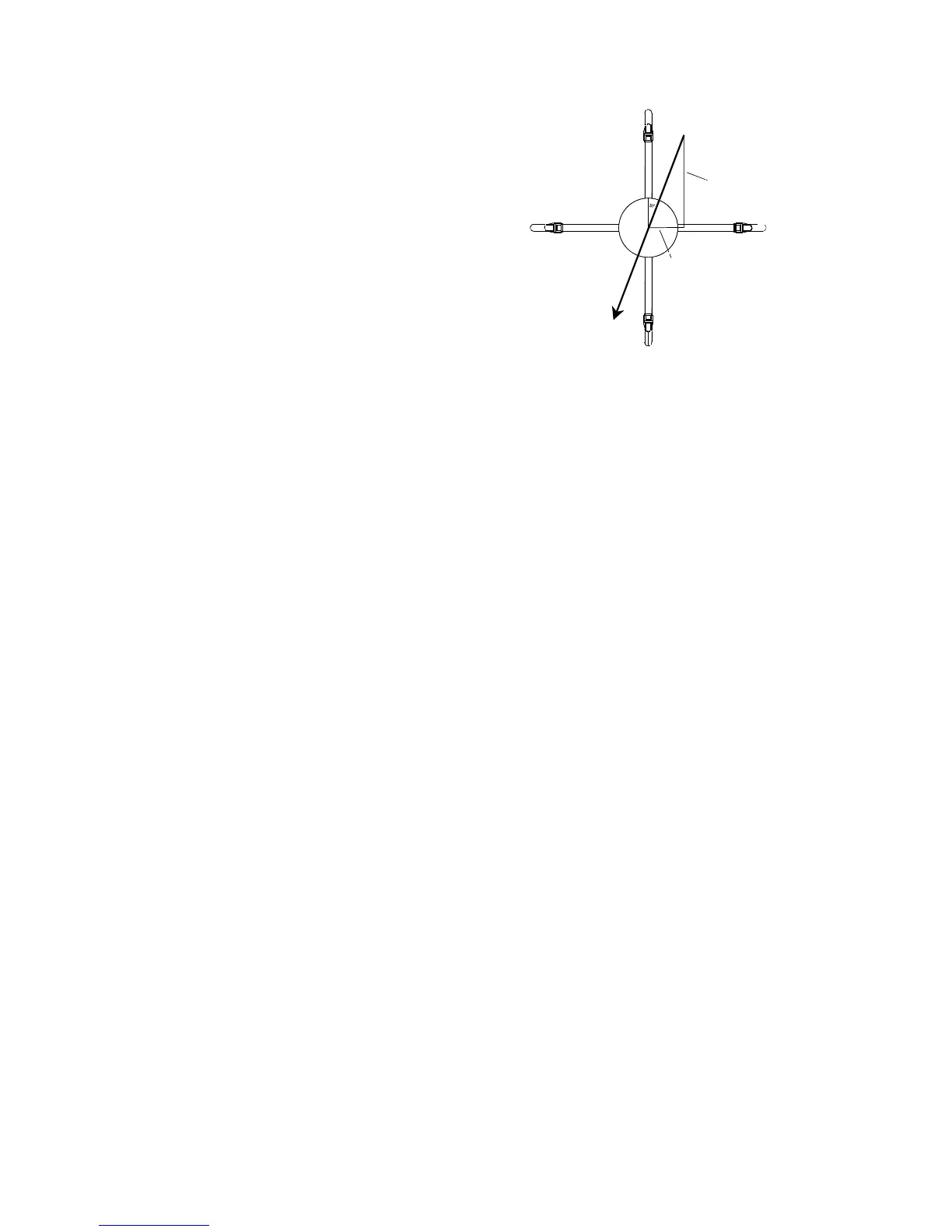
By combining the two measuring paths which are at right angles to each other, one obtains the
measurement results of the sum and the angle of the wind speed vector in the form of rectangular
components.
After the rectangular speed components have been measured, they are then transformed by the µ-processor
of the anemometer into polar co-ordinates and output as sum and angle of wind speed.
3.2 Acoustic-Virtual Temperature
As previously mentioned, the speed of the propagation of sound is shows a radix dependency on the
absolute air temperature, but is rather independent of air pressure, and only slightly dependent of humidity.
Thus these physical properties of gases can be used to measure air temperature at constant and known
chemical composition.
It is a measurement of gas temperature which is made without thermal coupling to a solid state sensor.
The advantages of this measured variable is, on the one hand, its inertia free reaction to the actual gas
temperature, and, on the other hand, the avoidance of measurement errors such as those which occur when
a solid state temperature sensor is heated up by radiation.
Due to the low dependency of the speed of propagation of the sound on the air humidity, the “Virtual
Temperature” refers to dry air (0% humidity) under the same pressure conditions as that one actually
measured.
The deviation of the measured “acoustic-virtual temperature”, compared with the real air temperature, is
linear-dependent from the absolute humidity content of the air.
The part of water vapour in the air increases proportionally the sonic speed, as H
2
O-molecules have approx.
only half of the mass of the remaining air-molecules (O
2
and N
2
).
The rise of the sonic speed leads to an apparent (virtual) rising of the measured temperature in humid air
compared with dry air of the same temperature.
The deviation of the measured virtual temperature in humid air, compared with real air temperature, can be
corrected according to the following correlation, when the value of absolute humidity is given:
T
r
= T
v
– T
v
* 0,135 K * m
3
/ g * H
abs
and Tr represents the real air temperature, T
v
the measured acoustic-virtual temperature and H
abs
the
absolute humidity in grams H
2
O per m³ of air.
The virtual temperature at 100 % is too high by approx. 2 Kelvin with an air temperature of 20°C.
2 - 10 021280/04/02


 To Next Page
 Loading...