
 Need help?
Do you have a question about the THOMSON SESAME 250 and is the answer not in the manual?
Guidelines for safe usage by children and supervised persons, and intended purpose of the device.
Details on electrical installation standards, safe connection practices, and avoiding crushing hazards.
Instructions for cleaning, maintenance, and replacement of parts, emphasizing safety.
Guidelines for proper disposal of used batteries and electronic waste, including safety warnings.
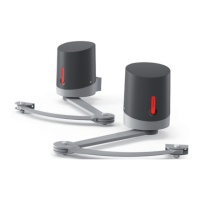
Lists all items included in the motor drive kit with quantities and reference numbers.
Lists tools and additional components needed for installation but not supplied with the kit.
Covers hazard analysis, regulations, gate specifications, safety checks, and rules for motorization.
Methods to eliminate specific hazards like shear zones, bottom edges, confinement areas, and others.
Step-by-step guide for mounting the motor drive unit onto the gate posts.
Instructions for mounting and connecting the safety flashing light to the gate post.
Procedures for installing photocells for safety and gate operation, covering different opening directions and optional sets.
Details on electrical connections for power supply, motors, flashing lights, photocells, Guardian module, control parts, backup battery, and solar kit.
Explanation of the control panel indicators (LEDs) and buttons (PROG, +, OK) for system interaction.
Navigating and understanding the basic settings menu (MENU 1), including menu structure, photocell alignment, operating modes, time delay, force, speed, and self-learning.
Instructions for programming remote controls, including initial programming, copy programming, and deletion.
Overview and details of advanced settings menus (MENU 2 and MENU 3) for acceleration, photocell mode, gate type, stop tolerance, panel time difference, and pre-flashing time.
General safety warnings and liabilities concerning the use of the motorised gate.
How the gate can be controlled using remote controls, keypads, or wired devices.
Differentiates between full gate control and pedestrian control commands.
Explains the three operating modes (Semi-automatic, Automatic closure, Collective) and how to select them.
Details photocell function during operation and instructions for manual gate movement.
Guidelines for regular maintenance tasks, frequency, and importance for safety and warranty.
Explanation of indicators for battery charge, events/errors, total reset procedures, and battery replacement.
Instructions on how to safely replace the power fuse in the motor drive unit.
List of compatible accessories for the gate motor drive system.
Detailed technical specifications for the motor drive, Guardian module, flashing light, battery, and photocells.
Details of product warranty, how to get technical support, and procedures for product returns and after-sales service.
Statements of compliance with relevant EU directives and standards for the product.
 General
| Max Gate Weight | 250 kg |
|---|---|
| Max Gate Length | 6 m |
| Power Supply | 230V AC |
| Motor Voltage | 24V DC |
| Protection Rating | IP44 |
| Remote Control | Yes |
| Manual Release | Yes |
| Type | Sliding Gate |
| Motor Type | DC |
| Safety Features | Obstacle detection |

 To Next Page