PAGE | 3
Digital Amps
We don’t do digital for one reason. Analog sounds better! What you’ll notice in digital amps is the
lack of a “Th” in the “Thump.” So you get “ump, ump, ump” and the low end bubbles along. Now
when you take a solo, it may sound good, but go back to a low bass line, and you’ll disappear on
stage. And a studio player told us that he was using a popular digital amp from Italy, and in the
headphones he heard a chorus! Is it possible that they put a digital effect into the amp to “beef it
up?” It’d be easy to do. And a third reason is these amps are made with parts and circuits that are
impossible for the average repair shop to handle. That’s why repairs usually require replacement
of the amp. That’s not very convenient for a professional player.
♦ CAUTION--Earsareyourmostimportantpieceofequipment,andcannotbereplaced.
♦ Usecommonsense.DONOToperateathighvolumelevelsoratlevelsthatareuncomfortable.
♦ Ifyoueverexperienceanyringingintheears,yourbodyistellingyousomething:TURNDOWN.
♦ If you suspect hearing loss, consult a health care professional.
AFewSecretsBehindTheThunderfunkTone
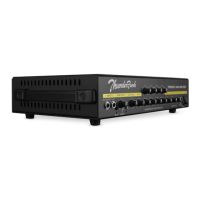
Thunderfunk Bass Amps are pure op-amp and transistor solid state designs – made famous by
suchclassicdesignsastheAcoustic360,andtheAMPBH-420.Theyusethelargesthigh-quality
powertransformersthatcanbepackedintotworackspaces.Halftheweightoftheampisthe
powertransformer,anditisconservativelycontrolledby1200-wattsworthofpowertransistors
intheTFB800-B2.
Otherkeyelementsoftheamp’stoneareawhoppingamountofpowersupplyltercapacitance,
so dynamics are maintained and distortion reduced even at the highest volumes and lowest fre-
quencies. A competitors’ amp might sound good in the store at low volumes, but falls apart when
pushed.
Andthebiggestreasonisweusehighqualitylmandsilvermicacapsprovidingapunchymid-
range, and a sweet high end that even makes piezo tweeters sound good. Other amps try to save
money by using electrolytic caps in the signal chain. The problem is that type of cap changes its
valuewithfrequency.They’remadeforpowersupplyltersthatrunataconstant60or120Hz.
Sowhenyoudesignalteryoupickvaluestokeepthedelaythroughthelterconstantacross
the frequency range you’re interested in. If the values you design for are always changing with the
frequenciesgoingthroughthelter,yougetaconfusedphase-shiftedsignalthatisthecauseof
the “I can’t penetrate the room” syndrome, similar to having woofers out of phase.


 To Next Page
 Loading...