Need help?
Do you have a question about the Tie Down Engineering 660E and is the answer not in the manual?
Detailed steps for installing the Model 660E brake actuator on a trailer.
Procedure for correctly connecting the trailer hitch and coupler to the tow vehicle.
Instructions for wiring the trailer brake solenoid to the tow vehicle's reverse lights.
Guidelines for routine maintenance and inspection of the brake actuator.
Essential safety warnings and precautions for braking and trailering operations.
Step-by-step guide on how to bleed the brake actuator system.
List of available replacement parts for Model 660E/660 actuators.
List of available replacement parts for Model 66 actuators.
Details on the manufacturer's warranty coverage and limitations.
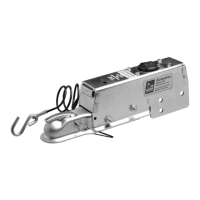
The Tie Down Engineering Model 660E Brake Actuator is a hydraulic surge brake actuator designed for trailer brakes with a capacity of 6,600 lbs. It is compatible with both drum and disc brakes, offering an automatic synchronization of trailer brakes with the tow vehicle's axle brakes. The actuator operates on the principle of "surge" or "push" from the trailer towards the tow vehicle. When the trailer pushes against the tow vehicle, the actuator telescopes together, applying force to the master cylinder and generating hydraulic pressure for the brakes. A built-in dampening shock absorber helps to retard the telescoping shock against the hitch ball, contributing to smoother braking.
The Model 660E Actuator comes fully assembled and is ready for installation. It is designed to be bolted to the trailer tongue and is compatible with tongue sizes of 3"x 3", 3"x 4", and 3"x 5". For lightweight tongues (less than 11 gauge), spacer tubes are required inside the tongue for reinforcement to ensure the attachment strength meets or exceeds 1.5 times the trailer's Gross Vehicle Weight Rating (G.V.W.R.).
For hydraulic brake systems, the actuator requires DOT 3 heavy-duty brake fluid. Bleeding the brakes can be done using a pressure-type brake bleeder, following the manufacturer's instructions, or manually by inserting a flat blade screwdriver into the bleeding access port on top of the actuator near the front and using a pumping action to activate the master cylinder. When bleeding, it's crucial to ensure the screwdriver tip is in front of the e-stop bracket and not in the slot. The bleeding process involves installing a bleeder hose on the wheel cylinder, submerging the loose end of the hose in a glass of clean brake fluid to observe bubbling, and loosening the bleeder screw. Bleeding is complete when bubbling stops, and the bleeder screw must be securely tightened afterward. The master cylinder reservoir should be replenished with brake fluid during the process to prevent the level from falling below half full, and after completion, it should be filled to 3/8" below the top of the reservoir with the filler cap securely in place.
The actuator is designed to accept 2" or 50mm trailer hitch balls. Using balls larger than 2.00" (50mm) or out of round can lead to coupler failure, while balls smaller than 1.95" may cause shock loading and sudden disconnection. It's essential to ensure the ball latch is in the correct position to retain the hitch ball, and a safety pin should be inserted into the forward hole as a safety lock for the hitch ball coupler before towing. The coupler should not be used if damaged.
Safety features include the connection of safety cables or chains in a crossed pattern under the tongue, or as directed by the trailer manufacturer. The actuator's breakaway cable S-hook must be connected to the tow vehicle only, not to the safety cables or chains. The breakaway system is intended to operate only if the trailer detaches completely from the tow vehicle and the safety chains fail; it is not designed to be a parking brake. If the breakaway system is accidentally applied, it can be released by prying out the spring clip on the side of the actuator with a flat blade screwdriver.
The Model 660E is designed for use with Free-Backing trailer brakes. For other types of brakes, an electric solenoid can be used to block braking action when backing up. For trailer movement when brakes are not required, a safety pin can be placed in the hole on the side of the actuator housing to block movement. However, it is critical to remove this pin before towing, as failure to do so will prevent forward braking and can result in serious property damage, injury, or death. The safety pin must always be in the lower, forward hole as a safety lock for the hitch ball coupler latch when towing.
Maintenance is crucial for the longevity and safe operation of the actuator. The brake fluid reservoir should be checked before each use, ensuring it is at least half full and refilled with DOT 3 brake fluid if necessary. DOT 5 brake fluid should never be used, as it can damage internal parts and lead to brake failure. Leaks should be repaired promptly, and brake fluid should never be reused. To extend the life of the coupler and ball and eliminate squeaking, both should be coated with a thin layer of grease, which should be renewed each time the trailer is used. The actuator should be examined for bent parts or wear before each use, and any necessary parts should be replaced. There are no user adjustments on the actuator itself. Actuator travel exceeding one inch indicates a need to adjust the brakes, add fluid, or bleed the brakes and check for leaks. Drum brakes require adjusting back-off adjusters from a locked position, while Free-Backing brakes are adjusted by rotating in the forward direction only. Disc brakes do not require adjustment but should be checked for pad wear.
After using the trailer in corrosive conditions, such as saltwater or areas with fertilizers, the actuator and brakes should always be flushed with fresh water. Before storing the trailer, the brakes should be removed and thoroughly cleaned. Repacking the bearings at the same time is also recommended. Failure to properly maintain the actuator can lead to serious damage, injury, or death.
Warnings are provided regarding tongue weight, which should be between 5% and 10% of the trailer's G.V.W.R. Too much tongue weight can cause premature brake actuation and loss of control, while too little can cause the trailer to fishtail. A loose fit between the coupler and hitch ball can cause separation, leading to damage, injury, or death, so the coupler latch safety pin must always be securely installed. Sharp turns should be avoided as they can cause the actuator to bind or jackknife, potentially damaging the actuator and causing brake failure. Towing the trailer over large bumps or dips that may overstress the connection between the trailer and tow vehicle should also be avoided. Any control devices that restrict the actuator's operation, including certain sway control devices, cannot be used, as the actuator must be free to telescope in response to braking requirements. Equalizing or weight-distributing hitches designed for surge brake actuators may be used, provided there is six to eight inches of free chain length.
 General
| Category | Controller |
|---|---|
| Model | 660E |
| Input Voltage | 12V DC |
| Operating Temperature | -40°F to +140°F |
| Protection | Short Circuit, Overload |

 To Next Page