remove the circuit from your guitar signal when it is off. This being the case capacitors that couple your
signal to the effect are not perfect and the voltage they have on them drifts. This voltage will make a pop
when the circuit is initially reconnected. Simply switch the unit on and off a couple times when you first
connect the pedal to stabilize the voltages in the unit.
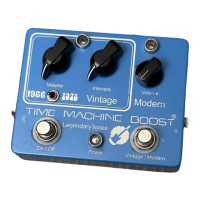
LEDs (Power On - RED, Vintage Channel - BLUE, Modern Channel - WHITE).
Battery Access – Battery for the Time Machine Boost can be accessed by removing the four screws on the
bottom of the unit. Current draw is low (approx. 12 mAs) and the battery will provide many hours of use.
Applications
The Time Machine Boost is a level/input voltage-altering effect that is specifically designed to work
together with quality tube amplifiers. It is not an overdrive or distortion unit, but a specific set of unique
booster circuits designed to enhance the sound of your guitar rig. By using the Time Machine Boost with its
levels set high, your amp will respond by naturally compressing to provide further overdrive and sustain –
especially if your amp is set for initial clipping before the Time Machine Boost has been activated! The
effect is very safe and in fact these boosting techniques are one of the methods that have been used by
professionals for many years. Boosters in various forms were often a musician’s “secret weapon” for tone
enhancement.
At lower level settings, the Time Machine Boost can either alter the tonal frequencies and enhance the
musical harmonics while in one of its two vintage modes, or serve as a completely transparent preamp that
allows volume and dynamic changes to be served up at the click of its footswitch. The possibilities for
applications are only limited by one’s imagination!
The Time Machine Boost can also be used successfully with overdrive and distortion pedals for a variety of
additional unique uses. By positioning the Time Machine Boost AFTER an overdrive unit in a chain set to
an amp running otherwise clean, you can increase your volume level without changing the character or
amount of distortion created by the overdrive unit itself. This is useful for example when you'd like to move
“up front” in the mix during a solo. The Time Machine Boost can also be placed BEFORE an overdrive
unit to increase the amount of distortion/drive of the unit while retaining similar output levels. This is
effective for moving from light overdrive to heavy drive musical passages with easy footswitchability.
Experiment with these two positions of Time Machine Boost placement within your signal chain to
determine the best uses for you.
The Time Machine Boost may also be used for a wide range of other purposes such as a clean preamp to
strengthen the tone and body of guitars that use lower output pickups. It can be used creatively to alternate
between its two boost modes using different level settings for each channel so you can use it for unique
rhythm and lead tone applications. The key is to experiment and have fun!! What follows is a description
of each of the Time Machine Boost’s three modes.
Vintage 1966 - Classic vintage “Treble Boost” effect and drive at the heart of which is a New Old Stock
(NOS) premium germanium transistor. This is the boost sound based on Eric Clapton’s famous
Rangemaster booster that he used when playing on John Mayall’s Bluesbreaker’s album. What makes 1966
so special is that with its increase in upper mid and high frequency response comes a natural clipping effect
in those same frequencies, courtesy of the select germanium transistor.
Vintage 1973 - Classic vintage Boost specifically tuned for more bottom end and fuller range, yet still
retaining the great top-end sparkle and drive by way of the same great NOS germanium transistor. 1973 is
based on the best of the modified treble-boosters of the day which also had more midrange punch as well.
Brian May of Queen used a modified booster circuit with his famous combination of a custom-built guitar
coupled with Vox AC30 amplifiers. Tony Iommi of Black Sabbath also used similar modified boosters to
drive the front end of his powerful Laney stacks.


 To Next Page
 Loading...