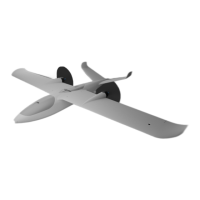
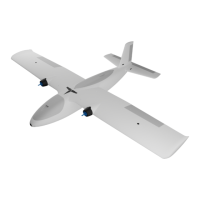
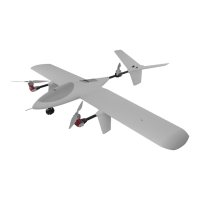
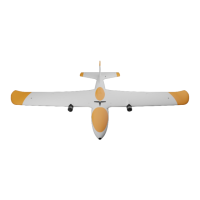
The Titan Dynamics Hornet VTOL is a 1.1m wingspan tri-tiltrotor vertical take-off and landing (VTOL) aircraft designed for recreational flying at a medium to small scale. Its design emphasizes aerodynamic efficiency, structural rigidity, and ease of transport and maintenance. The Hornet has been meticulously sculpted using Computational Fluid Dynamics (CFD) to optimize its aerodynamic performance and has been obsessively lightened while maintaining a robust structure.
Function Description:
The Hornet VTOL is a versatile aircraft capable of both vertical take-off and landing, similar to a multirotor drone, and efficient forward flight like a fixed-wing airplane. This dual capability makes it suitable for various applications, including recreational flying, aerial photography, and potentially other tasks requiring flexible flight profiles. The tri-tiltrotor configuration means it has three motors, with the front two motors capable of tilting to transition between vertical and horizontal flight, while the rear motor remains stationary. This design allows for precise control during hovering and smooth transitions to high-speed forward flight. The aircraft is designed to be built from 3D-printed parts, primarily using Lightweight Polylactic Acid (LW-PLA) filament, making it accessible for hobbyists with 3D printing capabilities.
Important Technical Specifications:
- Wingspan: 1100mm
- Wing Area: 2238cm²
- Maximum Take-off Weight: 2.5kg
- Efficiency: 2.2 Wh/km
- Cruise Speed: 50-75kph
- Recommended Propeller Diameter: 7 inches (ideally 7x4 or 7x5, but 6-8 inches can work)
- Root Airfoil: NACA 4410
- Tip Airfoil: NACA 2410
- Wingtip Airfoil: NACA 0010
- Root Chord: 240mm
- Tip Chord: 178mm
- Average Chord: 177mm
- Root Incidence: 3°
- Tip Incidence: 0°
- Aspect Ratio: 5.40
- Max L/D: 22
- Dihedral: 0°
- TE Sweep: -7°
Required Build Materials (Spars):
- 8x800mm - Front wing spar
- 8x600mm - Rear wing spar
- 4x300mm (2) - Wingtip support
- 2x300mm (2) - Aileron hinge
- 3x230mm (4) - Elevator hinge + stab support
- 3x130mm (2) - Vstab support
- 16x500mm (1) - Tail boom
Recommended Motor & Propeller:
- 16-19mm mounting pattern
- Tmotor F90 or V2208 or similar
- 7-inch propeller (ideally 7x4 or 7x5). 6-8 inch works as well.
Recommended Electronics:
- TBS Crossfire / ELRS radio system
- 5.8GHz / 1.2GHz analog or digital video system (19x19 camera)
- Matek F405-WTE flight controller or similar
- Matek M8Q-5883 GPS/Compass or similar
- (3) 35A BLHeli ESCs
- (6) Emax ES08MAII servos
- Battery: 6S2P 21700 Molicel 8400mAh Li-ion or 6S 4000mAh LiPo or similar
Miscellaneous:
- Polymaker Polylite prefoamed LWPLA (for most parts)
- Polycarbonate or other high-temp filament (for motor mounts and wing bay covers)
- Medium CA glue
- 200x200x200mm minimum size print bed (compatible with Prusa Mk3)
- Control horns (specific type recommended)
- M3 threaded inserts (max 6mm height)
- M3 bolts of various sizes
- 6x3mm magnets
Usage Features:
- Removable Wings and Tail: The wings and tail are fully removable, facilitating easy transport and storage.
- Large Wing Bays: Designed with spacious wing bays to accommodate VTX/RX units, ensuring maximum antenna separation for improved signal quality.
- Nearly Zero-Gap Control Surfaces: All control surfaces feature a nearly zero-gap design with rounded leading edges that are recessed into the wings/stabs. This design minimizes drag and improves aerodynamic efficiency.
- Serviceable Components: All servos and motors are easily accessible for maintenance and replacement, enhancing the longevity and usability of the aircraft.
- 3D Printable Design: The Hornet is primarily designed to be 3D printed, allowing users to produce parts at home. This approach offers flexibility in material choice and customization.
- Ardupilot Compatibility: The aircraft is designed to be controlled by Ardupilot, a widely used open-source autopilot software. This provides advanced flight control capabilities, including various flight modes, navigation, and data logging. Specific Ardupilot parameters for a tri-tiltrotor configuration are provided (Q_FRAME_CLASS = 7, Q_TILT_MASK = 3, Q_TILT_TYPE = 0).
- Flight Performance: Optimized for efficiency and speed, with a cruise speed of 50-75 kph and an efficiency of 2.2 Wh/km, indicating good endurance for its class.
- Landing Assistance: While take-off does not require flaps, landing can be made easier with half flaps, providing more controlled descents.
Maintenance Features:
- Modular Design: The removable wings and tail simplify repairs and component access.
- Accessible Servos and Motors: The design ensures that all servos and motors can be easily serviced or replaced, reducing downtime.
- 3D Printing for Replacement Parts: Since the aircraft is 3D printed, replacement parts can be easily fabricated by the user, making repairs cost-effective and convenient.
- Adhesion and Warping Prevention: The manual provides detailed guidance on bed adhesion techniques, including the use of glue sticks and the "TabAntiWarping" plugin in Cura, to ensure successful prints and minimize warping, which is crucial for maintaining the structural integrity of the printed parts.
- Hole Horizontal Expansion Tuning: Instructions are given for tuning the "hole horizontal expansion" setting in the slicer software to ensure a snug fit for carbon rods, which are critical structural elements. This customization accounts for variations in printers and materials.
- Gluing Techniques: Recommendations for using medium CA glue and proper alignment during assembly are provided to ensure strong and accurate joints, which are essential for the aircraft's structural integrity.
- Threaded Insert Installation: Guidance on properly installing M3 threaded inserts using a soldering iron ensures secure mounting points for components.
- Durability Enhancements: Suggestions like adding duct tape or other abrasion-resistant material to the bottom of the fuselage are provided to increase durability, especially during landings on rough surfaces.
- Ardupilot Data Logging: The recommendation to use Ardupilot's data logging capabilities is a key maintenance feature, as it allows for in-depth analysis of flight issues, helping users diagnose problems and improve future flight performance.
- Tail Boom Drilling Jig: A specific jig is provided for drilling holes in the tail boom, ensuring perfect perpendicularity and correct spacing, which is vital for the alignment and stability of the tail assembly.
The Titan Dynamics Hornet VTOL is a well-thought-out model that combines advanced aerodynamic design with practical considerations for 3D printing, assembly, and long-term use, making it an excellent choice for enthusiasts looking for a high-performance, build-it-yourself VTOL aircraft.

 Need help?
 General

 To Next Page