
 Need help?
Do you have a question about the TJERNLUND AIRESHARE ASLL and is the answer not in the manual?
Explains the function of the AireShare™ Level to Level Ventilator in improving home comfort.
Details blower, motor, sound, dimensions, and component specifics for the ASLL model.
Critical safety warnings, installation restrictions, and precautions for the ASLL unit.
Outlines necessary tools, pre-installation inspection, and cavity determination for installing the ASLL.
Step-by-step instructions for installing the ASLL ventilator in an upflow configuration.
Step-by-step instructions for installing the ASLL ventilator in a downflow configuration.
Diagrams and instructions for wiring the ASLL unit to a 120 VAC power source.
Guidance for running surface wiring to the ASLL unit if an existing outlet is not accessible.
Information on annual maintenance for the ASLL blower and availability of replacement parts.
Details the one-year limited warranty for the Tjernlund ASLL product.
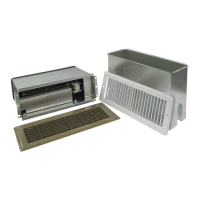
The AireShare™ Level to Level Ventilator, Model ASLL, is designed to improve air distribution and comfort within homes that experience temperature differentials between different levels. This device effectively moves air from one conditioned space to another, addressing issues of uncomfortably hot or cold rooms and helping to destratify stagnant air. By promoting air movement, the ASLL enhances ventilation rates and contributes to a more comfortable living environment across both levels of a house.
The primary function of the AireShare™ ASLL is to facilitate the transfer of air between two levels of a home, typically through a floor/ceiling cavity. This process helps to equalize temperatures, reducing the common problem of one level being significantly warmer or cooler than another. The ventilator is equipped with a cross-flow impeller that efficiently moves air, ensuring that conditioned air is circulated to areas that need it most. This active air movement not only balances temperatures but also prevents air from becoming stagnant, which can improve overall indoor air quality.
The ASLL can be installed in two primary configurations: upflow and downflow. In an upflow installation, the device discharges air from a lower level up to the level above it. Conversely, in a downflow installation, it discharges air from an upper level down to a lower level. This versatility allows the ASLL to be adapted to various home layouts and specific air distribution needs. The unit is designed to be integrated discreetly into the floor and ceiling, with grilles that can be painted to match the surrounding decor, ensuring it blends seamlessly into the home environment.
The ventilator can be operated via an on/off switch located below the floor grille, offering convenient control. For more advanced integration, the ASLL can also be wired into a 120 VAC wall switch or a thermostat, providing options for automated or remote control based on temperature settings. This flexibility in control mechanisms allows homeowners to tailor the operation of the ASLL to their specific comfort preferences and energy-saving goals.
Before installation, a thorough investigation of the floor joist/truss layout is crucial to ensure proper placement and avoid interference with plumbing lines, drains, vents, or ductwork. It is also important to confirm that foundation blocks or upstairs walls do not obstruct the installation path. For installations involving existing outlets, selecting a joist/truss section that already contains an electrical outlet is recommended, especially when using surface wiring.
The installation process involves creating openings in both the floor and ceiling. For finished ceilings, a stud finder is used to locate joist/truss edges, and a small inspection hole is cut to verify the installation area. If carpeting is present on the upper level floor, it may be pulled back to facilitate drilling pilot holes. Templates are provided to ensure accurate cutout dimensions for both the outer sleeve and blower housing, preventing issues such as the outer sleeve flange falling through the opening.
During installation, particular attention is paid to the electrical wiring. The unit is designed to be wired into a 120 VAC power source, with options for integrating a wall switch or thermostat. Strain relief bushings are used to secure wiring entering the electrical box. For installations where the combined width of the joist/truss thickness, ceiling, and subfloor exceeds a certain dimension, air flow leakage stickers are applied over the electrical relief slot opening in the outer sleeve to prevent air leakage into the joist/truss cavity. This detail ensures optimal performance and energy efficiency.
The ASLL is designed for ease of assembly, with components such as sheetrock mounting brackets that slide over sheetrock ends, ensuring secure installation. For unfinished ceilings, wood pieces cut from the floor opening can be used to support the blower housing. The ceiling grille and floor grille are then installed, completing the integration of the unit into the living space. The ability to paint the ceiling grille allows for aesthetic customization, making the unit virtually unnoticeable.
The AireShare™ ASLL is designed for minimal maintenance, ensuring long-term reliable operation. The blower wheel should be inspected annually to ensure it remains clean and free of debris. If necessary, it can be carefully cleaned or vacuumed using a bristle brush head. This routine cleaning helps maintain optimal airflow and efficiency.
The motor of the ASLL is permanently lubricated, which means it does not require any additional lubrication throughout its lifespan. This feature eliminates a common maintenance task associated with many mechanical devices, contributing to the overall low-maintenance profile of the unit. The robust design and quality components ensure that the ASLL operates effectively with minimal intervention from the homeowner.
In the event that replacement parts are needed, specific components such as the floor grille, ceiling grille, blower assembly, and on/off switch are available. This ensures that any worn or damaged parts can be easily replaced, extending the service life of the ventilator. The availability of replacement parts underscores the manufacturer's commitment to product longevity and customer support.
The device is factory line tested before shipment, ensuring that each unit meets quality standards and is ready for installation. This pre-shipment testing helps to minimize issues upon arrival and installation. Upon opening the carton, it is recommended to inspect the unit for any shipping damage, ensuring the impeller rotates freely and all electrical wires and connections are secure. Any damage found should be reported immediately to the freight carrier and distributor.
Overall, the AireShare™ Level to Level Ventilator is a user-friendly and efficient solution for improving air circulation and comfort in multi-level homes, designed with both ease of installation and minimal maintenance in mind.
 General
| Brand | Tjernlund |
|---|---|
| Model | AIRESHARE ASLL |
| Type | Ventilation Hood |
| Mounting Type | Wall Mount |
| Voltage | 120V |
| Duct Size | 4 inches |
| Material | Plastic |

 To Next Page