8
III. HOW TO OPERATE
Operating controls for the MX385 are located on the unit front panel or are remote inputs
through the rear panel.
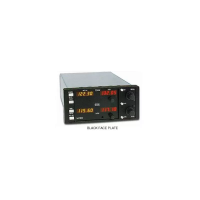
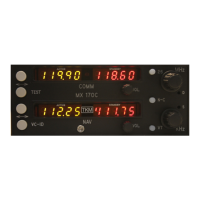
The unit front panel is shown in fig. 1. The upper left-hand (yellow) COMM readout
indicates the active COMM frequency and the right-hand (red) COMM readout indicates
standby COMM frequency. The lower left-hand (yellow) readout indicates the active
NAV frequency and the right-hand (red) NAV readout indicates the standby NAV
frequency. A ‘tic’ readout is provided on the upper left-hand corner of the first digit of
each of the four frequency readouts.
The active COMM ‘tic’ indicates the presence of transmitter power.
The standby COMM ‘tic’ indicates that the Frequency Selection knobs will control
COMM standby frequency.
The active NAV ‘tic’ indicates that the NAV receiver is in the Ident mode.
The standby NAV ‘tic’ indicates that the Frequency Selector knobs will control NAV
standby frequency.
Power Application
. The COMM volume control contains the master power switch and
activates both the NAV and COMM functions.
Frequency Selection. Then N/C button is used to activate either the COMM or the NAV
frequency selection as indicated by the appropriate “‘‘tic’’” display. The MHz and KHz
controls can then be used to select a desired standby channel. In COMM the ‘25’ button
is used to advance the frequency by 25 KHz.
After the desired standby frequency is selected it may be transferred to the active position
by pressing the Flip-flop button to the left of the ACTIVE display. The active and
standby channels will be interchanged each time the button is pressed.
Ident/Voice Selection
. The ID\VC button can be used to select a tone filter in order to
receive voice signals on the NAV receiver. The switch is also used for frequency storage
as described below.
Test. The TEST button is a dual function switch. In normal operation, it is used to
override the squelch to verify receiver operation and to receive weak signals. The switch
is also used for frequency storage as described below.


 To Next Page
 Loading...