Need help?
Do you have a question about the TMG PRO Series and is the answer not in the manual?
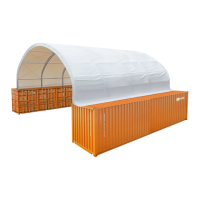
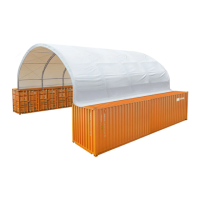
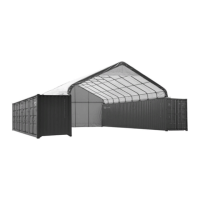
This document outlines the assembly, installation, and maintenance procedures for a 30Ft x 40Ft Container Shelter - Pro Series, designed for industrial applications. The shelter is intended to provide a covered space, typically for storage or as a workspace, by being mounted on top of two shipping containers.
The TMG-ST3040CVF container shelter serves as a robust and versatile overhead covering solution. Its primary function is to create a protected area between two standard shipping containers, effectively transforming the space into a sheltered environment. This design leverages the structural integrity and height of the containers, providing an elevated and expansive covered area. The shelter is particularly useful in industrial settings where protection from elements such as sun, rain, and light snow is required for equipment, materials, or temporary workspaces. It is not designed for human occupancy, emphasizing its utility as a functional, protective structure rather than a living or permanent working space. The modular nature of the design, utilizing existing containers, allows for relatively quick setup and potential relocation, making it a flexible solution for various site requirements.
The installation process for the container shelter is detailed and requires careful attention to safety and structural integrity. Before commencing assembly, users are strongly advised to thoroughly read the product manual and verify that all parts listed are present. Safety is paramount during installation, necessitating the use of proper personal protective equipment such as safety helmets, protective eyewear, and appropriate clothing. For elevated work, safety harnesses are recommended, along with the use of proper ladders, cages, and safe operating procedures.
The initial step involves selecting a suitable installation site. It is crucial to choose a solid, flat, and level ground area. Installation on soft ground, wetlands, uneven surfaces, or sloped areas is strictly prohibited, as these conditions can compromise the stability and safety of the structure. Furthermore, the containers themselves should be placed on hard foundations to ensure a stable base for the shelter. Awareness of the surrounding environment is also important; the building should not be set up near snowdrifts, open flames, or exposed electrical wires. Heat sources should be kept away from the fabric cover to prevent damage. Maintaining a clear surrounding area at all times is essential for safety and accessibility.
The assembly of the trusses is a critical phase. All truss components should be laid out on the ground in the correct configuration before bolting them together. The building includes a front truss, a rear truss, and eight middle trusses. The front and rear trusses are specifically designed to accommodate the fabric panels. Once assembled, the trusses are lifted and installed onto the base tube, secured firmly with self-locking bolts. For this step, the use of a crane or forklift is recommended, along with the assistance of two to three people, to ensure safe and secure installation.
After the trusses are in place, all purlins are connected with bolts, and the sidewall frame steel tension cables are installed. The remaining parts for the front and rear trusses, including door frame tubes and additional purlins, are then installed.
A key feature of the shelter's design is the use of scratch-resistant tape. This tape is applied around the sharp points of the joints to prevent friction between the fabric cover and the frame, thereby extending the lifespan of the cover by preventing fabric damage.
The installation of the cover panels begins with the front and rear cover panels. These are lifted from the center point of the frame (the highest ridge point) and secured to the truss using braided ropes threaded through grommets. All grommets must be tied firmly to the frame. Finally, the main top cover is expanded on the ground and carefully pulled into place, avoiding snagging on sharp edges or bolts. Both sides of the cover are tied to the bottom tube rebar through grommets using braided rope. The front and rear covers are also tied to the trusses. It is essential to tie all four sides firmly and simultaneously to ensure the cover is square, smooth, and straight. The grommets should be fastened to the frame with wavy lines, and the corners of the cover tied to the corners of the frame.
Regular inspection and maintenance are crucial for ensuring the longevity and safety of the container shelter. After installation, a thorough inspection of the entire structure is recommended. Users should walk around the building periodically to ensure that all parts are firmly fixed and that the structure is well-supported. This includes checking all bolts and hardware connectors to confirm they are in place and tightened. However, it is important not to overtighten bolts, as this can damage the tubes or components. The base plates should also be checked, and the ropes adjusted if necessary.
A significant maintenance consideration, especially in regions prone to snowfall, is snow removal. Snow accumulating on the fabric cover must be removed as soon as possible. If snow is allowed to solidify into ice, it can significantly increase the weight on the roof, potentially leading to the collapse of the building or a reduction in its lifespan. Therefore, immediate removal of snow from the roof is strongly recommended, and snow loads should not be left on the roof overnight. Furthermore, a clearance of at least three feet should be maintained on all sides of the building at all times. Allowing snow to accumulate and pile up on the sides can exert inward pressure, which could also lead to a collapse of the structure. Regular cleaning of the cover is also advised to maintain its condition and appearance.
In summary, the TMG-ST3040CVF container shelter is a practical and robust solution for creating sheltered industrial spaces. Its effective use and durability are heavily reliant on meticulous installation practices, adherence to safety guidelines, and consistent maintenance, particularly concerning snow removal and structural integrity checks.
 General
| UV Resistance | Yes |
|---|---|
| Dimensions | Varies by model |
| Weight | Varies by size and material |
| Ventilation | Varies by model, some include zippered mesh windows for ventilation |
| Doors | Optional zippered door panels available |
| Windows | Optional, various sizes |
| Floor Included | Optional |
| Anchoring System | Included (ground stakes or bolt-down kit) |
| Assembly Required | Yes |

 To Next Page