Need help?
Do you have a question about the TMG TMG-MSC2030F and is the answer not in the manual?
Bracing on truss sides distributes snow/wind load evenly, preventing excessive stress. Ensure secure attachment per manufacturer's instructions.
Anchor cables secure the shed to the ground against wind/snow loads. Install on all four corners securely for maximum stability.
A stable foundation on a concrete pad prevents shifting. Anchor bolts must secure the shed firmly to the pad as per instructions.
This document outlines the assembly and maintenance procedures for a metal garage carport shed, designed to provide shelter and protection for vehicles or other items. The manual emphasizes safety precautions, proper installation techniques, and essential maintenance practices to ensure the stability, durability, and longevity of the structure.
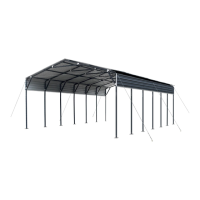
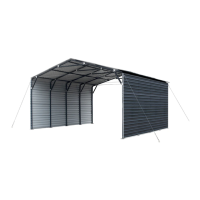
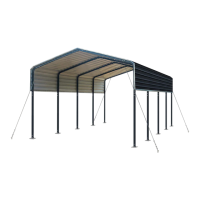
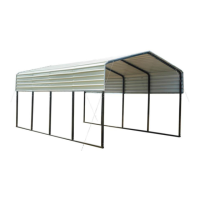
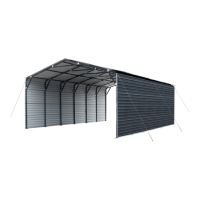
The metal garage carport shed serves as a robust and versatile outdoor shelter. Its primary function is to protect vehicles, equipment, or other stored items from various environmental elements such as sun, rain, snow, and wind. The structure is designed to be open-ended, allowing for easy access and egress. The frame is constructed from metal tubes, forming a series of trusses that support metal sheets for the roof and side panels. This design provides a sturdy and enclosed space, offering a degree of security and weather resistance. The shed is not intended for human occupancy but rather for storage and protection purposes.
The shed's design incorporates several features that facilitate its use and enhance its protective capabilities. The open-ended design allows for drive-through access, making it convenient for parking vehicles or moving equipment in and out. The metal sheet construction for the roof and side panels offers significant protection against precipitation, UV radiation, and wind. The modular design, as indicated by the detailed parts list and assembly steps, allows for a systematic and potentially straightforward installation process.
The structure is anchored to the ground using baseplates and expansion bolts, which are crucial for stability, especially in areas prone to wind. The inclusion of steel anchor cables further reinforces the structure's resistance to uplift and shifting due to strong winds or heavy snow loads. These cables are designed to be attached to all four corners of the shed and secured to the ground with suitable anchors, ensuring the shed remains firmly in place.
Shoulder support bracing, in the form of reinforcing tubes, is installed on both sides of the trusses. This feature is critical for distributing the weight of snow and wind loads evenly across the structure, preventing excessive stress on any single point. This even distribution helps to maintain the structural integrity of the shed under adverse weather conditions.
The manual highlights the importance of proper installation for the shed's performance. It advises choosing a day with low or no wind for assembly, as heavy winds can significantly complicate the installation process. The detailed diagrams and step-by-step instructions guide the user through positioning the baseplates, installing the trusses, attaching the wire ropes, and finally securing the top crossbars and metal panels. Each step is illustrated with clear visuals and a corresponding parts list, making it easier for the assembler to identify and use the correct components.
The shed's construction with metal sheets and a tubular frame provides a durable enclosure. The self-tapping screws and hex bolts are used to secure the metal sheets to the frame, creating a continuous protective barrier. Edge protectors and buckles are also included to finish the edges of the metal sheets, which can enhance both the aesthetic appeal and the safety of the structure by covering sharp edges. Square plugs are used to cap off open tube ends, preventing water ingress and improving the overall finish.
The design also considers the need for a stable foundation. The manual strongly recommends installing the shed on a concrete pad or an equivalent stable foundation. Anchor bolts are then used to firmly secure the shed to this foundation, preventing movement during high winds or heavy snow loads. This foundational stability is paramount for the long-term performance and safety of the carport.
The manual outlines several key maintenance practices that are essential for preserving the shed's stability, durability, and warranty validity. Regular inspection is a crucial maintenance feature. Owners are advised to periodically walk around and inspect the carport to ensure all components are still firmly secured and the entire structure is well-supported. This includes checking all bolts and nuts, as well as all connection points, to confirm they are in their proper positions and tightened securely. The base plates should also be checked for any signs of loosening or damage.
Adjusting the ropes and tie-downs is another important maintenance task. Over time, these components may loosen or stretch, reducing their effectiveness in securing the structure. Regular adjustments ensure that the steel anchor cables continue to provide adequate tension and support, especially after periods of strong winds or heavy loads.
Cleaning the cover regularly is also recommended. While the manual refers to "cover," in the context of a metal shed, this likely pertains to the metal roof and side panels. Keeping these surfaces clean prevents the buildup of debris, which could potentially lead to corrosion or reduce the aesthetic appeal of the shed.
A critical maintenance instruction pertains to snow removal. The manual explicitly states that snow accumulating on the cover must be removed as soon as possible. If snow is allowed to solidify into ice, it significantly increases the weight on the roof, which can lead to the collapse of the carport or drastically reduce its lifespan. The manual strongly recommends removing any snow from the roof immediately and not leaving any snow load on the roof overnight. Furthermore, it advises maintaining a 3-foot clearance on all sides at all times and preventing snow from accumulating and piling up on the sides of the building. Accumulating snow on the sides can exert inward pressure, potentially leading to a collapse. This proactive snow management is vital for preventing structural damage and ensuring safety.
The document also touches upon the importance of adhering to local building codes and regulations. While not a direct maintenance feature of the shed itself, it is a critical aspect of its long-term viability and legal compliance. Owners are responsible for checking if a permit is required for installation and ensuring that the shed meets any engineering requirements related to snow and wind loads. Failure to comply with these regulations or to perform the recommended maintenance may void the product warranty, underscoring the importance of diligent care and adherence to guidelines.
In summary, the maintenance regimen for this metal garage carport shed focuses on regular inspections, securing all fasteners and anchors, managing snow loads effectively, and ensuring compliance with local building standards. These practices are designed to maximize the lifespan of the shed and maintain its protective capabilities.
 General
| Category | Shelters |
|---|---|
| Manufacturer | TMG |
| Model | TMG-MSC2030F |
| Weather Resistance | Yes |
| Assembly Required | Yes |
| Material | Steel |

 To Next Page