Need help?
Do you have a question about the Toa RXA-212 and is the answer not in the manual?
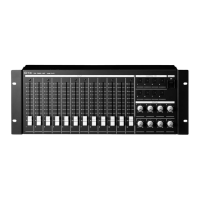
The TOA Powered Console, available in models RXA-212 and RXA-216, is a self-powered mixing console designed for professional sound reinforcement systems. These consoles offer a versatile and high-performance solution for a wide range of audio requirements, emphasizing reliability, easy maintenance, and serviceability through their modular construction.
The RXA-212 model features 12 input channels, 2 program outputs, 2 foldback outputs, 1 echo output, and 2 built-in power amplifiers, each delivering 120 watts into 8 ohms. The RXA-216 expands on this with 16 input channels, 2 program outputs, 2 foldback outputs, 1 echo output, and 4 built-in power amplifiers, each also providing 120 watts into 8 ohms.
Each input channel on both models is equipped with a balanced, low-impedance, transformer-isolated XLR connector and a high-impedance, unbalanced 1/4" jack. This dual input capability allows for flexible connection of various audio sources, from microphones to other line-level equipment. An input level switch and a trim control are provided on each channel, enabling precise gain settings to optimize signal integrity and prevent clipping. A peak indicator LED on each input channel illuminates when excessive input levels are detected, serving as a visual warning to adjust the input level selector switch and/or the input trim control to avoid signal distortion.
A four-band equalizer is integrated into each input channel, offering comprehensive tonal shaping. This includes a high equalizer control providing ±15dB of shelving equalization at 10kHz, a high-mid equalizer control with ±15dB of peaking equalization at 3kHz, a low-mid equalizer control with ±15dB of peaking equalization at 300Hz, and a low equalizer control with ±15dB of shelving equalization at 100Hz. Each equalizer control has a detented "0" position for a flat audio response.
A pan control on each input channel allows the fader output signal to be assigned to the Program L and R mixing buses. At the center position, the signal is routed equally to both buses, while panning to either side gradually assigns the input signal exclusively to Program L or R.
The consoles include two independent foldback outputs, which provide pre-fader and pre-EQ signals. These are particularly useful for stage monitor systems, allowing performers to hear a customized mix without affecting the main program output. Foldback controls (FB 1 and FB 2) on each input channel assign the pre-equalizer, pre-fader input signal to the respective foldback mixing buses.
An analog, electronic echo unit is built into the console, offering adjustable echo time (delay) and regeneration (number of repeats). The echo time control allows continuous variable adjustment in either short (14ms to 40ms) or long (40ms to 140ms) ranges. This internal echo can be bypassed via Echo Send/Return jacks for integration with external delay, reverb, or special effects units. An echo control on each input channel assigns the post-equalizer, post-fader signal to the echo bus. The echo return volume control sets the signal level from the built-in echo or an external echo unit and sends it to the program L and R, adjustable via the pan control. The echo send volume control adjusts the overall signal level of the echo mix to the echo send output or the internal analog delay.
Dual graphic equalizers (1/1 octave, 9 bands) are a key feature, switchable to either the program outputs, foldback outputs, or "off" for A-B comparison. These equalizers provide ±12dB of boost and attenuation at nine center frequencies (63Hz, 125Hz, 250Hz, 500Hz, 1kHz, 2kHz, 4kHz, 8kHz, 16kHz), with the "0" position of each filter providing a flat response.
Two additional stereo inputs are available for connecting stereo playback decks, disk players, and other auxiliary equipment. These stereo inputs have dedicated volume controls and a balance control to adjust the level balance of the stereo input signals fed to the program L & R mixing buses. Each stereo input also features switches for AUX (line level signals) and PHONO (direct input with RIAA equalization for turntables).
All faders on the console are log-linear type with 60mm travel, providing smooth and precise control over signal levels. The input faders adjust the channel's output to the program L and R mixing buses and the echo mixing bus, with a nominal level at the "0" position and a 6dB margin. Program faders (PGM L and PGM R) control the overall signal level of the program mixes fed to the program L & R outputs and the assigned internal power amplifiers. Foldback faders (FB1 and FB2) control the overall signal level of the mixes fed to the FB outputs 1 and 2.
A fluorescent bargraph peak meter (2-color, vertical type) monitors the outputs of program L and R, and foldback 1 and 2, providing clear visual feedback on output levels. Green LEDs indicate when an amplifier is connected to either the FB or program output, while red LEDs signal that the amplifier output is near clipping.
A cue switch on each input channel, stereo input, AUX echo input, program output, foldback output, and echo send allows monitoring of the respective pre-fader (pre-volume) signals through the phones output. The phones level control adjusts both the program L and R signals fed to the phones output and permits stereo monitoring when the cue switch is off. When the cue switch is on, the control adjusts the corresponding cue signal, combining signals if multiple cue switches are active.
The internal power amplifiers are highly flexible. They can be used for either program outputs or foldback outputs, or they can be used independently with external sources via "EXT IN" jacks. Power amplifier sensitivity switches (SENSITIVITY) allow changing the input sensitivity of the built-in amplifiers to either +20dB or +4dB. Power amplifier input selector switches assign each built-in amplifier to either the FB mix or PGM mix.
The console is designed for intuitive operation, with clearly labeled controls and a logical layout. The writing blocks on the input and stereo input sections allow users to label input equipment or microphone settings with an erasable felt pen or wax pencil, aiding in organization during live events or complex setups.
The input level selector switch and trim control system ensures optimal gain staging, preventing clipping while maximizing the signal-to-noise ratio. The four-band equalizer on each channel provides detailed control over individual instrument or vocal tones, allowing for precise sound sculpting. The dual graphic equalizers offer broad control over the overall mix, enabling users to compensate for room acoustics or tailor the sound to specific preferences.
The cue system is a powerful tool for monitoring, allowing engineers to audition individual channels, stereo inputs, or output mixes through headphones without affecting the main output. This is particularly useful for cueing the start of a tape or record, or for independently checking program mixes.
The internal echo unit provides a convenient way to add spatial effects, with adjustable delay time and regeneration to suit various musical styles. The ability to bypass the internal echo and connect external effects units offers further creative flexibility.
The power amplifier assignment switches allow for flexible routing of the internal amplifiers, whether for main program speakers, stage monitors, or external input sources. This adaptability makes the console suitable for diverse sound reinforcement scenarios.
The modular construction of the TOA Powered Console is highlighted as a feature that assures reliability and easy maintenance. While specific maintenance procedures are not detailed in the provided text, the emphasis on modularity suggests that components can be serviced or replaced with relative ease, contributing to the console's long-term usability.
The console includes a power fuse for protection against electrical overloads, and a power cord clamp to prevent accidental disconnection of the AC power cord. Ground terminals are provided for proper grounding of the chassis and connected equipment like tape decks or turntables, which is crucial for minimizing hum and noise.
Important precautions are outlined for installation and operation:
These design considerations and operational guidelines contribute to the console's robust performance and ease of upkeep in demanding professional environments.
 General
| Type | Stereo Mixer Amplifier |
|---|---|
| Input | Mic Input: 2 channels |
| Output | Line Output: 2 channels |
| Input Impedance | MIC: 600 Ω, AUX: 10 kΩ |
| Output Impedance | Speaker Out: 4 - 16 Ω |


 To Next Page