Need help?
Do you have a question about the Toa TC-651M and is the answer not in the manual?
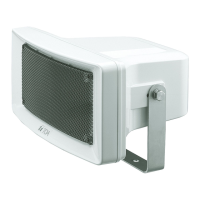
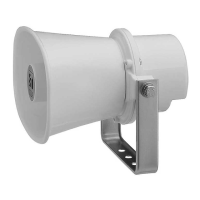
This document outlines the operational and safety guidelines for a TOA Horn Speaker, detailing its function, usage, and maintenance to ensure safe and effective performance.
The TOA Horn Speaker is designed for sound amplification, primarily in environments where robust and directional sound projection is required. It functions by converting electrical audio signals into acoustic energy, directing sound over a specific area. The speaker is available in both low-impedance and high-impedance versions, catering to different amplifier setups and installation requirements. High-impedance versions incorporate a built-in matching transformer, allowing for connection to constant voltage amplifier outputs, which is common in public address systems over long distances. The speaker's design includes a drain hole to prevent water accumulation, particularly important for outdoor installations, ensuring longevity and consistent performance. An impedance selector switch allows users to adjust the speaker's impedance to match the amplifier's output, optimizing sound quality and preventing equipment damage.
The TOA Horn Speaker offers several features to facilitate its use and integration into various sound systems. For installation, it is crucial to position the drain hole facing the ground, especially for models like the SC-610, SC-615, and SC-630 series, to prevent water ingress and potential failure. When multiple speakers are used in the same location, proper polarity must be observed to avoid issues like reduced bass output or decreased volume. Black speaker cables are typically positive (+), while white cables are negative (-) or common (COM). Parallel connections should use cables of the same colors, while series connections should use cables of different colors.
Users must avoid simultaneously connecting both low- and high-impedance speakers to the same amplifier to prevent amplifier failure. For high-impedance speakers, it is imperative to use only the specified line voltage (amplifier output voltage) indicated on the nameplate (e.g., [25/70 V LINE] or [70/100 V LINE]) to prevent fire or equipment damage.
For low-impedance speaker setups involving two or more speakers, all connected units must have identical impedance and input ratings. The total speaker impedance should match the amplifier's output impedance; a lower total impedance could damage the speakers or amplifier. When parallel-connecting low-impedance speakers, the total rated input of all speakers must exceed the amplifier output. For long distances between the amplifier and speaker (30 – 50 m), it is recommended to use solid wire speaker cable with a diameter over 2 mm or strand wire over 3.5 mm² to minimize transmission loss, or to connect an optional matching transformer to convert the speakers to high-impedance operation.
For high-impedance speakers, the total rated input of all connected speakers must be equal to or less than the amplifier output. Connecting all speakers in parallel is the standard method for high-impedance setups.
Impedance selection is a key feature, allowing users to adjust the speaker's impedance to match the amplifier. This is done by inserting a screwdriver into the impedance selector switch slot and turning the switch. An "OFF" position is available to disconnect the speaker from the amplifier, silencing it. Speakers are factory-preset for the highest rated input of two line voltages (e.g., 100 V line for the 70/100 V line version). The speaker's rated input and impedance are clearly indicated on the nameplate. Users should confirm the line voltage to be used and select the corresponding impedance. It is critical not to use the impedance selector switch position marked as "[-]", as this could lead to amplifier or speaker failure, or fire.
The speaker comes in three parts: Bell, Center, and Bracket. Assembly involves attaching these components using four assembly screws provided with the "Center" part.
The manual emphasizes several maintenance and safety precautions to ensure the longevity and safe operation of the horn speaker. Before installation or use, users must carefully read all instructions and follow precautionary guidelines, including warnings and cautions. The manual should be kept handy for future reference.
To prevent serious personal injury or property damage, users are warned against using the specified amplifier output voltage and impedance, as exceeding limits could cause fire or other failures. The unit should not be used near gasoline, thinner, or other combustibles to avoid accidental air explosions. Installation must only occur in locations that can structurally support the unit's weight and the mounting bracket; failure to do so could result in the unit falling and causing injury or damage. In snowy areas, the unit must be protected from snow build-up, which could cause the speaker to fall.
Mounting the bracket should only be done using specified methods, as extreme force applied otherwise could cause the unit to fall. When mounting in high locations, a safety wire must be attached to the unit to prevent personal injury if the speaker falls. Nuts and bolts appropriate for the ceiling's or wall's structure and composition must be used, and they must be tightened securely to ensure no loose joints in the bracket after installation.
To avoid electric shocks, the amplifier power must be switched off when connecting the speaker. The unit should not be installed in humid or dusty locations, or areas exposed to heaters, solvents, acid, alkali, smoke, steam, or direct sunlight (unless it's an outdoor-use version), as these conditions can lead to speaker failure, fire, or electric shock. Operating the unit with distorting sound for extended periods is an indication of a malfunction that can generate heat and cause fire.
Users should not stand, sit on, or hang from the unit, as this could cause it to fall, resulting in personal injury or property damage. Periodic checks by the purchasing shop are recommended. When mounting the unit on a vehicle, both the speaker and its mounts should be checked before moving to prevent the speaker from falling off due to damage or corrosion.
The manual also advises on using nuts and bolts appropriate for the ceiling's or wall's structure and composition, and tightening them securely to prevent the speaker from falling. For concrete walls and structures, appropriate bolts and nuts must be used, and they must be tightened securely. The bracket should have no loose joints after installation. The unit should not be mounted in locations exposed to constant vibration, as this can damage the mounting bracket and cause the speaker to fall.
Finally, the manual details the importance of periodical checks by the shop where the unit was purchased. For vehicle-mounted units, both the speaker and its mounts should be checked before moving to prevent accidents due to damage or corrosion.


 To Next Page
 General