
 Need help?
Do you have a question about the Top Tronic T1151 and is the answer not in the manual?
Warns of electric shock risks and stresses the importance of reading and understanding the manual before use.
Details checks for leads/fuses, avoiding live parts, and requiring competent, trained personnel for operation.
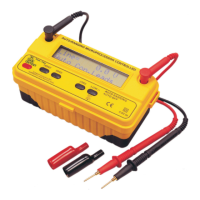
Introduces the testers, highlighting ruggedness, affordability, and unique features like MOV/GAS Arrester Testing.
Discusses advantages such as EnerSave, no moving parts, internal calibration, and extended calibration intervals.
Describes the Insulation Tester's basic features for installations, buzzer function, and test button usage.
Explains MOV/GAS Arrester tests, automatic voltmeter, and safety features for detecting voltage.
Covers voltage testing, lead connections, and safety measures for preventing errors.
Details the ON key, automatic battery testing, voltmeter mode, and the Auto-Hold safety feature.
Explains EnerSave for test duration limiting and continuity test features.
Guides on selecting insulation test voltages and managing test duration with EnerSave.
Covers continuity tests, short circuit current, and using the Auto-Null feature for lead resistance.
Explains tester OFF functions, auto-off, and how to select MOV and GAS Arrester tests.
Details automatic circuit discharge after tests and the non-destructive nature of most measurements.
Emphasizes secure lead connections and fuse integrity as essential for safety feature operation.
Covers lead connections, ON/TEST button, battery testing, and the default voltmeter mode.
Explains how to manually turn off the tester and the auto-off feature.
Details the safety feature Auto-Hold and how to select insulation test voltages.
Defines EnerSave, PI, DAR, and features of continuity testing like low resistance and buzzer.
Provides instructions for performing MOV and GAS Arrester tests on the tester.
Explains key operations (ON-TEST, voltage selection, continuity) and lead assignments.
Details the Voltmeter with Auto-Hold feature and its safety benefits for users.
Covers key operations, insulation test voltage selection, and MOV/GAS Arrester tests.
Explains continuity testing, auto-null, and the safety voltmeter's voltage detection and alarm.
Details automatic AC/DC voltage detection and automatic discharge of capacitive/inductive circuits.
Explains the auto-off feature, noting it's inactive when dangerous voltage is present.
Compares the features and functionalities of the Insulation Tester and the Multifunction Tester.
Describes the keypad interface, digital display, and fuse/crowbar protection mechanisms.
Explains the automatic battery test and the safety voltmeter with its hold function for user safety.
Covers insulation test voltages, measurement ranges, and the EnerSave battery-saving feature.
Details continuity test specifications and the safe voltmeter's voltage detection and alarm.
Explains the digital calibration process and the types of batteries the testers can use.
Guides on checking fuses, test leads, and cleaning the instrument.
Details procedures for replacing batteries and fuses.
Lists general specifications, display type, and voltmeter AC/DC ranges and accuracy.
Details insulation test voltages, ranges, accuracy, and typical output voltages.
Provides specifications for continuity, auto-null, buzzer, MOV, and GAS Arrester tests.
Details overload, overvoltage protection, and fuse specifications.
Lists mechanical dimensions, material, weight, and environmental operating conditions.
Outlines the warranty period, coverage, conditions, exclusions, and liability limitations.
 General
| Brand | Top Tronic |
|---|---|
| Model | T1151 |
| Category | Test Equipment |
| Language | English |

 To Next Page
