This document describes the R32 Residential Full DC Inverter Swimming Pool Heat Pump, a device designed for efficient heating and cooling of swimming pool water.
Function Description
The heat pump utilizes the sun's free heat by collecting and absorbing energy from the outside air. This energy is then compressed and transferred to the pool water. An existing water pump circulates the pool water through the heater, usually located near the pool equipment, where the water warms up. The heat pump timer can be set to operate during daylight hours, for example, from 9 am to 5 pm.
The unit incorporates a fan that draws in outside air and directs it over the surface of the EVAPORATOR (energy collector). The liquid refrigerant within the EVAPORATOR coil absorbs heat from the outside air and transforms into a gas. This warm gas then passes through the COMPRESSOR, where it is concentrated and its temperature increased, forming a very hot gas. This hot gas then flows to the CONDENSER (water heat exchanger), where it transfers heat to the cooler swimming pool water circulating through the coil. As the pool water warms up, the hot gas cools and returns to its liquid form after passing through the CAPILLARY TUBE, completing the cycle. This technology allows the heat pump to efficiently collect heat from outside air down to a temperature range of 7°C to 10°C, enabling pool water to be maintained at 26°C to 32°C in tropical and subtropical climates.
The heat pump is equipped with a micro-computer controller, allowing all operation parameters to be set and displayed on an LCD. It supports various modes including cooling, auto, and heating. The unit also features a timing function for Boost/Smart/Silent modes and can be controlled via a wired controller or, for some models, a WIFI remote control using the "Tuya Smart" APP.
Important Technical Specifications
The manual provides a table of "Operation Measured Parameters" (Table 1) and "Error Code" (Table 2) for troubleshooting.
Key parameters include:
- Current Actual Frequency of Inverter Compressor: 0~150 Hz
- AC Current: 0~50 A
- AC Voltage: 0~300 V
- DC Voltage: 0~500 V
- Inlet/Outlet Water Temperature: -30~150 °C
- Water Tank Temperature: -30~150 °C (Reserved)
- Cooling Coil Temperature: -30~150 °C
- Outdoor Coil Temperature: -30~150 °C
- Outdoor Ambient Temperature: -30~150 °C
- Return Gas Temperature: -30~150 °C
- Exhausting Temperature: 0~150 °C
- Inlet/Outlet Temperature of Plate Heat Exchanger: -30~150 °C (Reserved)
- Main/Auxiliary Board Electronic Expansion Valve Opening Degree: 0~500 pulses (Reserved for auxiliary board)
- IPM Temperature: 0~150 °C (Reserved)
Electrical connection details (3.9 Electrical Connection) specify power supply wires, cable diameter, specification (AWG), MAX current (A), and Fuse (A) for various models (J55SP32INVP to J320SP32INV3NP). For 220-240V~/50Hz models, cable diameters range from 3x2.5mm² (AWG 14) to 3x4.0mm² (AWG 12), with MAX currents from 6.6A to 22.9A and fuses from 10A to 32A. For 380-415V/3N~/50Hz models, cable diameters are 5x2.5mm² (AWG 14) or 5x4.0mm² (AWG 12), with MAX currents from 7.8A to 11A and fuses from 16A.
Unit dimensions (3.8 Unit Dimensions) are provided for various models, with measurements A, B, C, D, E, F, and G. For example, models J55SP32INVP to J95SP32INVP have dimensions A=902, B=357, C=665, D=637, E=340, F=320, G=106. Larger models like J250SP32INVP to J320SP32INV3NP have A=1117, B=456, C=770, D=770, E=456, F=470, G=106.
Usage Features
- High Efficiency: With a COP (Coefficient of Performance) value up to 11, these heat pumps are highly efficient, potentially saving up to 80% of costs compared to electrical heaters.
- Long Life-span: The heat exchanger is made of PVC Titanium tube, designed to withstand and prolong exposure to swimming pool water.
- Easy Control and Operation: The unit is user-friendly, requiring only a switch-on and setting of the desired pool water temperature. The micro-computer controller allows for setting all operation parameters, and the operation status is displayed on an LCD.
- Installation Flexibility: The unit can be installed virtually anywhere outdoors, provided minimum distance requirements from other objects are met to ensure adequate fresh air supply and prevent re-circulation of discharged air. Diagrams illustrate minimum free space requirements for both horizontal and vertical heat pump models.
- Check-valve Installation: It is crucial to install a check-valve to protect the heat pump from high concentrations of chemicals (like chlorine and pH dosage systems) that could corrode the heat exchanger, especially when these systems are located downstream of the heat pump.
- First Time Start-up: The filter pump must be running for water circulation. After turning on the electrical power, the unit starts after a 3-minute delay to protect electrical components. The unit automatically switches off when the set temperature is reached and restarts when the pool water temperature drops more than 1°C below the set point.
- Condensation Management: The unit produces condensation, especially under high atmospheric humidity, which is drained through an opening in the base pan. This is a normal phenomenon and should not be mistaken for a water leak.
- Safety Features:
- Water Flow Switch: Prevents the heat pump from operating without sufficient water circulation, protecting it from damage.
- Refrigerant Gas High and Low Pressure Protection: Safeguards the heat pump from damage due to over-pressurization or refrigerant leaks.
- Overheating Protection on the Compressor: Protects the compressor from excessive temperatures.
- Automatic Defrost Control: Activates in humid and cold conditions to defrost ice formed on the evaporator by reversing the heat pump cycle.
- Temperature Difference Protection: Automatically turns off the heat pump if the temperature difference between inflowing and outflowing water exceeds 13°C, indicating a circulation issue.
- Low Temperature Cut-out: Shuts off the unit during cooling if the outflowing water temperature drops to 5°C or below, restarting when it reaches 7°C or above.
- Anti-frost Protection (during winter): If the water temperature is between 2-4°C and air temperature is below 0°C, the filter pump turns on to prevent freezing. If water temperature drops below 2°C, the heat pump starts heating until it reaches 3°C.
Maintenance Features
- Regular Cleaning: Check water inlet and drainage regularly. Clean the pool filter to prevent clogging. Keep the area around the unit spacious and well-ventilated, and clean the sides of the heat pump regularly to maintain good heat exchange.
- System Checks: Regularly check all operational processes, refrigerant system pressure, power supply, and cable connections. Address any abnormal function or electrical smells promptly.
- Winterizing: To prevent damage from freezing temperatures, especially in areas where temperatures drop below freezing, all water must be drained from the heat pump, filter pump, filter, and conduits. The water inlet and outlet coupler fittings should be disconnected and then loosely reattached to prevent dirt ingress.
- Restarting after Winter: Before restarting in spring, check for dirt in conduits and structural problems. Ensure water inlet and outlet coupler fittings are fastened, start the filter pump for water flow, and reconnect the electrical power supply.
- General Check-up: Ensure easy access to the service panel. Keep the area around the heat pump free of organic waste and prune nearby vegetation. Remove water sprinklers from the vicinity of the heat pump. Prevent rain from directly running off a roof onto the heat pump by installing proper drainage. Do not use the heat pump if it has been flooded; contact a qualified technician for inspection and repair.
- Troubleshooting Guide: The manual provides a detailed troubleshooting guide (Table 2 Error Code) for common issues like "heat pump doesn't work," "insufficient heating," "cooling down instead of heating up," "heat pump doesn't stop," "water leakage," and "abnormal amount of ice formed on the evaporator." It lists possible causes and corresponding solutions, emphasizing the importance of noting error codes and system parameters when contacting service.
- Water Chemistry: Maintaining proper pool water chemistry is crucial for the heat pump's longevity. Recommended limits are: pH (7.0-7.4), Free chlorine (0.5-1.2 mg/l), TAC (80-120 mg/l), and Salt (max 3 g/l). Failure to comply with these limits will invalidate the warranty. Water treatment equipment should be installed past the heat pump's water outlet, with a check-valve to prevent backflow.

 Need help?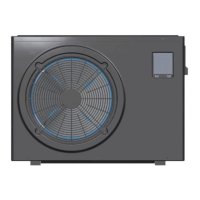

 To Next Page
 General