This document is an owner's manual for Torin BIG RED JACKS, specifically a range of jack stands. It provides essential information for the safe assembly, operation, and maintenance of these devices.
Function Description
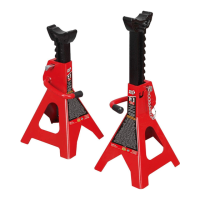
Jack stands are designed to support rated capacity, partial vehicle loads, specifically one end of a vehicle. They are intended to be used in pairs for each operation, providing stable support after a vehicle has been raised by a suitable jack. The stands feature a ratchet bar mechanism for height adjustment, secured by a locking pawl and handle. Once the vehicle is lowered onto the stands, they provide a secure platform for working on or around the vehicle.
Important Technical Specifications
The manual lists several models of jack stands with varying capacities and lifting ranges:
- T42002, T42002-1, T42002X: 2 TON capacity, with a minimum lifting range of 10-13/16 inches (27.5 cm) and a maximum of 16-9/16 inches (42 cm). The T42002X variant has a slightly different range: 9-13/16 inches (25 cm) minimum to 14-15/16 inches (38 cm) maximum.
- T43002, T43002-1, T43002X: 3 TON capacity. T43002/T43002-1 offer a minimum lifting range of 11-1/4 inches (28.5 cm) and a maximum of 16-3/4 inches (42.5 cm). T43002X has a range of 10-5/8 inches (27 cm) minimum to 16-1/8 inches (41 cm) maximum.
- T43006, T43006-1: 3 TON capacity, with a minimum lifting range of 14 inches (35.5 cm) and a maximum of 20-1/2 inches (52 cm).
- T46002, T46002-1: 6 TON capacity, with a minimum lifting range of 15-3/8 inches (39 cm) and a maximum of 23-13/16 inches (60.5 cm).
- T412002, T412002-1: 12 TON capacity, with a minimum lifting range of 18-5/16 inches (46.5 cm) and a maximum of 28-1/8 inches (71.5 cm).
The safe operating temperature for these jack stands is between 40°F – 105°F (4°C - 41°C). The assembly diagrams detail components such as the ratchet bar, locking pawl, spring pin, locking handle, handle sleeve, base frame, and for some models, a hex head bolt.
Usage Features
The manual emphasizes several key usage features and safety precautions:
- Paired Use: Jack stands must always be used as a matched pair and are rated for capacity per pair. They should not be used to simultaneously support both ends or one side of a vehicle.
- Surface Requirements: Operation must be on hard, level surfaces with less than 3 degrees of slope.
- Load Centering: The load must be centered on the stand's saddle for stability.
- Vehicle Support Points: Support should only be on areas of the vehicle specified by the vehicle manufacturer.
- Height Adjustment: Height is adjusted by pulling up on the ratchet bar. The locking handle's weight secures the ratchet bar in the desired position, and users should push down on the handle to confirm it's secure before loading.
- Pre-Operation Checks: Before use, operators must inspect the equipment for damage, excessive wear, or missing parts. Components like climbing pins should be checked for wear.
- Lowering Procedure: To lower a load, ensure the area is clear, raise the vehicle with a suitable jack, carefully release the stopper to allow the ratchet to glide to its lowest position, remove the stands, and then lower the vehicle with the lifting device.
- Prohibitions:
- Do not exceed rated capacity.
- Do not modify the jack stands.
- Do not use if damaged.
- Never use automotive jack stands on a lawn mower or lawn tractor.
- Do not move or dolly the vehicle while on support stands.
- Do not rock the vehicle while working on or around equipment.
- Do not use wood blocks or any other non-approved load sustaining devices.
- Wheel chocks or other blocking devices must be used on opposing wheels before using jack stands.
- Training and Awareness: Operators must read and understand the manual, be properly trained, and comprehend how to safely and correctly operate the product. Bystanders should be kept away from the supported load.
Maintenance Features
Regular maintenance is crucial for the longevity and safe operation of the jack stands:
- Regular Inspection: Inspect the equipment carefully before each use for damage, wear, broken or missing parts (e.g., pins). Check that all components function properly.
- Cleaning: All moving parts should be regularly cleaned. If the equipment binds, clean and lubricate the lifting mechanism. If moving parts are obstructed, use cleaning solvent or a good degreaser. Remove any existing rust with a penetrating lubricant.
- Lubrication: Lubricate parts as required by the manufacturer's specifications. The type of lubricant should be as specified by the manufacturer or a qualified person. Do not use motor oil or grease for lubrication.
- Rust Prevention: Check daily for signs of rust or corrosion. Lift the equipment as high as it goes without a load and inspect the lifting points; clean as needed.
- Storage: Store the equipment in a dry location, preferably indoors, where it will not be subjected to damage. If stored outdoors, lubricate all parts before and after use.
- Environmental Considerations: If used in extreme temperatures (above 140°F/60°C or below -20°F/-29°C) or chemically active environments (caustic/acid substances, fumes), consult the manufacturer or a qualified person. For environments with high moisture, gravel, sand, silt, grit, or dust-laden air, internal components should be frequently cleaned, inspected, and lubricated.
- Repair: Any necessary repairs should be made by qualified service personnel. Only genuine replacement parts should be used. Service and maintenance should only be performed when the equipment is not under a load.

 Need help?
 General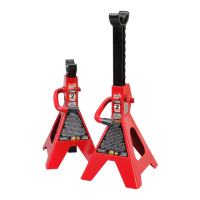

 To Next Page