
 Need help?
Do you have a question about the Toro Recycler 20379 and is the answer not in the manual?
Essential safety instructions for operating the mower and avoiding serious personal injury or death.
Information about safety decals and their importance for safe operation and hazard recognition.
Instructions for properly adding engine oil to prevent engine damage.
Critical safety checks and precautions to take before starting the mower.
Important safety guidelines for handling fuel to prevent fire or explosion.
Procedure for checking and maintaining the correct engine oil level.
Safety precautions to follow while the mower is in operation.
General safety rules to ensure safe mowing practices.
A schedule outlining recommended maintenance tasks and intervals.
Critical safety precautions to follow during maintenance procedures.
Steps to take to prepare the machine safely before performing maintenance.
Guide on how to service the engine's air filter for optimal performance.
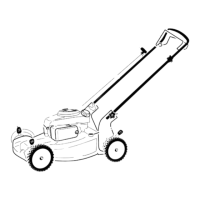
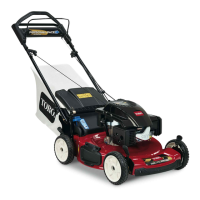
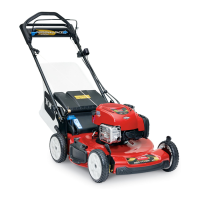
This document is an Operator's Manual for a 22-inch Recycler Lawn Mower, Model No. 20379, with serial numbers 407810000 and up. It provides comprehensive instructions for the safe and proper operation and maintenance of the device.
The lawn mower is a rotary-blade, walk-behind machine designed for residential homeowners to cut grass on well-maintained lawns. Its primary function is to recycle grass and leaf clippings back into the lawn, but it also supports bagging and side-discharging clippings.
The manual guides users through the initial setup, including assembling and unfolding the handle, installing the recoil-starter rope in its guide, adding oil to the engine, and assembling the grass bag.
Before operation, users are instructed on general safety practices, such as ensuring all guards and safety devices are in place, inspecting blades, and removing objects from the mowing area. Fuel safety is emphasized, detailing proper fueling procedures, avoiding spills, and storing fuel safely. The manual specifies the type of unleaded gasoline to use and recommends adding fuel stabilizer/conditioner.
Key operational steps include checking the engine-oil level, adjusting the handle height for user comfort, and setting the cutting height. Users are warned to shut off the engine and wait for all moving parts to stop before adjusting the cutting height, and to keep hands away from the hot muffler.
During operation, the manual covers general safety, such as wearing appropriate clothing, maintaining focus, and avoiding operation while ill or under the influence. It stresses keeping hands and feet away from moving parts, ensuring bystanders and children are clear of the operating area, and stopping the machine before leaving the operating position. Slope safety is highlighted, advising users to mow across slopes, avoid excessively steep slopes, and exercise caution near drop-offs.
Starting the engine involves holding the blade-control bar against the handle and pulling the recoil-start handle. For self-propel drive models, engaging the drive requires pulling the self-propel-drive bar to the handle. The manual notes that the maximum self-propel-drive speed is fixed, and speed can be reduced by increasing the space between the bar and handle. Releasing the self-propel-drive bar disengages the drive. To shut off the engine, users simply release the blade-control bar, and the engine and blade should stop within 3 seconds.
The mower offers different clipping management options. By default, it's set up for recycling clippings. Users can install the grass bag to collect clippings or install the side-discharge chute for cutting tall or thick grass. Instructions are provided for installing and removing both the grass bag and the side-discharge chute.
Operating tips include inspecting the mowing area, avoiding solid objects, and shutting off the engine immediately if it strikes an object or vibrates excessively. For cutting grass, users are advised to cut only about a third of the grass blade at a time, avoid cutting below 51 mm (2 inches) unless grass growth is slow, and mow at a higher setting for tall grass before a second pass at a lower setting. Wet conditions should be avoided. The manual also suggests alternating mowing direction for even fertilization and provides troubleshooting for unsatisfactory lawn appearance, such as replacing or sharpening the blade, walking slower, raising cutting height, or overlapping swaths. For cutting leaves, users should ensure half of the lawn shows through the cut leaf cover, possibly requiring multiple passes.
The manual outlines a recommended maintenance schedule, with daily checks for engine-oil level and blade-control bar function. After each use, the machine should be cleaned of grass clippings and dirt. Yearly maintenance includes servicing the air filter, changing the engine oil, and replacing or sharpening the blade. Before yearly storage, the fuel tank should be emptied.
Maintenance safety emphasizes shutting off the machine, waiting for parts to stop, and allowing it to cool before any adjustments or servicing. Users must disconnect the spark-plug wire before maintenance and wear gloves and eye protection. Blades are sharp and should not be repaired or altered. Tampering with safety devices is prohibited. Tipping the machine for maintenance should be done carefully to avoid fuel leaks, and the engine should be run dry or fuel removed with a hand pump.
Preparation for maintenance involves shutting off the engine and disconnecting the spark-plug wire. After maintenance, the spark-plug wire should be reconnected.
Servicing the air filter involves pressing down on latch tabs to open the cover, removing and inspecting the paper air filter and foam pre-filter, and replacing them if damaged or excessively dirty. Dirty filters can be tapped or blown with compressed air, but not brushed. Dirt should be removed from the air-filter body and cover with a moist rag, avoiding wiping dirt into the air duct.
Changing the engine oil is a yearly task. The engine should be run for a few minutes to warm the oil for better flow. After preparing for maintenance, the dipstick is removed, and the machine is tipped onto its side (air filter up) to drain used oil from the oil-fill tube. After draining, the machine is returned to the operating position, and about 3/4 of the engine capacity of new oil is poured in. After a 3-minute wait, the dipstick is inserted (not screwed in) and removed to check the oil level. If too low, small amounts of oil are added, waiting 3 minutes between checks. If too high, excess oil is drained. The dipstick is then securely installed, and used oil is recycled.
Replacing the blade is also a yearly task, requiring a torque wrench for proper installation. Users are warned about the sharp blade and advised to wear gloves. After preparing for maintenance, the machine is tipped onto its side (air filter up), and a block of wood is used to hold the blade steady while removing the mounting hardware. The new blade is installed with all mounting hardware, ensuring the curved ends point toward the machine housing. The blade bolt is tightened to 82 N·m (60 ft-lb).
Adjusting the self-propel drive is necessary when installing a new cable or if the drive is out of adjustment. This involves loosening cable adjustments, pulling or pushing cables to adjust tension (pushing toward the engine increases traction, pulling away decreases it), and then tightening the adjustment nut firmly.
For storage, the machine should be kept in a cool, clean, dry place. Storage safety reiterates shutting off the engine, waiting for parts to stop, and allowing it to cool.
Preparing the machine for storage involves adding fuel stabilizer to the last refueling of the year and running the machine until the engine shuts off from lack of fuel, ensuring it's sufficiently dry. The spark-plug wire is disconnected and connected to a retaining post. The spark plug is removed, 30 ml (1 fl oz) of engine oil is added through the spark-plug hole, and the starter rope is pulled slowly several times to distribute oil and prevent cylinder corrosion. The spark plug is then loosely installed, and all nuts, bolts, and screws are tightened.
Removing the machine from storage includes checking and tightening all fasteners, removing the spark plug, spinning the engine rapidly by pulling the recoil-start handle to blow excess oil, installing and tightening the spark plug to 20 N·m (15 ft-lb), performing any necessary maintenance, checking the engine-oil level, filling the fuel tank with fresh fuel, and connecting the wire to the spark plug.
 General
| Cutting Width | 22 inches |
|---|---|
| Cutting Height | 1.0 - 4.0 in (2.5 - 10.2 cm) |
| Drive Type | Self-Propelled |
| Starter Type | Recoil |
| Engine Displacement | 163 cc |
| Cutting Height Adjustment | Single Lever |
| Deck Material | Steel |
| Mulching Capability | Yes |
| Bagging Capability | Yes |
| Side Discharge Capability | Yes |
| Fuel Tank Capacity | 1 quart |
| Engine | Briggs & Stratton |
| Fuel Capacity | 1.0 qt (0.95 L) |
| Wheel Size | 8 in (20.3 cm) Front / 11 in (27.9 cm) Rear |
| Drive System | Personal Pace® Rear-Wheel Drive |



 To Next Page