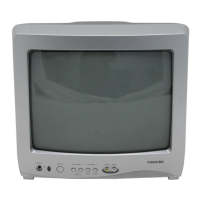
This document is a service manual for the Toshiba Color Television, model 14CS2R, which operates on an S3E Chassis. It provides comprehensive information for servicing, adjusting, and maintaining the television, including safety precautions, electrical adjustments, specific technical data, and parts lists.
Function Description:
The Toshiba 14CS2R is a color television designed for standard broadcast reception and video input. It features a 14-inch picture tube (372.5mm overall diagonal, 335.4mm viewable diagonal, 90° deflection) and supports multiple television systems including PAL B/G, PAL I, PAL D/K, SECAM B/G, SECAM D/K, NTSC M (US and Japan), and special RF signals for NTSC4.43 and PAL 60 Hz. The television includes a tuner for channel reception, a micro-processor for video, chroma, and OEF control, and audio/video input/output terminals. It also features a headphone jack for private listening.
Important Technical Specifications:
- Model: 14CS2R
- Chassis: S3E
- Rated Voltage: ~220 - 240V 50Hz
- Power Consumption: 60W
- Dimensions (WxDxH): 478.0mm x 390.0mm x 363.0mm
- Mass: 10.7 kg
- Picture Tube: Type 14 (372.5mm overall, 335.4mm viewable, 90° deflection)
- Television Systems (Aerial Input):
- PAL B/G (CCIR): Channels 2-12 (VHF), 21-69 (UHF), X~Z+2, S1~S41 (CATV)
- PAL I (UK): Channels 21-69 (UHF)
- PAL D/K (CHINA): Channels 1-12 (VHF), 13-57 (UHF), Z-1~Z-38 (CATV)
- SECAM B/G (CCIR): Channels 2-12 (VHF), 21-69 (UHF), X~Z+2, S1~S41 (CATV)
- SECAM D/K (OIRT): Channels 1-12 (VHF), 21-69 (UHF), X1~X19 (CATV)
- NTSC M (US): Channels 2-13 (VHF), 14-69 (UHF), A-6~A-1, A~W, AA~ZZ, AAA, BBB (CATV)
- NTSC M (JAPAN): Channels 1-12 (VHF), 13-62 (UHF), M1~M10, S1~41 (CATV)
- Special RF Signal (Color/Sound System):
- NTSC4.43: 5.5/6.0/6.5 MHz
- PAL 60 Hz: 5.5/6.0/6.5 MHz
- Color System: PAL / SECAM / NTSC4.43 / NTSC3.58
- Sound Output: 2.5W x 2
- Terminals:
- Input: Video, Audio (Monaural)
- Monitor Output: Video, Audio (Monaural)
- Speaker: 6 x 12cm (2)
- Accessories: Remote controller (1), Batteries (R03, AAA) (2), Owner's Manual
Usage Features:
The television can be operated via front panel controls or a remote control. Key functions include channel selection, volume adjustment, and menu navigation for various settings. The remote control offers direct channel selection, mute, picture control, and specific buttons for TV/VIDEO input, on-screen display, and game functions. The manual details how to program channel memory, including auto search memory (ASM), manual search, and store position functions. It also covers skip function for unnecessary channels and auto/manual fine tuning (AFT/MFT) to optimize picture quality under varying reception conditions.
Maintenance Features:
The manual provides detailed instructions for service and maintenance, emphasizing safety precautions.
- Safety Instructions: Crucial warnings regarding X-ray radiation, electrical shock, and fire hazards are highlighted. Technicians are advised to use an isolation transformer, discharge the picture tube anode, and use shatter-proof goggles when handling the picture tube. Replacement parts must be identical to original specifications, especially for safety-related components identified by international hazard symbols.
- Set-Up Adjustment: Procedures for color purity, convergence, and white balance adjustments are provided. These mechanical and electrical adjustments are critical when a complete realignment is required or a new picture tube is installed.
- Service Mode: A dedicated service mode allows technicians to access and adjust various internal parameters. This includes selecting adjustment items, changing data values, and performing test signal selections (red, green, blue rasters, black/white screens, cross-bar patterns, cross-hatch patterns, H signals).
- Design Mode: Similar to service mode, the design mode allows for specific adjustments, particularly after memory IC replacement.
- Electrical Adjustments: Detailed steps are given for adjusting focus, sub-brightness, horizontal/vertical position, and vertical amplitude. These adjustments ensure optimal picture geometry and clarity.
- Circuit Check: Instructions for high voltage checks are included, emphasizing the importance of using an accurate and reliable high voltage meter and ensuring the voltage does not exceed specified limits.
- Self-Diagnostic Function: The television includes a self-diagnostic function accessible via the remote control, which checks the interface among ICs and displays status messages (e.g., power, bus line, bus control, block status). It also indicates potential issues like overcurrent or bus line malfunctions through power indicator blinking patterns.
- Parts List: Comprehensive lists for chassis and cabinet replacement parts, including capacitors, resistors, coils, semiconductors, and other components, are provided with part numbers and descriptions. This is essential for accurate and safe component replacement.
- Schematic Diagrams: Detailed schematic diagrams for the main board and CRT drive board are included, illustrating the circuit structure and component interconnections, which are vital for troubleshooting and repair.
- PC Boards Bottom View: Diagrams showing the bottom view of the PC boards help in identifying component locations.
- Terminal View of Transistors: Illustrations of transistor terminal configurations aid in correct installation and testing.

 Need help?

 To Next Page
 General