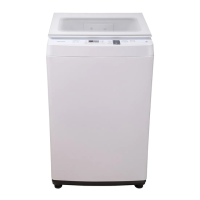
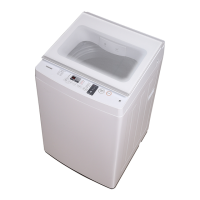
This document describes a Toshiba fully automatic washing machine, providing detailed instructions for its installation, operation, and maintenance. The manual emphasizes safety precautions throughout, using symbols and descriptive words to highlight potential hazards and important notes.
Function Description:
The Toshiba fully automatic washing machine is designed for household use, specifically for washing textiles suitable for machine washing. It offers various washing courses and options to cater to different laundry needs and user preferences. The machine is equipped with a control panel that allows users to select courses, adjust settings, and monitor the washing process.
Usage Features:
The washing machine offers a range of features to enhance the user experience and ensure effective cleaning:
- Preparation Before Washing: Before starting a wash cycle, users are instructed to ensure the unit is properly installed. For the first wash, it's recommended to run a tub clean cycle without clothes. The manual outlines a complete cycle, including plugging in the machine, opening the tap, loading and closing the lid, and adding detergent.
- Washing Process: The basic washing operation involves powering on the machine, selecting a course, and pressing the start button.
- After Washing: Once the washing is finished, the machine signals with a buzzer and automatically cuts off the power supply, indicating that the laundry can be unloaded.
- Washing Matters Needing Attention: The manual provides crucial advice for preparing laundry, such as checking clothes labels and detergent instructions, using low-density detergent, emptying pockets, tying tassels, fastening zippers, putting small clothes in a laundry net, turning clothes inside out to prevent fiber formation, and segregating clothes by texture and material. It also warns against washing a single piece of clothing to avoid unbalance and suggests adding more items for smoother spinning. Users are cautioned not to wash clothes stained with flammable materials like kerosene, gasoline, or alcohol.
- Detergent Usage: For powder detergent that may form clusters, it's recommended to dilute it with water before pouring it into the detergent box to prevent clogging and overflowing. Users should choose detergents suitable for various washing temperatures to optimize washing effect, water, and energy consumption.
- Control Panel: The control panel features buttons for On/Off, Start/Hold, Course selection, Option, and a Display. The "Fuzzy" function allows the machine to automatically select the water level based on load weight, though this function is not available if water is already in the tub or if the user manually selected the water level before pressing Start/Hold. Courses like Regular, Jeans, Memory, and Heavy Wash have the fuzzy function.
- Option Functions: The machine includes options for Water Level, Wash/Rinse/Spin settings, and Preset.
- Water Level: Allows users to select the water level based on clothing categories, degree of soiling, and washing habits.
- Wash/Rinse/Spin: Enables selection of washing time, number of rinses, spinning time, and other settings.
- Function Selection: Users can choose specific functions like Soaking, Washing, Rinsing, or Spinning.
- Preset: This feature allows users to set a delayed start time for the washing operation.
- Memory Function: In case of a power supply interruption, a special memory stores the selected program and recalls the settings when power is restored.
- GREATWAVES™ Technology: This feature is designed to shorten wash time through a special rhythm and water flow.
- Child Proof: A safety feature to prevent accidental operation by children. When activated, all buttons except On/Off are locked. If the lid is opened during operation with Child Proof on, the machine will beep, flash indicators, stop water supply and wash/spin operations, and drain water for approximately 20 seconds.
- Personalized Setting of Washing Course: Users can customize washing courses by setting washing time, number of rinses, spinning time, water volume, and course start time.
- Operations of Washing Process: The machine supports single processes or combinations of washing, rinsing, and spinning. The manual provides examples for Soak, Wash, Rinse, and Spin, detailing how to set parameters like soak time (0-60 minutes), wash time (15-20 minutes), rinse times (1-4 times), and spin times (1-9 minutes).
- Washing Course Table: The manual lists various washing courses and their descriptions:
- SPEED: Suitable for lightly-stained clothes and summer wear.
- DELICATE: Offers Mid/High/Low water level selection, soft tempo, slow washing, and spinning speed for minimal wear and deformation.
- MEMORY: Allows users to store and recall a preferred washing cycle.
- TUB CLEAN: Cleans the inner and outer surfaces of the drum and pulsator by intermittent spinning to remove dirt.
- REGULAR: Standard program for cotton fabric, involving one wash, two rinses, and a longer spin time.
- JEANS: Suitable for heavily-stained/thick clothes.
- BLANKET: Features longer wash time and stronger water action for better washing effect.
- HEAVY WASH: Also for heavily-stained/thick clothes.
- Recommended Detergent Amount: A table provides guidelines for powder and liquid detergent, as well as softener, based on rated capacity and manual water level settings.
Maintenance Features:
The manual outlines essential maintenance procedures to ensure the longevity and optimal performance of the washing machine:
- Cleaning and Care: Users are advised to unplug the machine and close the tap before any maintenance.
- Cleaning the Cabinet: The cabinet surface should be cleaned with diluted non-abrasive neutral detergents. Any water overflow should be wiped off immediately with a wet cloth. Sharp items are not allowed. Formic acid, diluted solvents, alcohol, and other chemical products are forbidden for cleaning.
- Cleaning the Inlet Filter: The inlet filter needs cleaning if water pressure from the inlet drops. This involves unscrewing the inlet pipe, pulling out the filter with pliers, cleaning it with a brush, and reinstalling it.
- Lint Filter Cleaning: The built-in lint filter collects lint during washing cycles and should be cleaned every 10 cycles. Users need to take it out, clean it with water, and place it back into the washer.
- Trouble Shooting: A comprehensive troubleshooting guide helps users identify and resolve common issues such as no washing, no water flow, abnormal draining, or abnormal spinning. It provides reasons for these problems and corresponding solutions. For persistent issues or alarm codes, users are instructed to contact the service center.

 Need help?
 General

 To Next Page