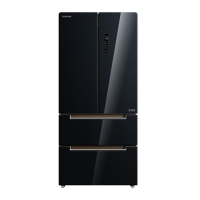
This document is an Owner's Manual for a Toshiba Refrigerator Freezer, specifically models GR-RF532WE-PGJ(22), GR-RF532WE-PMJ(02), and GR-RF532WE-PGM(22), intended for home use.
Function Description
The Toshiba Refrigerator Freezer is designed for household use, primarily for storing various foods. It features a refrigerating chamber for short-term storage of fruits, vegetables, and beverages, and a low-temperature freezing chamber for long-term storage of frozen foods and ice making. The appliance includes a "big drawer" with an adjustable temperature range for specialized storage, such as extending the freshness of ready-to-eat foods or storing fresh fish and meat that can be easily cut without manual defrosting. The refrigerator operates on an air-cooling principle and includes an automatic defrosting function.
Important Technical Specifications
- Models: GR-RF532WE-PGJ(22), GR-RF532WE-PMJ(02), GR-RF532WE-PGM(22)
- Dimensions (approximate): 830mm (width), 600mm (depth), 1400mm (height). A minimum of 30cm top clearance and 10cm rear clearance for heat dissipation is recommended.
- Refrigerating Chamber Temperature Range: 2°C to 8°C (adjustable).
- Freezing Chamber Temperature Range: -24°C to -16°C (adjustable).
- Big Drawer Temperature Range: -2°C to 3°C (adjustable).
- Refrigerant: Flammable refrigerant (specific type not mentioned, but implies R600a or similar).
- Foaming Material: Cyclopentane foaming material (flammable).
- Power Supply: Requires a dedicated power socket with a reliable grounding line. Do not use extension cords or ungrounded adapters.
- Ambient Temperature Categories:
- SN: +10°C to +32°C
- N: +16°C to +32°C
- ST: +16°C to +38°C
- T: +16°C to +43°C
- Lighting: LED lamps, replacement or maintenance to be performed by the manufacturer, service agent, or qualified person.
Usage Features
- Initial Setup: After unpacking, the refrigerator should remain still for half an hour before connecting to power. Before first use, it should run for 2-3 hours (or 4+ hours in summer) before loading food. All packing materials and protective films must be removed.
- Placement: The appliance should be placed in a well-ventilated indoor area, away from direct sunlight, heat sources, and moist environments. The ground must be flat and sturdy, with leveling feet for stability. Adequate clearance (30cm top, 10cm rear) is required for heat dissipation.
- Leveling: The refrigerator can be leveled by rotating the adjustable feet. Doors can also be leveled using fastener-rings and pliers to adjust the gap between the hinge-grommet and the lower hinge.
- Control Panel: Features a display screen and touch buttons for various functions:
- Radar Icon: Indicates radar function.
- Refrigerating Icon: Indicates refrigerating chamber status.
- Freezing Icon: Indicates freezing chamber status.
- OFF Icon: Indicates the refrigerating chamber is turned off (during Vacation mode).
- Lock/Unlock Icon: Indicates panel lock status.
- Temperature Display Area: Shows set temperatures.
- Super Cool Icon: Activates Super Cool mode (refrigerating chamber set to 2°C).
- Vacation Icon: Activates Vacation mode (freezing chamber set to -18°C, refrigerating chamber off).
- Fast Freezing Icon: Activates Super Freezing mode (freezing chamber set to -24°C).
- Operation Modes:
- Lock/Unlock: Long press the LOCK/UNLOCK button for 3 seconds to lock or unlock the control panel.
- Temperature Setting: Individual buttons allow adjustment of refrigerating chamber (2°C-8°C) and freezing chamber (-24°C to -16°C) temperatures in 1°C increments.
- Cooling Mode Setting (All Compartments): Long press the FRZ.TEMP button for 5 seconds to set the refrigerator and freezer chamber to 5°C and the big drawer to 3°C. Repeat to exit.
- Super Cool Mode: Sets the refrigerating chamber to 2°C.
- Super Freezing Mode: Sets the freezing chamber to -24°C.
- Vacation Mode: Sets the freezing chamber to -18°C and turns off the refrigerating chamber.
- Big Drawer Functions: The TEMP button adjusts the big drawer temperature between -2°C and 3°C. It also has its own lock/unlock function.
- Power Failure: In case of power failure, the appliance maintains its working state until re-electrification.
- Food Storage:
- Cooked foods should be cooled to room temperature before placing in the refrigerating chamber.
- Foods are recommended to be sealed.
- Meat chunks should be divided into small pieces for easy access.
- Avoid overloading the appliance, as this forces the compressor to run longer and can affect food quality.
- Wrap foods properly and wipe containers dry to prevent frost buildup.
- Do not line storage bins with foil or paper, as this interferes with air circulation.
- Organize and label food to reduce door openings and search times.
Maintenance Features
- Overall Cleaning:
- Regularly clean dust from behind the refrigerator and on the ground to improve cooling efficiency and energy saving.
- Clean the interior regularly with soft towels or sponges dipped in water and non-corrosive neutral detergents.
- The freezer should be cleaned with clean water and a dry cloth.
- Open the door for natural drying before turning on the power.
- Do not use hard brushes, steel balls, wire brushes, abrasives (like toothpaste), organic solvents (alcohol, acetone, banana oil), boiling water, or acidic/alkaline items, as these can damage surfaces.
- Do not rinse with water to avoid affecting electrical insulation.
- Always unplug the refrigerator before defrosting and cleaning.
- Door Tray Cleaning: Door trays can be removed by squeezing and pushing them upward. After washing, they can be reinstalled and adjusted for height.
- Big Drawer Cleaning: The big drawer can be disassembled by squeezing its front buckle to separate it from the metal rail mounting hole. Reinstallation involves inserting the back buckle into the back mounting hole, then the front buckle into the front mounting hole.
- Defrosting: The appliance has an automatic defrosting function. Any frost formed due to seasonal changes or temperature can be manually removed by unplugging the appliance and wiping with a dry towel.
- Out of Operation:
- Long-time nonuse: Unplug and clean the appliance, then leave the doors open to prevent odor.
- Moving: Remove all objects, secure glass partitions, vegetable holders, and freezer drawers with tape. Tighten leveling feet. Close and tape doors. Do not lay the appliance upside down or horizontally, or vibrate it. Inclination during movement should not exceed 45°.
- Troubleshooting: The manual provides a table of common issues (e.g., failed operation, odor, loud noise, door seal issues, water pan overflow, hot housing, surface condensation, abnormal noise) and possible causes/inspection items to help users resolve minor problems before contacting after-sales service.
- Fault Indication: The display shows error codes (E1, E2, E3, E4, E5, E6, E7, EH) for various sensor and circuit failures. While the refrigerator may still function, a maintenance specialist should be contacted for optimal operation.
- Disposal: The product should not be disposed of with general household waste. It contains flammable refrigerant and foaming material and must be recycled responsibly through designated collection systems or the retailer to prevent environmental harm. Before scrapping, doors, door gaskets, and shelves should be removed to prevent child entrapment.

 Need help?
 General



 To Next Page