
 Need help?
Do you have a question about the Total TSTLI20018 and is the answer not in the manual?
Guidelines for safe operation in the work environment, including user condition and attention.
Defines the tool's designed purpose and specifies what uses are prohibited to prevent injury.
Details essential protective gear required for safe operation, including clothing, gloves, and footwear.
Critical safety guidelines for handling electrical components and the battery to prevent hazards.
Essential checks and setup procedures to ensure the tool is safe and ready for initial use.
Outlines correct techniques and precautions for operating the tool safely and effectively.
Covers regular maintenance tasks and checks to ensure the tool's longevity and safe performance.
Alerts users to health risks from dust and chemicals, providing mitigation advice.
Explains the meaning of various symbols used in the manual for user safety and tool identification.
Critical safety instructions for handling, charging, and storing the battery cartridge to prevent accidents.
Provides actionable advice to maximize the lifespan and performance of the battery.
Compiles essential safety rules and precautions for correct and safe tool operation.
Lists key technical data including no-load speeds, cutting diameters, and voltage.
Warns about potential vibration effects and factors influencing emission values during tool use.
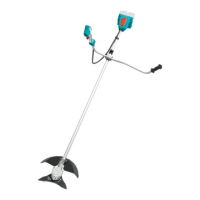
Provides an overview of the tool and identifies its main parts using an illustration.
Guides through the process of mounting the tool and correctly installing or removing the battery.
Explains how to check the remaining charge level of the battery using its indicator lights.
Emphasizes using the correct cutting tool and guard combination for safety and optimal tool balance.
Provides step-by-step instructions on how to properly attach the safety guard to the tool.
Details the necessary steps to safely start and prepare the tool for operation.
Instructs on how to wear and adjust the shoulder harness for optimal user comfort and control.
Offers guidance on proper tool positioning and handling for maximum control and reduced risk of injury.
Explains the functionality and operation of the nylon cutting head, including bump feed mechanism.
Provides tips for achieving effective cutting performance and ensuring proper nylon cord feeding.
Outlines essential steps for cleaning and maintaining the tool to ensure proper function and longevity.
Details the correct procedure for replacing the nylon cord, including safety precautions.
Provides guidelines for environmentally responsible disposal and recycling of the tool and its parts.
Illustrates the tool's components in an exploded view with corresponding part numbers for identification.
This document describes the TOTAL Battery Brush Cutter, model TSTLI20018, a cordless tool designed for cutting grass and light weeds. It operates on a 20V battery system.
The cordless brush cutter is specifically designed for cutting grass and light weeds. It is not intended for other purposes such as trimming borders or hedges, as this may cause injury. The tool features a nylon cutting head (bump and go type) with a double line trimmer head. When using the nylon head, the line is removed by tapping the trimmer head against the ground while turning.
Safety First: The manual emphasizes reading all safety warnings and instructions before use to prevent battery discharge, fire, or serious injury. Users should be familiar with the instructions and wear appropriate personal protective equipment, including a helmet (if there's a risk of falling objects), safety glasses/helmet visor, ear protection (muffs, ear plugs), thick protective gloves, sturdy shoes with non-slip soles, and a protective hair cover for long hair. A dust mask is recommended if the job creates dust.
Work Area Safety: The tool should not be used by children or untrained users. The work area must be clear of other people and animals within a 15-meter (50 feet) radius. Users should maintain posture and balance, avoid overdoing it, and keep fingers away from the switch trigger when the tool is not in use or being moved.
Electrical and Battery Safety: The tool should not be used in damp or wet locations or exposed to rain. The battery pack must be disconnected before making adjustments, changing accessories, or storing the machine. Only specifically designated battery packs and chargers should be used. Battery packs should be kept away from other metal objects when not in use to prevent short circuits. Damaged or modified batteries should not be used. Batteries should not be exposed to fire or temperatures above 130°C (265°F). Charging should occur within the specified temperature range (10°C to 40°C / 50°F to 104°F). Batteries should not be opened, cut, or incinerated.
Commissioning and Operation: Before use, the tool's safety must be checked, including the nylon cutting head, guard, and switch trigger. Damaged parts must be repaired or replaced by an official Total dealer. The motor should only be started when hands and feet are clear of the nylon cutting head, and the head is not in contact with hard objects. Any adjusting wrench or blade cover must be removed before turning on the power tool. Users must ensure no electrical wires, water pipes, or gas pipes are in the work area.
Battery Installation/Removal: To remove the battery cartridge, slide it out while pressing the button on the front. To install, align the tab on the battery cartridge with the slot on the casing and slide it in until it clicks and the red indicator is no longer visible. The battery should not be forced.
Cutting Tool and Guard Installation: The guard must be attached to the bracket with screws. The nylon cutting head is installed by inserting a hex key through the hole in the tool head to lock the shaft, rotating the shaft until the hex key is fully inserted, placing the nylon cutting head on the spindle, tightening it firmly by hand, and then removing the hex key. Only original Total nylon trimmer heads should be used.
Shoulder Harness: The shoulder harness must always be used and adjusted to the user's size to avoid fatigue. It should be properly attached to the tool hanger. The harness features a quick-release buckle.
Handling: The tool should always be placed to the user's right for maximum control. Operators must maintain control at all times. When multiple operators are working, a distance of more than 15 m (50 ft) must be maintained, and an observer should be present. The tool must be stopped immediately if someone or an animal enters the work area or if the cutting tool hits a hard object.
Cutting Technique: The tool should only be used in good light and visibility. Caution is advised in slippery or wet areas, ice, and snow. Users should not cut above waist height, climb ladders or trees, or work on unstable surfaces. Sand, stones, nails, and other foreign particles must be removed from the work area. If the nylon trimmer head hits hard objects, the engine should be turned off immediately, and the head inspected. The nylon cutting head must reach maximum working speed before starting to cut.
Regular Checks: The condition of the nylon cutting head and protection devices must be checked before starting work. Loose fasteners or damaged parts (e.g., cracks in the trimmer head) should be inspected.
Cleaning and Storage: The tool must be turned off, and the battery cartridge removed before any inspection, maintenance, or cleaning. Gasoline, thinner, alcohol, or similar substances should not be used for cleaning. The handlebar should be kept dry, clean, and free of oil and grease. When not in use, the equipment should be stored in a dry, indoor, locked location out of reach of children.
Replacement Parts: Only replacement parts and accessories recommended by the manufacturer should be used. Repairs and adjustments must be carried out by an official Total dealer.
Nylon Cord Replacement: Only nylon cord with the specified diameter should be used. Thicker line, metal wire, or string should never be used. The nylon cutting head must be removed from the tool when replacing the cord. The trimmer head cover must be securely fastened to the housing. The nylon cord should be replaced if it no longer feeds.
Battery Maintenance: The battery cartridge should be charged before it is fully discharged. Overcharging should be avoided as it shortens battery life. A hot battery cartridge should be allowed to cool before charging. If not used for a long time (approx. more than six months), the battery cartridge should be charged.
Environmental Considerations: Electrical appliances should not be disposed of as unsorted municipal waste. Separate collection facilities should be used. Raw materials should be recycled. The machine, accessories, and packaging must be sorted for environmentally friendly recycling. Plastic components are labeled for categorized recycling.
 General
| Brand | Total |
|---|---|
| Model | TSTLI20018 |
| Category | Brush Cutter |
| Language | English |

 To Next Page