7
Before First Use:
Read all instructions and safety information carefully before first use. Please retain this
information for future reference. If the appliance is given to someone else, it should always
be accompanied by these operating instructions. As they form an integral part of the
appliance.
1. Remove your appliance from the packaging.
2. Check that there is no damage to the cord or any visible damage to the body.
3. Check that all listed parts are present.
4. Dispose of the packaging in a responsible manner.
5. Remove any stickers or labels from the appliance. DO NOT remove the rating plate or
any warnings.
6. The device should be used for the first time without any food in it as it may produce
some smoke or odours due to coating residues. Allow the device to heat up on the
highest temperature setting for approx. 15 minutes without any food in it (see the
Using your Appliance section).
7. Thoroughly clean the fryer following the Cleaning and Care Section with hot water,
some washing-up liquid and a non-abrasive sponge and rinse thoroughly.
8. Wipe the inside and outside of the appliance with a damp cloth.
9. DO NOT fill the fryer with oil or frying fat. This fryer operates using hot air and
requires very little to no oil.
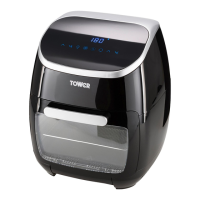
10. Familiarise yourself with the control panel.
Using Your Appliance.
Oil Drip Tray:
Insert the fat collecting tray into the bottom of the cooking space so that any dripping fat,
crumbs or other food residues can be collected in it.
Air Flow Racks:
1. The air flow racks are intended for drying. However, they can also be used for crisping,
warming up etc.
2. Slide the air flow racks onto the rails in the cooking space. The heating element is
located at the top of the cooking space. Therefore the higher up a air flow rack is
placed, the more intense the heat is from above.
3. In the top section, the food is cooked faster and crispier. The middle position should
be chosen to achieve even heating from all sides. The bottom rails are suitable for
gentle cooking.
Rotisserie:
The rotisserie consists of the shaft and two rotisserie forks. The rotisserie is suitable for
grilling large pieces of meat, e.g. chicken, pork.
Assemble the rotisserie and insert it into the appliance:
1. Slide one of the rotisserie forks onto the shaft and lock it with the locking screw. The
shaft contains a small round notch for the tip of the locking screw. In the case of
smaller pieces of food, the rotisserie forks can be secured more centrally on the shaft
(see Illustration A).
2. Slide the food for grilling onto the rotisserie fork.
3. Slide the other rotisserie fork onto the shaft and food and lock it with the locking
screw.
4. Plug one end of the shaft into the round holder on the left-hand side of the cooking
space. Then hang the other end of the shaft into the support on the right-hand side
of the cooking space.
5. Check that it fits securely. The rotisserie must not be able to rotate about its own axis
when the device is switched off. If this is not the case, plug the left-hand end of the
shaft deeper into the holder.
6. After use, remove the hot rotisserie from the cooking space using the removal tool
(see the ‘Removal Tool’ section). Always use oven gloves to remove the rotisserie forks
and take off the grilled items.
Note: The shaft contains two small round notches marking the outermost position of the
locking screws. These must not be attached any further than the outer ends of the shaft to
ensure smooth operation.
DO NOT place any pieces of meat that are too large onto the rotisserie as this could hinder
rotation.


 To Next Page
 Loading...