The most common mistake when learning to fly is "over control."
Think of
pressure
instead of large movements of the control
sticks. Remember all Tower Trainer 40's will recover from almost
any over control situation within 50 - 100 feet if you simply let
go of the sticks.
Add and practice one maneuver at a time, learning how your
Tower Trainer 40 behaves in each one.
After you have several flights on your Tower Trainer 40, it’s time
to reward yourself with your first aerobatic maneuver – a loop.
Climb to a safe altitude and turn into the wind. Apply full
throttle, level the wings, then slowly pull back on the elevator
stick to about 1/2 to 3/4 up elevator (depending on your throws),
and hold this control input. After you
go over the top
and start
down the back side of the loop, pull the throttle back to about
half. This will keep the stresses on the airplane low and the
airspeed relatively constant. Keep holding "up" elevator until the
plane is level, then slowly release the sticks. You're done! It's
really that easy!
CAUTION (THIS APPLIES TO ALL R/C AIRPLANES): If, while
flying, you notice any unusual sounds, such as a low-pitched
"buzz", this may indicate control surface "flutter". Because
flutter can quickly destroy components of your airplane, any
time you detect flutter you must immediately cut the throttle
and land the airplane! Check all servo grommets for
deterioration (this will indicate which surface fluttered), and
make sure all pushrod linkages are slop-free. If it fluttered
once, it will probably flutter again under similar circumstances
unless you can eliminate the slop or flexing in the linkages.
Here are some things which can result in flutter: Excessive
hinge gap; Not mounting control horns solidly; Sloppy fit of
clevis pin in horn; Elasticity present in flexible plastic
pushrods; Side-play of pushrod in guide tube caused by tight
bends; Sloppy fit of Z-bend in servo arm; Insufficient glue used
when gluing in the elevator joiner wire or aileron torque rod;
Excessive flexing of aileron, caused by using too soft balsa
aileron; Excessive "play" or "backlash" in servo gears; and
insecure servo mounting.
57
LANDING
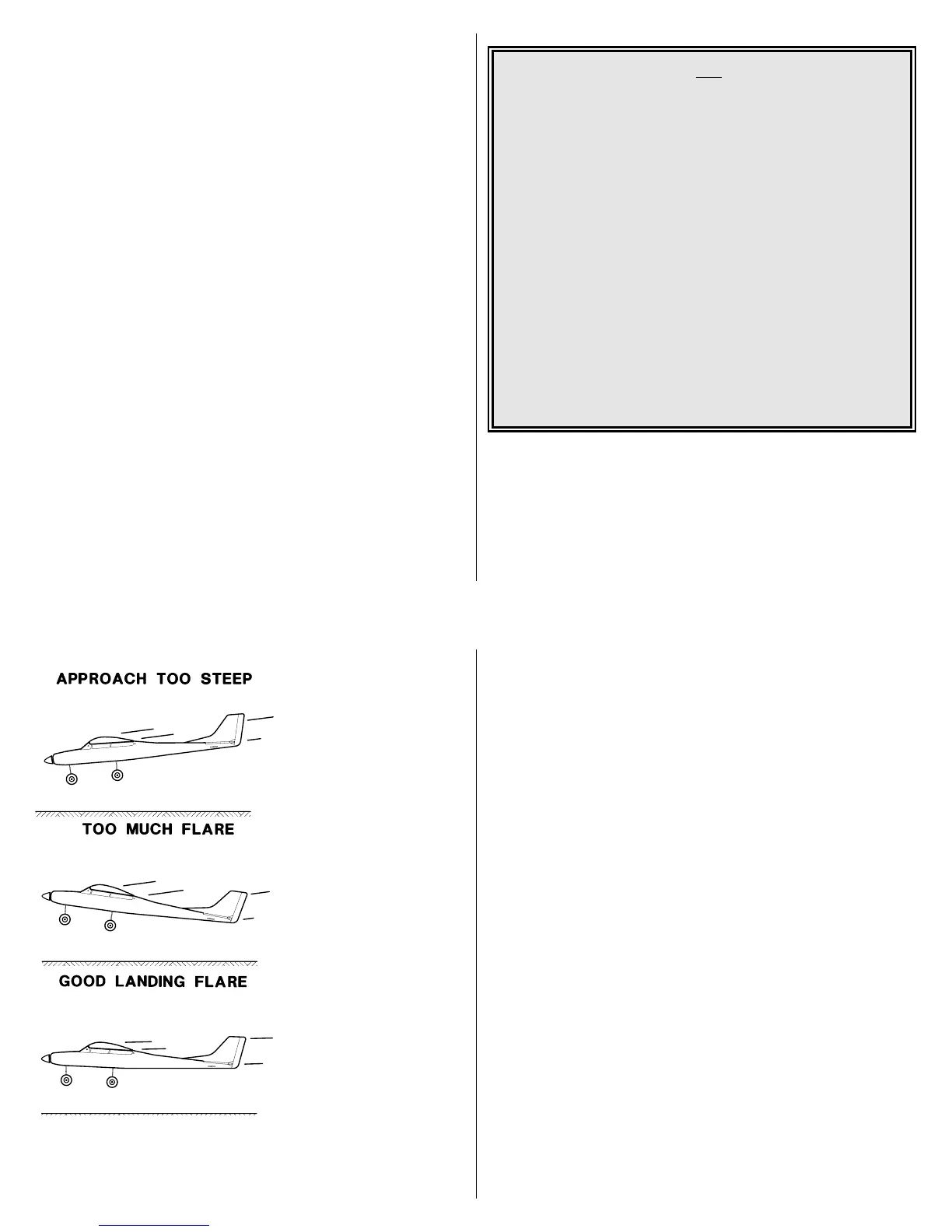
When it's time to land, fly a normal landing pattern and
approach as follows: Reduce the power to about 1/4 and fly a
downwind leg far enough out from the runway to allow you to
make a gentle 180 degree turn. As you make the turn into the
wind for your final approach, pull the throttle back to idle. The
Tower Trainer 40 has a lot of lift so you will need a slow, reliable
idle in order to achieve a nice, slow landing. Allow the plane to
keep descending on a gradual
glide slope
until you are about 3
feet off the runway. Gradually apply a little up elevator to
flare
for landing. You should apply just enough up elevator to hold the
plane just off the runway while the excess speed bleeds off. The
Tower Trainer 40 should settle onto the runway for a slow,
slightly nose-high landing.
Good luck and have fun flying your Tower Trainer 40, but always
stay in control and fly in a safe manner.
Hold this angle
until touchdown.
Danger of stalling!
Release elevator.
Apply up elevator.
58


 To Next Page