11
can be deleted immediately. The nal reading derives from the statistical calculation and from
the guaranteed tolerance levels of the instrument. T (coating thickness) = M (mean value) ± S
(standard deviation) ± A (measuring accuracy)
5.2 Factors aecting accuracy
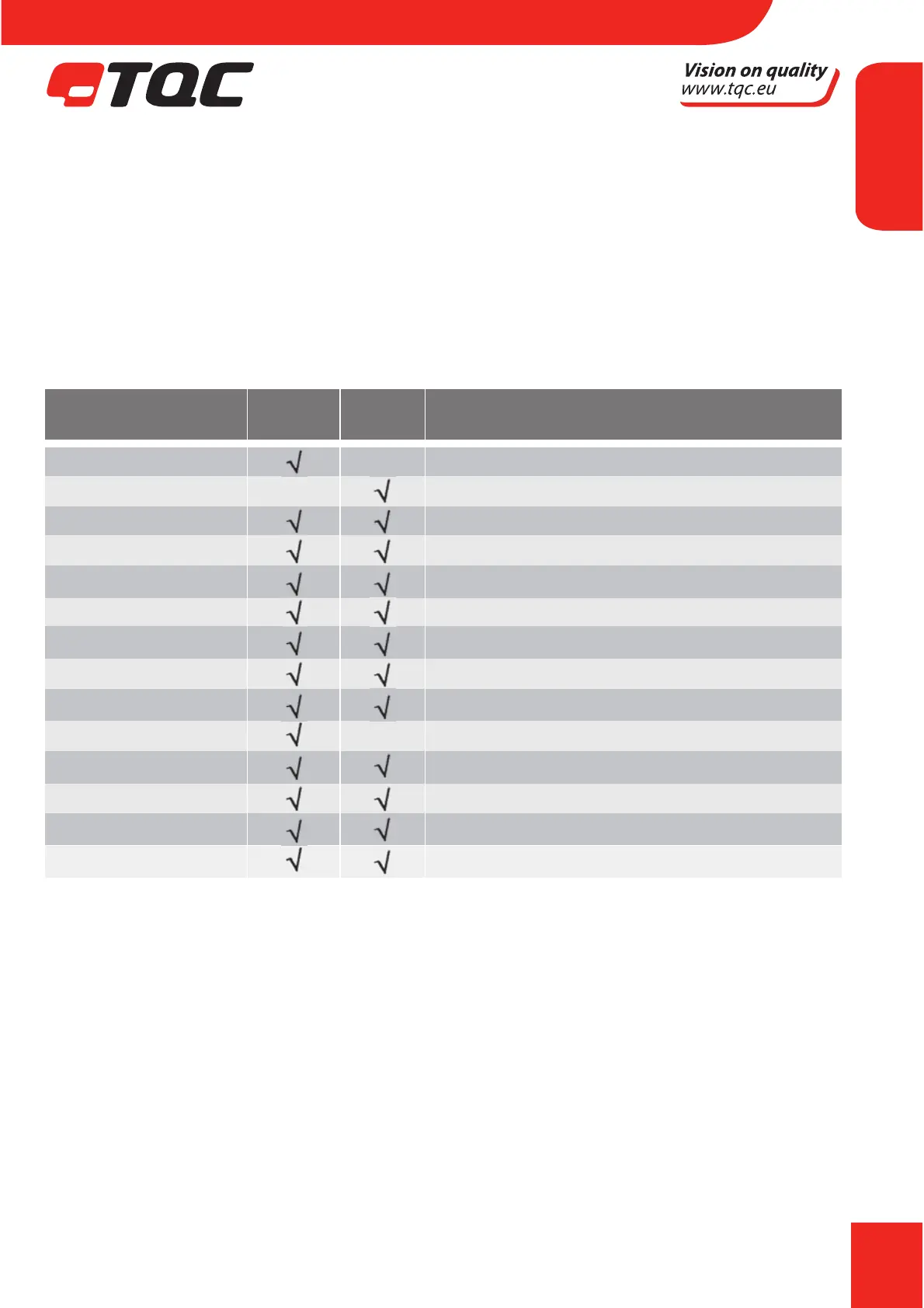
There are some factors which might aect the measurement’s accuracy. These factors are listed
as below;
Factor/principal Magnetic Eddy Recommendations
current
Magnetic samples Calibration needed
Electrical samples Calibration needed
Curvature radius Please read paragraph 1.1 + calibration needed
Substrate thickness Please read paragraph 1.1 + calibration needed
Size of measuring area Please read paragraph 1.1 + calibration needed
Surface roughness
Position and shape
Sample deformation Avoid measuring on too soft or too thin materials
Adhesive substances Clean probe and sample
Strong magnetic elds Keep away from strong magnetic elds
Temperature & Humidity Re-calibrate at the same environment conditions
Measuring operations Please read paragraph 5.1.2.
Low batteries Please replace the batteries
Probe wear Please contact supplier
The measured sample must have the same conditions as the calibration sample (material proper-
ties, curvature radius) The more closely the measured sample matches the calibration sample, the
more accurate the readings will be. In addition, curvature radius should meet the minimum value
as specied in paragraph 1.2.
The minimum substrate thickness and the minimum measuring area as specied in chapter 1.2
should be taken into account. The instrument needs to be re-calibrated (Zero/Multi-point) if
measuring various samples for higher accuracy.
To achieve high-accuracy readings, it is advisable to log calibration values several times. In this
way, the instrument will automatically establish a mean calibration value. The high-accuracy
calibration is an obvious advantage when calibrating uneven and rough surfaces.
EN


 To Next Page