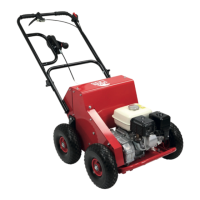
The CAMON LA25 Lawn Aerator is a robust piece of landscape machinery designed by Tracmaster for effectively aerating grass lawns and other grassed areas. Its primary function is to improve lawn health by allowing air, water, and nutrients to reach the grass roots, thereby relieving soil compaction and removing unwanted sub-surface thatch. The machine is specifically engineered for use on grassed areas where the surface soil depth exceeds 10cm, a crucial point that operators must verify with a garden fork prior to use to prevent damage to the tines or corers.
Usage Features:
The LA25 Lawn Aerator is powered by a Honda GX160 four-stroke engine, which runs on standard unleaded fuel. The engine is air-cooled, emphasizing the importance of keeping the recoil rope grille clear of debris to maintain performance. A fuel on/off lever and a choke lever are integrated into the engine for operational control, and operators should consult the engine's specific instructions for their proper use.
Starting the engine involves a few key steps: first, checking the engine oil level with the provided dipstick and topping up with SAE 10W/30 oil (API SJ or later) if necessary. Next, the fuel level must be checked and refilled with unleaded petrol, ensuring a one-inch space in the tank during refilling and immediately cleaning any spills. The engine ignition switch is then turned to the "ON" position, and the fuel tap lever on the carburetor is also set to "ON." If the engine is cold, the choke lever should be set to "ON." To start, the recoil handle is pulled slowly until it engages, then pulled hard and fast. Once the engine starts, the cord should be guided back, and if the choke was used, it should be returned to the "OFF" position after a few seconds.
The machine's tines are engaged via a two-stage operating lever located underneath the top handlebar. A grey button must be depressed before the main lever can be pulled up to engage the drive. This mechanism transfers engine power through a gearbox to rotating tine rods, which push the tines into the ground and withdraw them as they rotate.
Height adjustment, which dictates the depth of tine penetration, is achieved by altering the position of the back axles. Each back axle has three holes, allowing for attachment to the main chassis frame. Moving from the lowest to the highest hole decreases the depth of penetration by 10mm at each step. The LA25 is supplied with both 10mm solid spikes and hollow corer tines. It is critical to use a consistent tine type during setup and operation. Solid tines aid nutrient delivery and drainage, while hollow tines further reduce surface compaction by removing soil sections. Four tines of the same type must always be fitted, threaded, and secured tightly into the tine holder rods with a washer and spring washer, tightened with a 17mm spanner.
For optimal operation, the grass must be cut short and cleared of any objects like stones or sticks that could damage the aerator. Operating on long grass will quickly cause damage. The machine should not be used on wet lawns or in wet weather, and hollow tines are specifically recommended for moist ground conditions. Hardcore or rubble beneath the turf can also cause damage. Once safety checks are complete, the throttle lever is positioned midway, and the operating lever is lifted to engage the drive and start the tines rotating in their lifted position. The tine control lever is then used to lower the tine lifting board, allowing the tines to penetrate the ground. During operation, a small pulling pressure on the handlebar ensures the tines and rods remain vertical for maximum aerating depth and efficient propulsion. The aerator should not be operated on slopes greater than 20 degrees and should always be worked across the slope, not up and down.
To stop the engine, the operating lever is released, the engine ON/OFF switch is set to "O" (OFF), and the fuel tap lever is turned to "OFF." The tines must have stopped before moving the machine. In case of an unexpected shut down, the operating lever is released, and the engine operating switch on the handlebars is turned to "OFF."
Maintenance Features:
Regular maintenance is crucial for the longevity and safe operation of the CAMON LA25. Before any maintenance, the engine must be off and the fuel tap closed. A schedule outlines daily, weekly, and monthly checks.
Daily checks include verifying the engine oil level (SAE 10W/30 API SJ or later) and inspecting the condition of the tines. Weekly checks involve consulting the separate engine manual, inspecting tine rod condition, and checking the operating lever and cable. Monthly checks expand to include belt condition, protection cover condition, bearings, lubrication of wheel bearings, and tightening all nuts and bolts.
Basic maintenance involves ensuring all guards are securely fitted, the cable connecting the operating lever to the engine is fastened at both ends and shows no wear, and pneumatic tyre pressure is correct with no significant wear. Wheels must be held securely by their fixed pins.
Engine maintenance includes checking the oil level before each use and every 8 hours of operation, only when the engine is off and horizontal. The oil filler plug and surrounding area should be cleaned, the dipstick wiped clean, and the oil level checked. Refill if needed with SAE 10W/30 API SJ or equivalent. Engine oil changes are recommended after the first 50 hours of work, and subsequently every 100 hours, or every 50 hours in extreme conditions. The oil should be drained when the engine is cool, disposed of properly, and refilled with fresh oil using a funnel.
The air filter elements should be inspected by removing the air cleaner cover. Cleaning involves removing the wing nut from the cover, then removing the wing nut from the air filter itself, and separating the foam filter from the paper filter. Both elements should be inspected for damage and replaced if necessary, with the paper filter replaced at scheduled intervals. The spark plug should be cleaned and replaced as needed.
Cleaning the machine, especially after using a pressure washer, requires re-lubricating all lubrication points. The engine should only be cleaned with a cloth, avoiding water jets to prevent leaks into the fuel and ignition systems.
Troubleshooting guidance is provided for common issues. If there's no drive to the blades, a broken belt is a possible cause, requiring belt replacement. Poor depth and propulsion often indicate the operator is pushing the machine, and the remedy is to pull back on the handlebar to ensure tines are vertical. Engine issues like not starting could be due to a disconnected spark plug connector (remedy: connect it), an unactuated choke lever (remedy: actuate it), an empty fuel tank (remedy: fill it), a clogged fuel line (remedy: clean it), or a defective spark plug (remedy: clean or replace it). An engine with too much fuel requires drying and adjusting the spark plug, then starting on full throttle. Engine overheating can be caused by low engine oil (remedy: refill immediately), impaired cooling (remedy: clean cooling fan grille), or a clogged air filter (remedy: clean air filter).
For lubrication, SAE 10W/30 API SJ or equivalent engine oil is specified for the engine. For roller bearings in the wheels, bio-lubricating grease is recommended.
Transportation, Storage, and Handling:
When transporting the aerator, ramps should be used to maneuver it onto a vehicle. It must be securely fixed with straps and chocks behind the wheels, always transported horizontally, not tilted. The engine's fuel control lever must be in the "OFF" position to prevent fuel leakage into the carburetor.
For storage, the engine must be allowed to cool down. The machine should be thoroughly cleaned and dried, and all lubrication points re-greased. For long storage periods, the engine oil should be changed, and the fuel either drained completely or filled with fuel stabilizer. The aerator should not be stored in wet rooms, near fertilizer, or in stables, as heavy corrosion may occur. It must always be stored horizontally.
Handling the LA25 requires at least two people for lifting due to its weight. Gloves must be worn. The machine should not be tilted in a way that allows fuel to leak into the engine's air filter. When performing maintenance on a workbench, the machine must be firmly held in position. Crucially, the machine should never be lifted solely by the engine.
Safety Features:
The manual emphasizes reading and understanding all operating, warning, and safety instructions before commissioning the machine. Operators must be aware of all safety requirements and visually check the machine for operational safety, complete components, and fixed guarding before each use. The work area should be cordoned off from the public, and any objects that could damage the machine cleared. Operation is strictly prohibited under the influence of alcohol or drugs, and only medically fit individuals should operate it. Work must be performed in good light and visibility, wearing correct personal protection equipment (PPE) including ear defenders, eye protection, protective footwear, and safety gloves. Loose clothing and poor-grip footwear are to be avoided. Operators must know how to stop the machine in an emergency.
Engine-specific safety instructions highlight that petrol is highly flammable. The engine must always be stopped, and the fuel tap turned off before refueling, transporting, cleaning, or making adjustments. Smoking and naked flames are forbidden during refueling. Only unleaded petrol from designated containers should be used, refilling outdoors with the cap securely replaced. Starting the engine in open air is essential to avoid inhaling toxic substances. Contact with the hot engine during operation should be avoided, and it must cool before contact or storage. Control settings of the engine should never be interfered with.
Machine safety stickers provide critical warnings: "Danger - moving blades. Keep hands and feet away." Other stickers instruct to "Read operating instructions before use," "Remove spark plug before servicing or performing maintenance," and "Warning: Keep bystanders away." The maximum sound power level (LWA) is 104 dB, requiring ear protection. A "WARNING: DO NOT OPERATE WITH GUARD REMOVED" sticker underscores the necessity of safety guards. A specific instruction for the tine board lever states: "Pull up ring 1 before moving tine board lever 2," emphasizing that the ring MUST be lifted before moving the lever, and forcing the lever without lifting the ring first is prohibited. The exhaust cover can become hot and should not be touched. A warning also states that aerating long grass will quickly damage components, recommending grass is cut prior to aerating.


 To Next Page
 General