EasyManua.ls Logo

TRAMPA VESC STR 500 - User Manual

TRAMPA VESC STR 500
14 pages
Print Icon
To Next Page IconTo Next Page
Loading...
1 Feature overview
Voltage: 24V 92V (Safe for 6S to 22S LiPo).
Optimal performance at 20S LiIon
Voltage spikes may not exceed 100V
Current: Continuous 500A, peak 680A. Values
depend on the temperature, switching frequency and
cooling of the device!
1x 5V 0,5A output for external electronics
1x switchable 5V 3A output for external electronics
5x switchable and variable 6-24V (15A combined)
1x static output, variable 6-24V
3.3V 0,5A output for external electronics
9 axis IMU
Modes: DC, BLDC, FOC (sinusoidal)
Supported sensors: ABI, HALL, AS5047, SIN/COS
and other encoders
STR-500 Vehicle Controller
2 Applications
Controller for light electric vehicles
Non street legal if not homologated
For integration into VESC ecosystem
3 Description
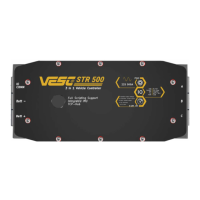
The VESC STR 500 is a versatile three-in-one vehicle controller
designed primarily for use in light electric vehicles such as
electric motorbikes, boats, karts, and similar applications. It
incorporates a microprocessor-controlled DC-DC converter to
generate auxiliary power for the vehicle's electronics.
Apart from the DC-DC converter, the STR 500 is equipped with
IO functionality for controlling inputs and outputs. This feature
enables direct control of various vehicle-mounted equipment,
including lights, blinkers, a horn, and more. Additionally, the
STR 500 includes a logging module for continuous recording
onto a Micro SD-Card and supports GPS antenna connectivity.
For accessibility, the device offers wireless connections through
BLE and WiFi. The STR 500 is supported by the VESC-Tool,
compatible with Linux, Windows, iOS, MacOS, and Android. Its
features encompass a broad range of adjustments for controller
setup and operation, along with real-time monitoring and
logging capabilities on a computer or directly onto the STR 500
itself.
Page 1 Rev. 1.1
Page 1
4 Typical installation
The typical installation is shown in the diagram below.
It is necessary to use appropriate fuses on the battery
connection, matching the current flow in the system.
The battery needs to be managed by a suitable battery
management system (BMS). The BMS should control a
contactor on the positive discharge wire.

Question and Answer IconNeed help?

Do you have a question about the TRAMPA VESC STR 500 and is the answer not in the manual?

Overview

The STR-500 Vehicle Controller is a versatile, three-in-one vehicle controller designed primarily for use in light electric vehicles such as electric motorbikes, boats, karts, and similar applications. It incorporates a microprocessor-controlled DC-DC converter to generate auxiliary power for the vehicle's electronics.

Function Description:

The STR-500 is designed to handle direct control of various vehicle-mounted equipment, including lights, blinkers, a horn, and more. It offers additional logging modules for continuous recording onto a Micro SD-Card and supports GPS antenna connectivity. The device is compatible with Linux, Windows, iOS, macOS, and Android operating systems, providing a broad range of adjustment, controller setup, and operation. It allows for real-time monitoring and logging capabilities, which can be accessed directly on the STR-500 itself or via a computer.

Important Technical Specifications:

  • Voltage: 24V – 92V (Safe for 6S to 22S LiPo). Optimal performance at 20S LiPo.
  • Voltage Spikes: May not exceed 100V.
  • Current: Continuous 500A, peak 680A. Values depend on temperature, switching frequency, and cooling of the device.
  • Outputs:
    • 1x 5V 0.5A output for external electronics.
    • 1x switchable 5V 3A output for external electronics.
    • 1x switchable 5V 3A output for external electronics (combined).
    • 1x static output, variable 6-24V.
    • 3x switchable output, variable 6-24V (15A combined).
    • 1x static output, variable 6-24V.
    • 3x 3.3V 0.5A output for external electronics.
  • IMU: 9-axis IMU.
  • Motor/Encoder Support: ABI, HALL, AS5047P, SIN/COS, and many other encoders (Full list available in VESC-Tool).
  • Supported Batteries: Lead Acid, LiIon, LiPo, and LiFePo4.
  • Dimensions (Box Outer):
    • STR-500 Box Length: 236mm
    • STR-500 Box Width: 108mm
    • STR-500 Box Height: 67mm
    • STR-500 Weight: 1500g
  • Dimensions (Box Outer with Heat Sink):
    • STR-500 Box Length: 267mm
    • STR-500 Box Width: 122mm
    • STR-500 Box Height: 75mm
    • Weight: 2190g
    • Weight: 1,641g (likely a typo, should be 1641g)

Usage Features:

  • Controller for Light Electric Vehicles: Specifically designed for light electric vehicles, ensuring optimal performance and safety.
  • Not for Integration into VESC Ecosystem: This device is designed to operate independently and is not intended to be integrated into a larger VESC ecosystem.
  • Accurate Current and Voltage Measurement: All phases are precisely measured.
  • Adjustable Current and Voltage Sensors: Allows for fine-tuning of motor and battery parameters.
  • Works Reliably with BLDC and PMSM Motors: Compatible with various motor types, including BLDC and PMSM motors, and their inductance sensors.
  • Regenerative Braking: Supports regenerative braking for increased efficiency and energy recovery.
  • Sensored or Sensorless Operation: Can operate with or without motor sensors, offering flexibility in motor setup.
  • Configurable Power, Current, Voltage, and Power Limits: Users can set specific limits for various power parameters.
  • Input Source: Supports PPM, Analogue, NRF (BLE 4.1), and other communication protocols.
  • Communication Ports: USB, CAN, UART, I2C, SPI for versatile connectivity.
  • Throttle Curve and Ramping: Allows for custom throttle response and smooth acceleration/deceleration.
  • Seamless 4-Quadrant Operation: Enables full control in all four quadrants of motor operation.
  • Motor Revolution, Amp Hour, Watt Hour Counting: Tracks motor usage and energy consumption.
  • Transmission and Wheel Diameter Configurable: Allows for accurate calculation of speed and consumption.
  • BLE Wireless Connection (if activated): Enables wireless connectivity for monitoring and control.
  • Real-time Data Analysis: Provides immediate feedback on performance.
  • Scripting Interface: Offers advanced functionality through scripting.
  • Data Storage: Supports SD card for logging.
  • GPS Antenna Connectivity: Allows for location tracking and data logging.
  • Modes: Supports Current Control, PID Speed Control, Position Control, Cruise Control, and Self Balancing (Monowheel, Onewheeled, Gimbals).
  • High Regenerative Braking Current: Separate limits for motor and power input.
  • High RPM: Separate limits for each direction.
  • Over Temperature (MOSFET and Motor): Protection against overheating.
  • Over Temperature for the Battery: Battery temperature monitoring.
  • Over Current and Short Circuit: Protection for auxiliary output (6-24V).
  • IO-Board Connections: The device features a dedicated IO-Board with various connections for sensors, PWM, CAN, and switchable outputs.
  • Hibernation Switch: A momentary (Normally Closed) switch can wake the device from hibernation.
  • Fault Codes: LED light codes indicate various fault conditions (Blue: powered up, Green Dim: SW running, Green Bright: driving motor, Red: fault code).

Maintenance Features:

  • Firmware Updates: USB ports allow for configuration, firmware updates, and real-time data analysis.
  • Software (Beta Tool): The STR-500 requires the BETA FIRMWARE until VESC-Tool 6.05 is released. The beta version of VESC-Tool is used for configuration.
  • File Downloads: Beta firmware and software are available as .rar files, requiring unpacking with tools like Winrar or Winzip.
  • Regular Updates: Beta versions of VESC-Tool are updated weekly, so users should keep up to date.
  • Motor Tuning: The VESC-Tool allows for detailed motor tuning, including adjusting resistance, inductance, and time constants, to optimize performance for specific motors (e.g., Talaria® SUR-RON®).
  • Increased Current Settings: Users can adjust motor current limits (e.g., Motor Current Max, Battery Current Max) to match application requirements, with warnings about potential overcurrent faults if settings are too high.
  • DC-DC Programming: The 15A DC-DC converter can be configured via CANBUS and the VESC-Tool, allowing users to set the output voltage.
  • Troubleshooting: Fault codes can be read out in VESC-Tool by typing "faults" into the Terminal, helping diagnose issues like ABS overcurrent. Faults are erased after de-powering the VESC controller.

Safety Warnings:

  • Read the entire instruction manual before operating to prevent damage or injury.
  • Operate with caution, common sense, and in accordance with regulations.
  • Requires special mechanical and electrical ability and training.
  • Not for use by children (under 18 years).
  • Do not disassemble, use incompatible components, or augment without manufacturer approval.
  • Not for safety-critical applications (vehicles, aircrafts, medical, nuclear, military).
  • Battery cells must not be overcharged or operated below their lowest specified discharge voltage to avoid fire/explosion risks.
  • Protection circuits (contactor, fuse, BMS) must be installed between the battery and the controller.
  • Pre-charge switch is required for battery connections to prevent initial current surges.
  • Disconnect the STR-500 from the battery during vehicle storage/parking.
  • Monitor the charging process at all times; do not charge hot batteries.
  • Use appropriate wire gauge for motor and battery cables.
  • Ensure proper cable entry grommets for IP67 sealing.
  • Cable routing and insulation must prevent short circuits.
  • Do not use flammable materials in assembly.
  • Ensure adequate heat dissipation and limit direct water spray.
  • Lilon, LiPo, and LiFePo4 batteries are dangerous; handle with care. Refer to specific battery care manuals.

TRAMPA VESC STR 500 Specifications

General IconGeneral
BrandTRAMPA
ModelVESC STR 500
CategoryController
LanguageEnglish