EasyManua.ls Logo

TRIGA TR-PHOTO-T-W - User Manual

TRIGA TR-PHOTO-T-W
2 pages
Print Icon
To Next Page IconTo Next Page
Loading...
refer to NFPA 72 or the System Smoke Detector Application Guide, available
from System Sensor.
WIRING GUIDE
All wiring must be installed in compliance with the National Electrical Code,
applicable local codes, and any special requirements of the Authority Having
Jurisdiction. Proper wire gauges should be used. The installation wires should
be color-coded to limit wiring mistakes and ease system troubleshooting. Im-
proper connections will prevent a system from responding properly in the
event of a fire.
Remove power from the communication line before installing sensors.
1. Wire the sensor base (supplied separately) per the wiring diagram, Figure 2.
2. Set the desired address on the sensor address switches, see Figure 1.
3. Install the sensor into the sensor base. Push the sensor into the base while
turning it clockwise to secure it in place.
4. After all sensors have been installed, apply power to the control panel and
activate the communication line.
5. Test the sensor(s) as described in the TESTING section of this manual.
CAUTION
Dust covers provide limited protection against airborne dust particles during
shipping. Dust covers must be removed before the sensors can sense smoke.
Remove sensors prior to heavy remodeling or construction.
FIGURE 2. WIRING DIAGRAM
2
3
1
2
3
3
1
2
1
(–)
(+)
+ -
UL Listed Compatible
Control Panel
CAUTION: Do not loop wire under
terminal 1 or 2. Break wire run to
supervise connections.
CLASS A OPTIONAL WIRING
Remote
Annunciator
(–)
(+)
RA
+
+
RA
+
+
RA
+
+
C0129-10
TAMPER-RESISTANCE
Photoelectric and temperature sensors include a tamper-resistant capability
that prevents their removal from the base without the use of a tool. Refer to
the base manual for details on making use of this capability.
TESTING
Before testing, notify the proper authorities that the system is undergoing
maintenance, and will temporarily be out of service. Disable the system to
prevent unwanted alarms.
All sensors must be tested after installation and periodically thereafter. Test-
ing methods must satisfy the Authority Having Jurisdiction (AHJ). Sensors
UL 268 listed for Open Air Protection
UL268A listed for Duct Applications
UL 521 listed for Heat Detectors
This sensor must be installed in compliance with the control panel system
installation manual. The installation must meet the requirements of the Au-
thority Having Jurisdiction (AHJ). Sensors offer maximum performance when
installed in compliance with the National Fire Protection Association (NFPA);
see NFPA 72.
GENERAL DESCRIPTION
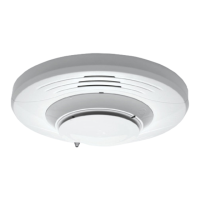
Models TR-PHOTO-T-W and TR-PHOTO-T-IV are plug-in type multi-sensor
smoke sensors that combine a photoelectronic sensing chamber and 135°F
(57.2°C) fixed temperature heat detector across addressable-analog communi-
cations. The sensors transmit an analog representation of smoke density over
a communication line to a control panel. Rotary dial switches are provided
for setting the sensor’s address. (See Figure 1.) The intelligent photoelectric
and temperature sensors also transmit an alarm signal due to heat at 135°F
(57.2°C) per UL 521.
FIGURE 1. ROTARY ADDRESS SWITCHES
TENS ONES
9
10
11
12
13
14
15
8
7
6
5
4
3
2
1
0
9
8
7
6
5
4
3
2
1
0
C0162-00
Two LEDs on the sensor are controlled by the panel to indicate sensor status.
An output is provided for connection to an optional remote LED annunciator
(P/N TR-RA100Z).
Triga panels offer different feature sets across different models. As a re-
sult, certain features of the photoelectric and temperature sensors may be
available on some control panels, but not on others. These devices support
Triga IDP Protocol systems. The possible features available if supported by the
control panel are:
1. The sensor’s LEDs can operate in three ways—on, off, and blinking–and
they can be set to red, green, or amber. This is controlled by the panel.
2. The remote output may be synchronized to the LED operation or con-
trolled independent of the LEDs.
3. Devices are point addressable up to 159 addresses.
Please refer to the operation manual for the UL listed control panel for spe-
cific operation. The photoelectric and temperature sensors require compatible
addressable communications to function properly. Connect these sensors to
listed-compatible control panels only.
SPACING
Triga recommends spacing sensors in compliance with NFPA 72. In low air
flow applications with smooth ceilings, space sensors 30 feet apart (9.1 m).
When using the photoelectric and temperature sensors as a heat detector in
FM3210 compliant applications, space sensors 20 feet (6 m) apart. For specific
information regarding sensor spacing, placement, and special applications,
I56-6973-000
INSTALLATION AND MAINTENANCE INSTRUCTIONS
TR-PHOTO-T-W and TR-PHOTO-T-IV
Intelligent Photoelectric and
Temperature Sensors
SPECIFICATIONS
Operating Voltage Range: 15 to 32 VDC
Operating Current @ 24 VDC: 200 uA (one communication every 5 seconds with green LED blink on communication)
Maximum Alarm Current: 2 mA @ 24 VDC (one communication every 5 seconds with red LED solid on)
Maximum Current: 4.5 mA @ 24 VDC (one communication every 5 seconds with amber LED solid on)
Operating Humidity Range: 10% to 93% Relative Humidity, Non-condensing
Operating Temperature Range: 32°F to 115°F (0°C to 47°F)
Air Velocity: 0 to 4000 ft./min. (0 to 1219.2 m/min.)
Height: 2.0˝ (51 mm) installed in TR-B300-6 Series Base
Diameter: 6.2˝ (156 mm) installed in TR-B300-6 Series Base; 4.1˝ (104 mm) installed in TR-B501 Series Base
Weight: 3.4 oz. (95 g)
Isolator Load Rating: 0.0063*
*Please refer to your isolator base/module manual for isolator calculation instructions.
TRIGA Life Safety Systems, LLC
7600 Olde Eight Rd.
Hudson, Ohio 4426-1057
Tel: +1 330-577-5199. Email: info@trigaglobal.com
1 I56-6973-000
4/27/2021

Question and Answer IconNeed help?

Do you have a question about the TRIGA TR-PHOTO-T-W and is the answer not in the manual?

Summary

Specifications

Sensor Specifications

Details operating voltage, current, temperature, humidity, air velocity, dimensions, and weight.

General Description

Sensor Functionality

Describes plug-in multi-sensor smoke and heat detectors with analog communication.

LED and Annunciator Control

Explains sensor LED operation and remote annunciator output control.

Compatibility and Addressing

Details sensor compatibility, addressability, and panel integration features.

Sensor Spacing

Spacing Recommendations

Details sensor spacing based on NFPA 72 and application types.

Wiring Guide

Installation Procedure

Step-by-step guide for wiring sensor bases, setting addresses, and installing sensors.

Wiring Diagram

Illustrates the connection of the sensor to a compatible control panel.

Testing

Functional Magnet Test

Tests sensor electronics and panel connection using a magnet.

Smoke Entry Testing

Methods for testing smoke detection using approved aerosol products.

Direct Heat Method

Tests thermistors using a heat source like a hair dryer.

Multi-Criteria Method

Utilizes Testifire by SDi for smoke and heat sensor testing.

Cleaning

Cleaning Procedure

Steps for safely removing the sensor and cleaning the sensing chamber.

Special Application

High Sensitivity Mode

Describes special application mode for higher sensitivity in specific environments.

Overview

The TR-PHOTO-T-W and TR-PHOTO-T-IV are intelligent photoelectric and temperature sensors designed for use in fire alarm systems. These devices are plug-in type multi-sensor smoke sensors that integrate a photoelectronic sensing chamber with a 135°F (57.2°C) fixed temperature heat detector. They communicate via addressable-analog communication lines, transmitting an analog representation of smoke density to a control panel. Additionally, they signal an alarm due to heat at 135°F (57.2°C) in accordance with UL 521.

Function Description:

These sensors are designed to detect both smoke and heat, providing comprehensive fire detection capabilities. They are compatible with Triga IDP Protocol systems and are point addressable, supporting up to 159 addresses. The sensors feature two LEDs, which are controlled by the panel and can operate in three ways (on, off, or blinking) with selectable colors (red, green, or amber). An output is also provided for connecting an optional remote LED annunciator (P/N TR-RA100Z), which can be synchronized with the LED operation or controlled independently.

Important Technical Specifications:

  • Operating Voltage Range: 15 to 32 VDC
  • Operating Current @ 24 VDC: 200 uA (one communication every 5 seconds with green LED blink on communication)
  • Maximum Alarm Current: 2 mA @ 24 VDC (one communication every 5 seconds with red LED solid on)
  • Maximum Current: 4.5 mA @ 24 VDC (one communication every 5 seconds with amber LED solid on)
  • Operating Humidity Range: 10% to 93% Relative Humidity, Non-condensing
  • Operating Temperature Range: 32°F to 115°F (0°C to 47°F)
  • Air Velocity: 0 to 4000 ft./min. (0 to 1219.2 m/min.)
  • Height: 2.0" (51 mm) installed in TR-B300-6 Series Base; 4.1" (104 mm) installed in TR-B501 Series Base
  • Diameter: 6.2" (156 mm) installed in TR-B300-6 Series Base
  • Weight: 3.4 oz. (95 g)
  • Isolator Load Rating: 0.0063* (refer to isolator base/module manual for calculation instructions)
  • Listings: UL 268 listed for Open Air Protection, UL268A listed for Duct Applications, UL 521 listed for Heat Detectors.

Usage Features:

  • Address Setting: Rotary dial switches are provided for setting the sensor's address (0-159).
  • Installation: Sensors are installed into a compatible sensor base by pushing and turning clockwise to secure them. Wiring must comply with the National Electrical Code, local codes, and AHJ requirements.
  • Spacing: Triga recommends spacing sensors in compliance with NFPA 72. For low air flow applications with smooth ceilings, sensors should be spaced 30 feet apart (9.1 m). When used as a heat detector in FM3210 compliant applications, spacing should be 20 feet (6 m) apart.
  • Special Application Mode: When configured at the fire alarm control panel, the detector can operate in a special application mode with higher sensitivity than normally allowed by UL 268. This mode is suitable for areas where early warning is critical, such as hospitals, museums, and assisted living facilities, but is not compliant with the Cooking Nuisance Smoke Test and may be more prone to false alarms in unsuitable environments (e.g., areas with airborne particulate from sawing, drilling, grinding, textile/agricultural processing, or unvented engines).
  • Tamper-Resistance: The sensors include a tamper-resistant feature that prevents removal from the base without a tool.

Maintenance Features:

  • Testing:
    • Functional (Magnet Test): A test magnet (P/N M02-04-01 or M02-09-00) can be used to electronically simulate smoke, testing the sensor electronics and control panel connections.
    • Smoke Entry: Canned aerosol simulated smoke (e.g., HSI Fire & Safety 25S/30S, SDi SMOKECENTURIAN/SOLO A10/SMOKESABRE/TRUTEST, TESTIFIRE 2000) can be used to test the smoke detector's response. Sensitivity readings are available through the FACP.
    • Direct Heat Method: A 1000-1500 watt hair dryer can be used to test the thermistors. Heat should be directed towards each thermistor from approximately 12 inches (30 cm) away to avoid damaging the plastic housing.
    • Multi-Criteria Method: A Testifire® by SDi can be used to test both smoke and heat sensors.
    • All sensors must be tested after installation and periodically thereafter, following AHJ requirements.
  • Cleaning:
    • Notify authorities and disable the system before cleaning.
    • Remove the sensor from the system.
    • Remove the sensor cover by pressing the four removal tabs.
    • Carefully vacuum the screen.
    • If further cleaning is needed, remove the chamber cover/screen assembly by pulling it straight out.
    • Use a vacuum cleaner or compressed air to remove dust and debris from the sensing chamber.
    • Reinstall the chamber cover/screen assembly, ensuring it is firmly in place.
    • Replace the cover, aligning with the LEDs, and gently pushing until it locks, ensuring thermistors are not bent.
    • Reinstall the detector and test it.
    • Reconnect disabled circuits and notify authorities that the system is back online.
  • Dust Covers: Dust covers provide limited protection during shipping and must be removed before sensors can sense smoke. Sensors should be removed prior to heavy remodeling or construction.

TRIGA TR-PHOTO-T-W Specifications

General IconGeneral
BrandTRIGA
ModelTR-PHOTO-T-W
CategoryAccessories
LanguageEnglish