WHEELS
AND
TYRES
SOFT
CUSHION
RUBBER
TREAD
I
BREAKER
CASING
BEAD
WIRES
Fig.
I
Tyre
Construction.
Construction
of
Tyre
One of the principal functions of the tyres
fitted to a car is to eliminate high frequency
vibrations. They do this by virtue of the fact
that the unsprung mass of each tyre-the part
of the tyre
in
contact with the ground-is very
small.
Tyres must be flexible and responsive. They
must also be strong and tough to contain the
air
pressure, resist damage, give long mileage,
transmit driving and braking forces, and at the
same time provide road grip, stability, and good
steering properties.
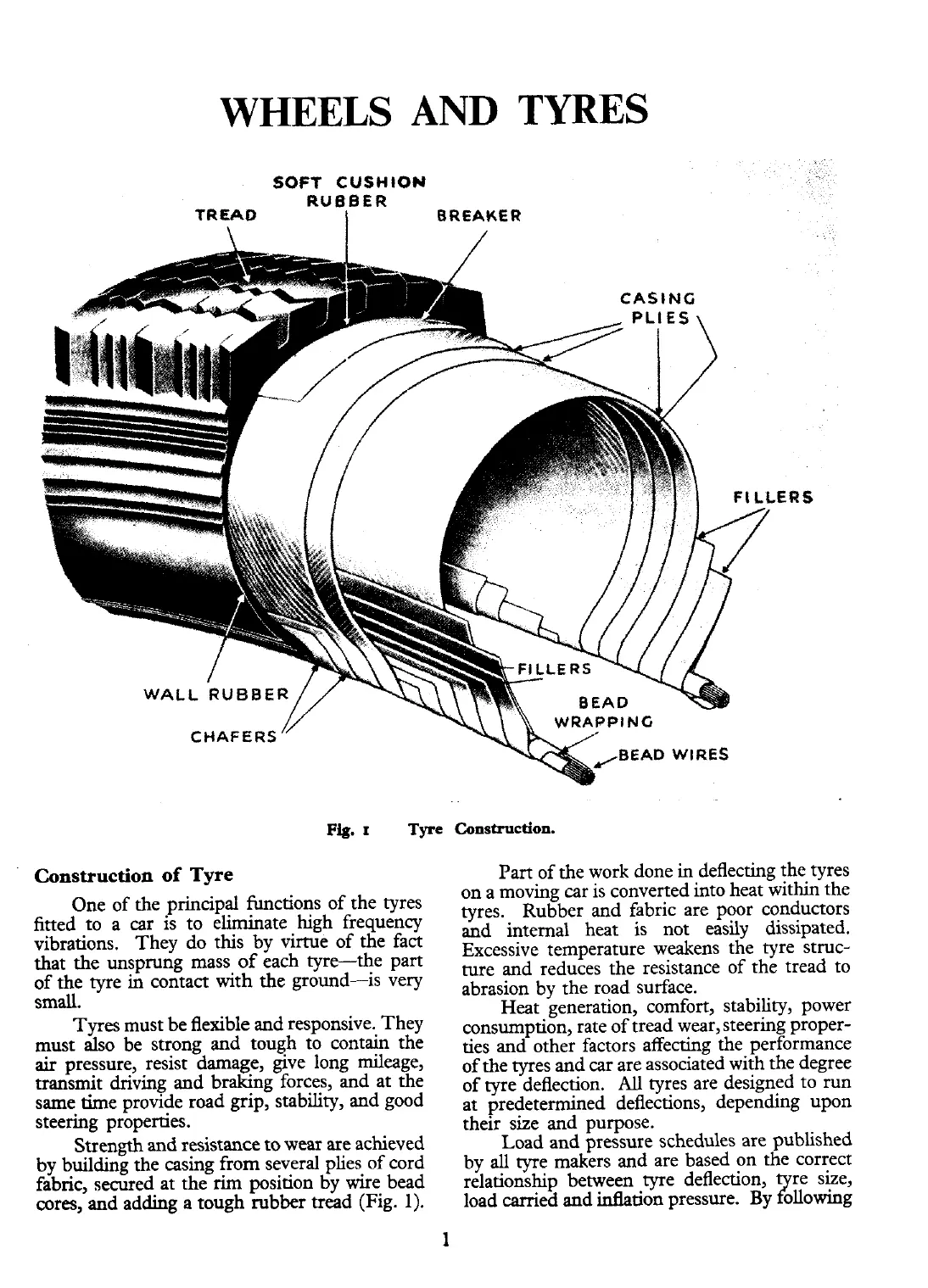
Strength and resistance to wear are achieved
by building the casing from several plies of cord
fabric, secured at the
rim
position by wire bead
cores, and adding a tough rubber tread (Fig.
1).
Part of the work done
in
deflecting the tyres
on a moving car is converted into heat within the
tyres. Rubber and fabric are poor conductors
and internal heat is not easily dissipated.
Excessive temperature weakens the tyre struc-
ture and reduces the resistance of the tread to
abrasion by the road surface.
Heat generation, comfort, stability, power
consumption, rate of tread wear, steering proper-
ties and other factors affecting the performance
of the tyres and car are associated with the degree
of tyre deflection.
All
tyres are designed to run
at predetermined deflections, depending upon
their size and purpose.
Load and pressure schedules are published
by all tyre makers and are based on the correct
relationship between tyre deflection,
r"
load carried and inflation pressure.
By
ollomg



 To Next Page