WHEELS
AND
TYRES
disadvantage in this respect and their
pattern displacement tends to be al-
ways
in
the same direction.
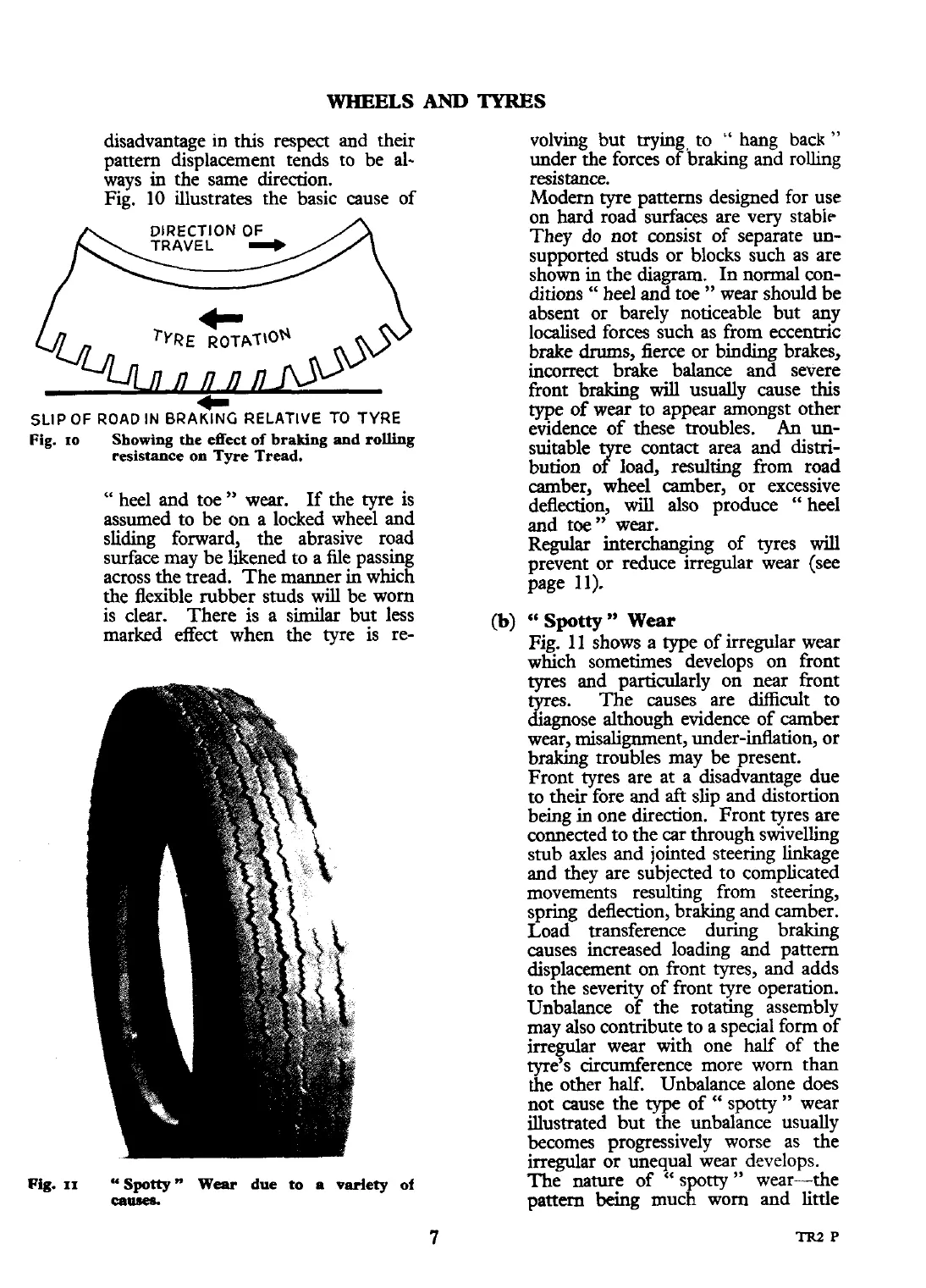
Fig.
10
illustrates the basic cause of
DIRECTION OF
0
SLIP
OF ROAD
IN
BRAKING RELATIVE
TO
TYRE
Fig.
KO
Showing the effect of braking and rolling
resistance
on
Tyre Tread.
"
heel and toe
"
wear.
If the tyre is
assumed to be on a locked wheel and
sliding forward, the abrasive road
surface may be likened to a file passing
across the tread. The manner in which
the flexible rubber studs will be worn
is clear.
There is a similar but less
marked effect when the tyre is re-
Pig.
XI
-
Spotty"
Wear
due
to
a
variety
of
cawes.
volving but trying, to
"
hang back
"
under the forces of braking and rolling
resistance.
Modern tyre patterns designed for use
on hard road surfaces are very stabir
They do not consist of separate un-
supported studs or blocks such as are
shown in the diagram. In normal con-
ditions
"
heel
and toe
"
wear should be
absent or barely noticeable but any
localised forces such as from eccentric
brake drums, fierce or binding brakes,
incorrect brake balance and severe
front braking
will
usually cause this
type of wear to appear amongst other
evidence of these troubles.
An
un-
e contact area and distri-
bution o
?'=
load, resulting from road
camber, wheel camber, or excessive
deflection,
will
also produce "heel
and toe
"
wear.
Regular interchanging of tyres
will
prevent or reduce irregular wear (see
page
11).
(b)
"
Spotty
"
Wear
Fig.
11
shows a type of irregular wear
which sometimes develops on front
tyres and particularly on near front
tyres. The causes are difficult to
diagnose although evidence of camber
wear, misalignment, under-inflation, or
braking troubles may be present.
Front tyres are at a disadvantage due
to their fore and
aft
slip and distortion
being
in
one direction. Front tyres are
connected to the car through swivelling
stub axles and jointed steering linkage
and they are subjected to complicated
movements resulting from
steerinp,
spring deflection, brhg and camb&:
Load transference during braking
causes increased loading aid pattern
displacement on front tyres, and adds
to the severity of front tyre operation.
Unbalance of the rotating assembly
may also contribute to a special form of
irregular wear
with
one
half
of the
tyre's circumference more worn than
the other half. Unbalance alone does
not cause the
type
of
"
spotty
"
wear
illustrated but the unbalance usually
becomes progressively worse as the
irregular or unequal wear develops.
The
MNe of
"
spotty" wear-the
pattern being much worn and little


 To Next Page
 Loading...