WHEELS
AND
TYRES
4.
CAMBER, CASTOR
AND
KING
PIN
INCLINATION
These angles normally require no attention
unless they have been disturbed by a
severe impact or abnormal wear of front end
bearings. It is always advisable to check
them if steering irregularities develop.
Wheel camber, usually combined with road
camber, causes a wheel to try to turn in the
direction of lean, due to one side of the
tread attempting to make more revolutions
per mile than the other side. The resulting
increased tread shuffle on the road and the
off centre tyre loading tend to cause rapid
and one-sided wear. If wheel camber is
excessive for any reason the rapid and one-
sided tyre wear will be correspondingly
greater. Unequal cambers introduce un-
balanced forces which try to steer the car
one way or the other.
This must be
countered by steering in the opposite direc-
tion which results in still faster tread wear.
When tyre wear associated with camber
results from road conditions and not from
car condition little can be done except to
interchange or reverse the tyres. This will
prevent one-sided wear, irregular wear, and
fast wear from developing to a maximum
degree on any one tyre, usually the near
front tyre.
Castor and king pin inclination by them-
selves have no direct bearing on tyre wear
but their measurement is often useful for
providing a general indication of the con-
dition of the front end geometry and
suspension.
5.
TYRE
AND WHEEL BALANCE
(a) Static Balance
In the interests of smooth riding, pre-
cise steering, and the avoidance of high
speed
"
tramp
"
or "wheel hop,"
all
Dunlop tyres are balance checked to
predetermined limits.
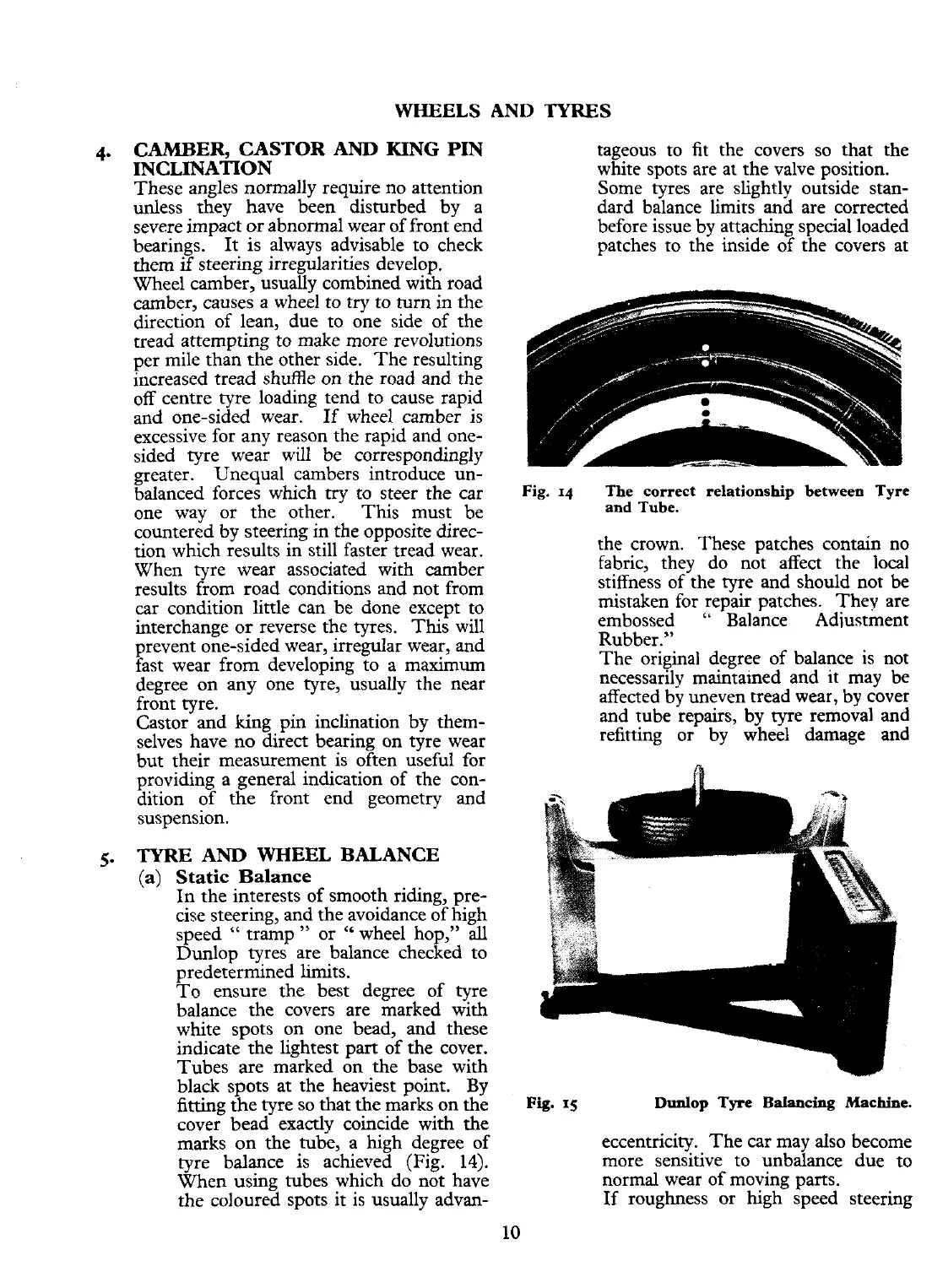
To ensure the best degree of tyre
balance the covers are marked with
white spots on one bead, and these
indicate the lightest part of the cover.
Tubes are marked on the base with
black spots at the heaviest point. By
fitting the tyre so that the marks on the
cover bead exactly coincide with the
marks on the tube, a high degree of
tyre balance is achieved (Fig.
14).
When using tubes which do not have
the coloured spots it is usually advan-
tageous to fit the covers so that the
white spots are at the valve position.
Some tyres are slightly outside stan-
dard balance limits and are corrected
before issue by attaching special loaded
patches to the inside of the covers at
Fig.
14
The correct relationship between Tyre
and Tube.
the crown.
These patches contain no
fabric, they do not affect the local
stiffness of the tyre and should not be
mistaken for repair patches. Thev are
embossed
"
Balance Adjustment
Rubber."
The original degree of balance is not
necessarily maintained and it may be
affected by uneven tread
wear,
by cover
and tube repairs, by tyre removal and
refitting or by wheel damage and
F%.
15
Dunlop Tyre Balancing Machine.
eccentricity. The car may also become
more sensitive to unbalance due to
normal wear of moving parts.
If roughness or high speed steering
10


 To Next Page
 Loading...