ELECTRICAL
EQUIPMENT
the regulator core, due to the shunt or
voltage winding, becomes sufficiently strong
to attract the armature to the core. This
causes the contacts to open, thereby insert-
ing the resistance in the generator field
circuit.
The consequent reduction in the generator
field current lowers the generator terminal
voltage, and this, in
turn,
weakens the
magnetic
flux
in the regulator core. The
armature therefore returns to its original
position, and the contacts closing allow the
generator voltage to rise again to its
maximum value. This cycle is then repeated
and an oscillation of the armature is
maintained.
As the speed of the generator rises above
that at which the regulator comes into
operation, the periods of contact separation
increase in length and, as a result, the
mean value of the generator voltage under-
goes practically no increase once this
regulating
speed has been attained.
The series or current winding provides a
compensatiori on this system of control, for
if the control were arranged entirely on the
basis of voltage there would be a risk of
seriously overloading the generator when
the battery was in a low state of charge,
articularly if the lamps were simultaneous-
&
in use.
Under these conditions of reduced battery
voltage, the output to the battery rises and,
but for the series winding, would exceed
REGULATOR CUT-OUT
/
\
;HUNT
COIL
SHUNT
COIL
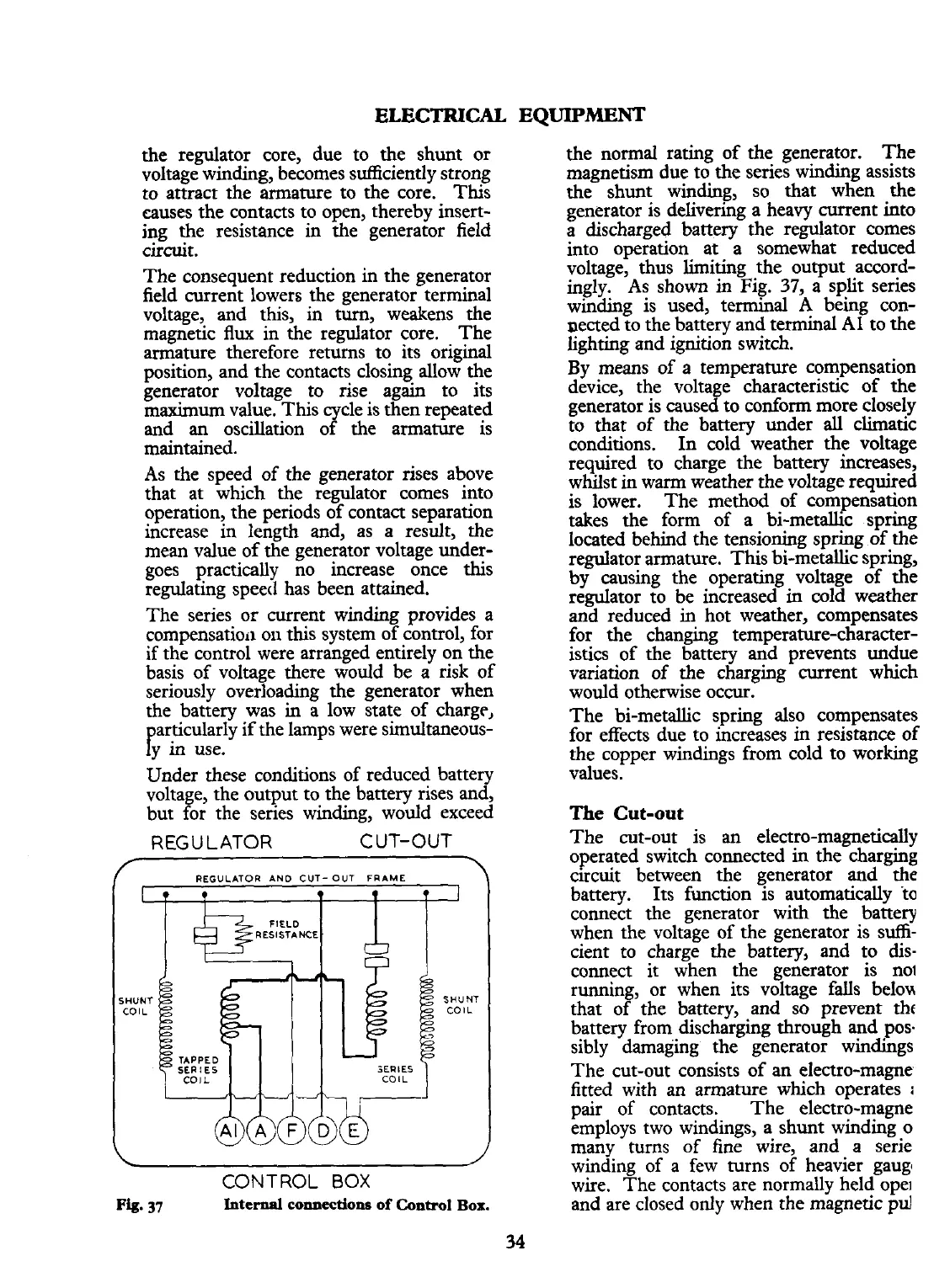
CONTROL BOX
Fk.
37
Internal
connections
of
Control
Box.
34
the normal rating of the generator.
The
magnetism due to the series winding assists
the shunt winding, so that when the
generator is delivering a heavy current into
a discharged battery the regulator comes
into operation at a somewhat reduced
voltage, thus limiting the output accord-
ingly. As shown in Fig.
37,
a split series
winding is used, terminal A being con-
~ected to the battery and terminal AI to the
lighting and ignition switch.
By means of a temperature compensation
device, the voltage characteristic of the
generator is caused to conform more closely
to that of the battery under
all
climatic
conditions. In cold weather the voltage
required to charge the battery increas&,
whilst in warm weather the voltage reauired
is lower.
The method of cohpensation
takes the form of a bi-metalhc spring
located behind the
tensioning spring of the
regulator armature. This bi-metallic spring,
by causing the operating voltage of the
regulator to be increased in cold weather
and reduced in hot weather, compensates
for the changing
temperature-character-
istics of the battery and prevents undue
variation of the charging current which
would otherwise occur.
The bi-metallic spring also compensates
for effects due to increases in resistance of
the copper windings from cold to working
values.
The
Cut-out
The cut-out is an electro-magnetically
operated switch connected in the charging
circuit between the generator and the
battery. Its function is automatically
ta
connect the generator with the battery
when the voltage of the generator is suffi-
cient to charge the battery, and to dis-
connect it when the generator is
no1
running, or when its voltage falls below
that of the battery, and so prevent tht
battery from discharging through and pos.
sibly damaging the generator windings
The cut-out consists of an electro-magm
fitted with an armature which operates
:
pair of contacts. The electro-magne
employs two windings, a shunt winding o
many turns of fine wire, and a serie
winding of a few turns of heavier
gaug
wire. The contacts are normally held opel
and are closed only when the magnetic pul


 To Next Page
 Loading...