BODY
used, or a hot air blast can be directed to
the lacquer.
If neither oven nor hot air
blast is available the component can be
left undisturbed in
a
warm atmosphere
for
24
hours. Although reasonable sealing
will be obtained by the instructions con-
tained
in
this paragraph, the proper heat
treatment at the higher temperature will
provide the best possible water proofing.
ADJUSTMENT OF SIDE CURTAINS
An aluminium
wedge with two tapped
holes is attached to each side screen support
stay by a single screw which fits in slotted
apertures providing the adjustment.
It
is by moving these wedges up or down the
support stays that adjustment is obtained.
When adjustments have been completed
ensure that the press studs of the curtain
align with those on the door panel and the
support stays are secured in their sockets
by knurled screws.
32.
TO
PREPARE
CAR
FOR FIBRE-
GLASS
HARD
TOP CANOPY
(a)
Remove hood and fittings as described
on page
8.
(b)
Withdraw the screws securing the three
cappings to the rear elbow rail and
the fixing screw of the front petrol
tank
trim.
Protect the exterior of the
car
adjacent to the elbow rail with
masking tape.
(c)
Remove the millboard from the rear
of the petrol
tank
by withdrawing the
screws.
(d)
Assemble the windscreen bracket and
bridge pieces to the canopy.
(e)
Position canopy on the windscreen
and elbow rail of the car-windscreen
first.
Mark the position of the wind-
screen bracket holes on the flange.
(f)
Remove the canopy from the car and
drill the windscreen beading. Transfer
windscreen brackets from the canopy
to the beading and secure with the
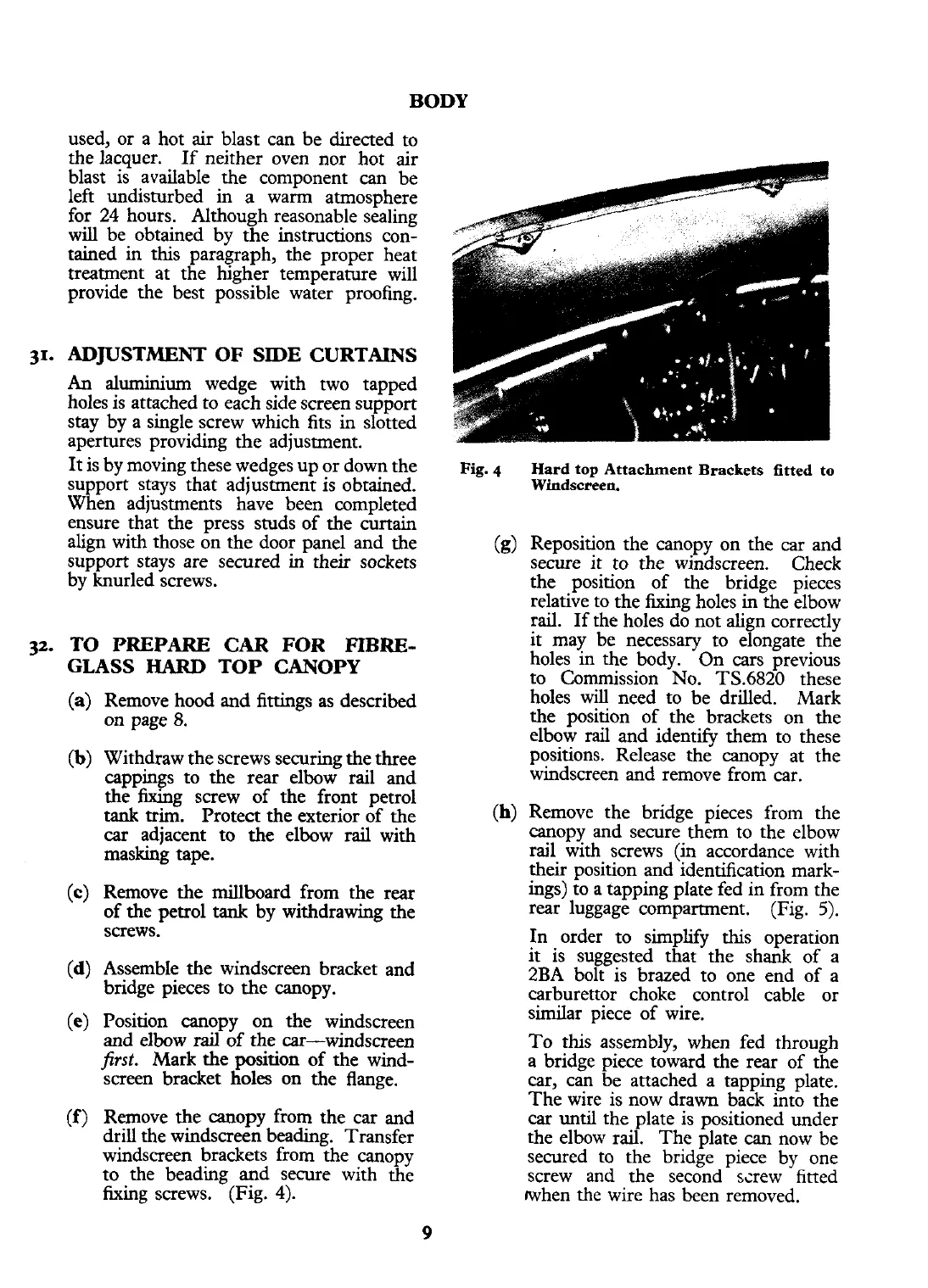
fixing screws. (Fig.
4).
Fig.
4
Hard top Attachment Brackets fitted to
Windscreen.
(g)
Reposition the canopy on the car and
secure it to the windscreen.
Check
the position of the bridge pieces
relative to the fixing holes in the elbow
rail. If the holes do not align correctly
it may be necessary to elongate the
holes in the body. On cars previous
to Commission No. TS.6820 these
holes will need to be drilled. Mark
the position of the brackets on the
elbow rail and
identlfy them to these
positions. Release the canopy at the
windscreen and remove from car.
(h)
Remove the bridge pieces from the
canopy and secure them to the elbow
rail with screws (in accordance with
their position and identification mark-
ings) to a tapping plate fed in from the
rear luggage compartment. (Fig.
5).
In order to simplify this operation
it is suggested that the shank of a
2BA bolt is brazed to one end of a
carburettor choke control cable or
similar piece of wire.
To this assembly, when fed through
a bridge piece toward the rear of the
car, can be attached a tapping plate.
The wire is now drawn back into the
car
until
the plate is positioned under
the elbow rail. The plate can now be
secured to the bridge piece by one
screw and the second screw fitted
when the wire has been removed.


 To Next Page
 Loading...