COOLING
The :soling system is pressurised and
thermostatically controlled, with an irnpel-
ler pump to ensure efficient circulation of
water at
all
times. The
capacity
is 13 pints
or 14 when a heater is fitted. Careful con-
sideration has been pjven to mints where
adequate cooling is neces&y, such as
sparking
plugs
and valve
guides,
etc.
--
-
TO
assist cooling when the
car
is stationary
or travelling at low speeds a
123"
diameter
four bladed fan attached to the crankshaft
draws
air
through the radiator.
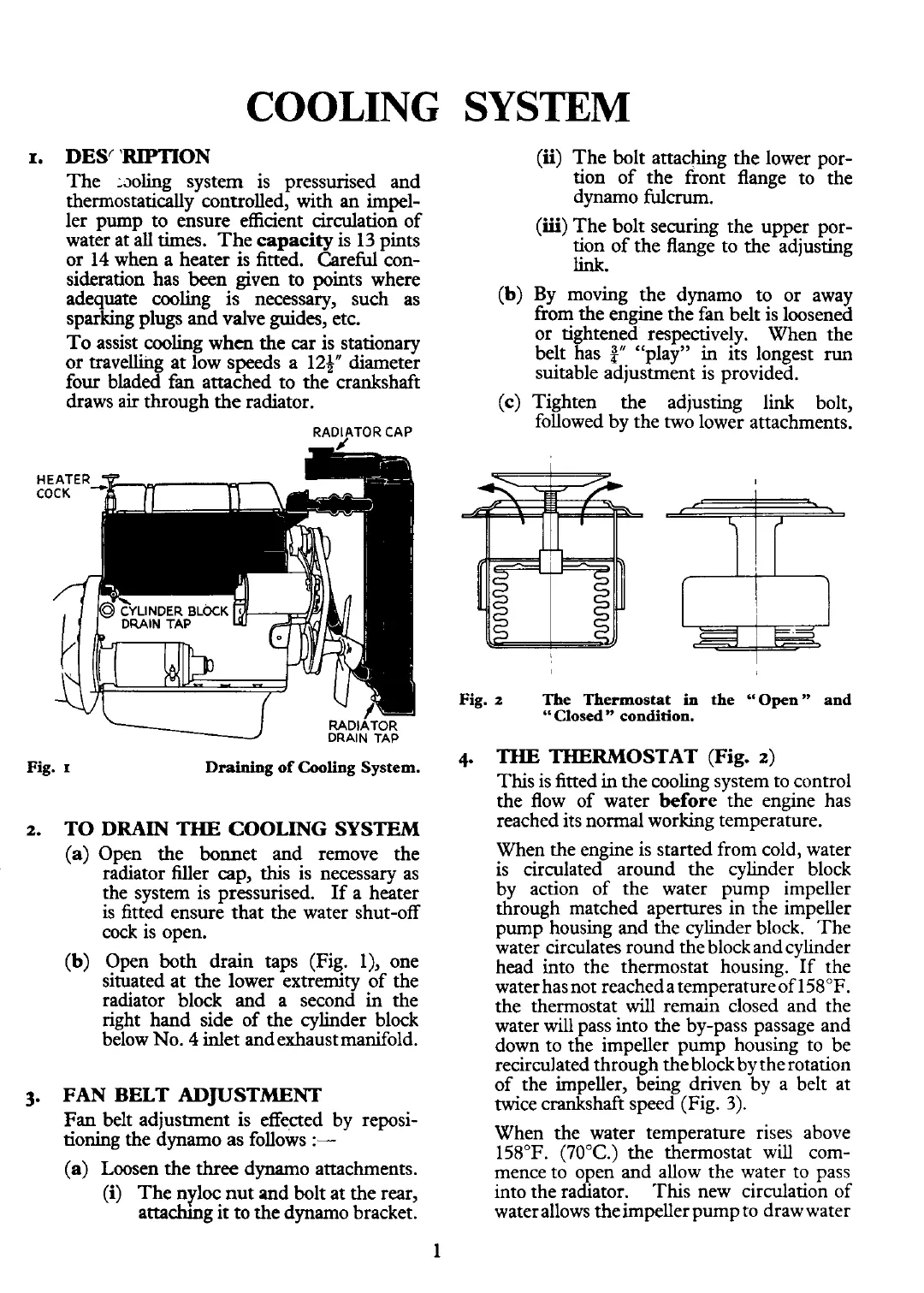
RADIATOR
CAP
RADIATOR
DRAIN
TAP
Fig.
I
Draining
of
Cooling
System.
2.
TO
DRAIN
THE
COOLING SYSTEM
(a)
Open the bonnet and remove the
radiator filler cap, this is necessary as
the system is pressurised. If a heater
is fitted ensure that the water shut-off
cock is open.
(b)
Open both drain taps (Fig.
l),
one
situated at the lower extremity of the
radiator block and a second in the
right hand side of the cylinder block
below No.
4
inlet andexhaust manifold.
3.
FAN
BELT ADJUSTMENT
Fan belt adjustment is effected by reposi-
tioning the dynamo as follows
:-
(a)
Loosen the
three
dynamo attachments.
(i)
The nyloc nut and bolt at the rear,
attachmg it to the dynamo bracket.
SYSTEM
(ii)
The bolt attaching the lower por-
tion of the front flange to the
dynamo
fulcrum.
(iii)
The bolt securing the upper por-
tion of the flange to the adjusting
link.
(b)
By moving the dynamo to or away
from the engine the fan belt is loosened
or tightened respectively. When the
belt has
g"
"play" in its longest
run
suitable adjustment is provided.
(c)
Tighten the adjusting link bolt,
followed by the two lower attachments.
Fig.
z
The Thermostat
in
the "Open" and
"
Closed" condition.
4.
THE
THERMOSTAT
(Fig. 2)
This is fitted in the cooling system to control
the flow of water
before
the engine has
reached its normal working temperature.
When the engine is started from cold, water
is circulated around the cylinder block
by action of the water pump
impeller
through matched apertures in the impeller
pump housing and the cylinder block. The
water circulates round the block and cylinder
head into the thermostat housing. If the
water has not reacheda temperatureof 158°F.
the thermostat
will
remain closed and the
water will pass into the by-pass passage and
down to the
impeller pump housing to be
recirculated through the block by the rotation
of the impeller, being driven by a belt at
twice crankshaft speed (Fig.
3).
When the water temperature rises above
158°F.
(70°C.)
the thermostat will com-
mence to open and allow the water to pass
into the radiator. This new circulation of
water allows theimpeller pump to draw water


 To Next Page
 Loading...