OPERATING THE EZ-LINK™ SYSTEM
NOTE: To make installing or removing the attachment easier, place the unit on the
ground or on a work bench.
Installing the Attachment
NOTE: Remove the protective cap and gray spacer from the upper and lower
shafts prior to assembling the attachment.
1. Turn the knob counterclockwise to loosen (Fig. 4).
2. While firmly holding the attachment, push it straight into the coupler until the
release button snaps firmly into the primary hole (Fig. 6).
NOTE: Aligning the release button with the guide recess will help installation (Fig. 5).
3. Turn the knob clockwise to tighten (Fig. 4).
For decorative edging with the line head trimmer attachment, lock the release button
of the attachment into the 90° hole (Fig. 4).
Removing the Attachment
1. Turn the knob counterclockwise to loosen (Fig. 4).
2. Press and hold the release button (Fig. 5).
3. While firmly holding the upper shaft housing, pull the attachment straight out of
the coupler (Fig. 6).
The EZ-Link™ System
The EZ-Link™ system enables the use of these optional attachments:
• Edger*
• Cultivator
• Turbo Blower
• Brushcutter*
• Pole Saw
• Hedge Trimmer*
• Straight-shaft trimmer
• Curved-shaft trimmer
*DO NOT use this attachment with an electric powered unit.
STARTING INSTRUCTIONS
1. Mix fuel with oil. Fill fuel tank with fuel/oil mixture. See Oil and Fuel Mixing
Instructions.
2. Fill the fuel tank with fresh, clean fuel mix. Refer to Fueling the Unit.
NOTE: There is no need to turn the unit on. The On/Off Control is in the ON ( I )
position at all times (Fig. 7).
3. Fully press and release the primer bulb 10 times, slowly. Some amount of fuel
should be visible in the primer bulb and fuel lines (Fig. 8). If fuel can not be seen in
the bulb, press and release the bulb until fuel is visible.
4. Place the choke lever in Position 1 (Fig. 8).
5. Crouch in the starting position (Fig. 9). Squeeze the throttle control lever. Pull the
starter rope 5 times.
6. Place the choke lever in Position 2 (Fig. 8)
7. Squeeze the throttle control, pull the starter rope in a controlled motion 3 to 5
times to start engine.
8. Keep the throttle squeezed and allow the engine to warm up for 30 to 60 seconds.
9. Continue squeezing the throttle control, move the choke lever to Position 3 (Fig. 8)
and continue warming the engine for an additional 60 seconds. The unit may be
used during this time.
NOTE: Unit is properly warmed up when engine accelerates without hesitation.
IF... the engine hesitates, return the choke lever to Position 2 (Fig. 8) and continue warm-up.
IF... the engine does not start, go back to step 3.
IF... the engine fails to start after 2 attempts, place the choke lever in Position 3 and squeeze the throttle
control. Pull the starter rope out with a controlled and steady motion 3 to 8 times. The engine should start. If
not, repeat.
IF WARM... If the engine is already warm, start the unit with the choke lever in Position 2. After the unit starts, move
the choke lever to Position 3.
OIL AND FUEL MIXING INSTRUCTIONS
Old and/or improperly mixed fuel are the main reasons for the unit not running properly. Be sure to use fresh, clean
unleaded fuel. Follow the instructions carefully for the proper fuel/oil mixture.
DEFINITION OF BLENDED FUELS
Today's fuels are often a blend of gasoline and oxygenates such as ethanol, methanol, or MTBE (ether). Alcohol-
blended fuel absorbs water. As little as 1% water in the fuel can make fuel and oil separate. It forms acids when
stored. When using alcohol-blended fuel, use fresh fuel (less than 30 days old).
USING BLENDED FUELS
If choosing to use a blended fuel, or its use is unavoidable, follow recommended precautions:
• Always use the fresh fuel mix explained in the operator's manual
• Always agitate the fuel mix before fueling the unit
• Drain the tank and run the engine dry before storing the unit
USING FUEL ADDITIVES
The bottle of 2-cycle oil contains a fuel additive which will help inhibit corrosion and
minimize the formation of gum deposits. It is recommended to use our 2-cycle oil
with this unit.
If unavailable, use a good 2-cycle oil designed for air-cooled engines along with a fuel additive, such as STA-BIL® Gas
Stabilizer or an equivalent. Add 0.8 oz. (23 ml.) of fuel additive per gallon of fuel according to the instructions on the
container. NEVER add fuel additives directly to the unit's fuel tank.
Thoroughly mix the proper ratio of 2-cycle engine oil with unleaded fuel in a separate fuel can. Use a 40:1 fuel/oil ratio.
Do not mix them directly in the engine fuel tank. See the table for specific gas and oil mixing ratios.
NOTE:
One gallon (3.8 liters) of unleaded fuel mixed with one 3.2 oz. (95 ml.) bottle of 2-cycle oil makes a 40:1 fuel/oil ratio.
NOTE: Dispose of the old fuel/oil mix in accordance to Federal, State and Local regulations.
FUELING THE UNIT
1. Turn unit on its side, with the fuel cap facing up, and remove the fuel cap.
2. Place the gas container’s spout into the fill hole on the fuel tank and fill the tank.
NOTE: Do not overfill the tank.
3. Wipe up any gasoline that may have spilled.
4. Reinstall the fuel cap.
5. Move the unit at least 30 ft. (9.1 m) from the fueling source and site before starting the engine.
MIXING RATIO - 40:1
3
KNOW YOUR UNIT
APPLICATIONS
As a trimmer:
• Cutting grass and light weeds.
• Edging
• Decorative trimming around trees,
fences, etc.
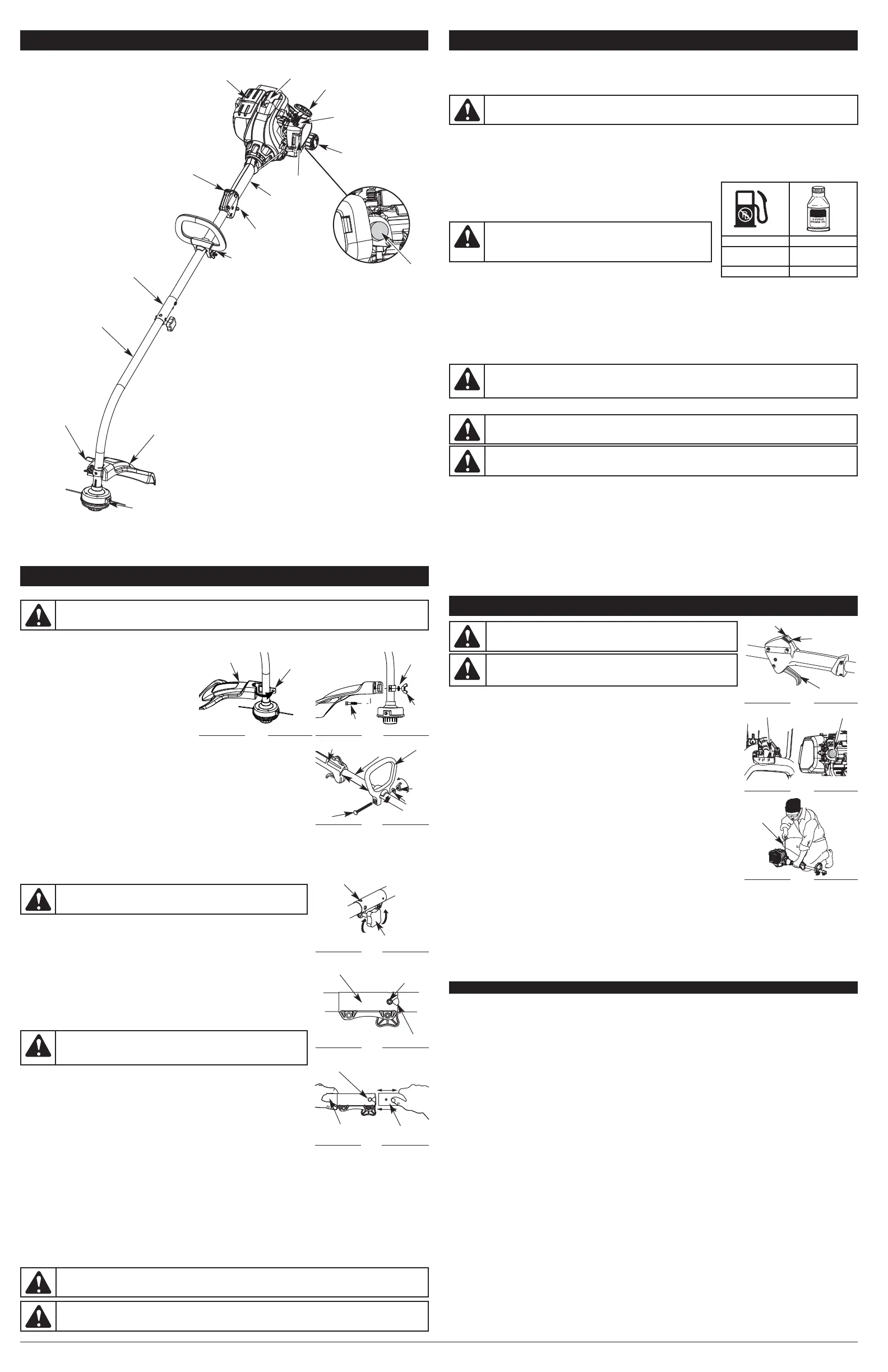
Throttle Control
D-Handle
Shaft Grip
Air Filter Cover
Spark Plug
Shaft Housing
Starter Rope Grip
Line Cutting
Blade
Muffler
On/Off Control
Cutting Head
Cutting Head Shield
Fuel Cap
OIL AND FUEL INFORMATION
INSTALL CUTTING ATTACHMENT SHIELD
Use the following instructions if the cutting attachment shield on the unit is not installed. Use only the instructions that
apply to the type of shaft and shield that the unit is equipped with.
1.
Place the cutting attachment shield onto the shaft
housing. Be sure the guard mounting bracket slides
into the slot on the edge of the cutting shield. Rotate
the shield into place, counterclockwise (Fig. 1). The
holes in the guard mounting bracket and cutting
attachment shield will line up.
2. From inside the cutting attachment shield, push
the square bolt through the hole until the
threaded end protrudes through the guard
mounting bracket (Fig. 2).
3. Put the washer on the bolt, then screw the wing nut onto the bolt and tighten.
INSTALL AND ADJUST THE D-HANDLE
1. Push the D-handle down onto the shaft housing (Fig. 3). The hex bolt hole in the
handle should be on the left side.
2. Insert the bolt into the hex hole in the handle and push through. Place the washer
on the bolt, then screw the wing nut onto the bolt. Do not tighten until making the
handle adjustment.
3. Rotate the D-handle to place the grip above the top of the shaft housing. Place it
a minimum of 6 inches (15.24 cm) from the end of the shaft grip.
4. While holding the unit in the operating position (Fig. 10), move the D-handle to the location that provides the best grip.
5. Tighten the wing nut until the D-handle is secure.
ASSEMBLY INSTRUCTIONS
WARNING:
To prevent serious personal injury, never operate the trimmer without the cutting
attachment shield in place.
Cutting
Shield
Mount
Bracket
Fig. 1
Fig. 2
Choke Lever
Primer Bulb
Square Bolt
UNLEADED GAS 2 CYCLE OIL
1 GALLON US
(3.8 LITERS)
3.2 FL. OZ.
(95 ml)
1 LITER 25 ml
CAUTION:
For proper engine operation and maximum
reliability, pay strict attention to the oil and fuel mixing instructions
on the 2-cycle oil container. Using improperly mixed fuel can
severely damage the engine.
WARNING:
Gasoline is extremely flammable. Ignited vapors may explode. Always stop the engine
and allow it to cool before filling the fuel tank. Do not smoke while filling the tank. Keep sparks and open
flames at a distance from the area.
WARNING:
Remove fuel cap slowly to avoid injury from fuel spray. Never operate the unit without the
fuel cap securely in place.
WARNING:
Add fuel in a clean, level and well ventilated outdoor area. Wipe up any spilled fuel immediately.
Avoid creating a source of ignition for spilled fuel. Do not start the engine until fuel vapors dissipate.
STARTING/STOPPING INSTRUCTIONS
WARNING:
Avoid accidental starting. Make sure you are in the
starting position when pulling the starter rope (Fig. 9). To avoid serious
injury, the operator and unit must be in a stable position while starting.
OFF (O)
ON (I)
Throttle
Control
Fig. 7
Starter
Rope
Starting Position
Fig. 9
Washer
Wing
Nut
WARNING:
It has been proven that fuel containing greater than 10% ethanol will likely damage this engine
and void the warranty.
WARNING:
Operate this unit in a well-ventilated outdoor area.
Carbon monoxide exhaust fumes can be lethal in a confined area.
Guide Recess
Fig. 5
Release
Button
EZ-Link™ Coupler
Upper Shaft
Housing
Fig. 6
Lower Shaft
Housing
Primary Hole
Knob
Fig. 4
90˚ Edging Hole
(Trimmer Only)
Shaft Grip
Shaft
Housing
D-Handle
Tighten
Wing
Nut
Bolt
Fig. 3
Washer
Minimum
6 inches
(15.24 cm)
Fig. 8
Primer Bulb
Choke Lever
HOW TO START THE UNIT USING THE ELECTRIC STARTER OR POWER START BIT ACCESSORY.
NOTE- This Unit Can Use an Electric Start or Power Start Bit™ Optional Accessory!
Please refer to the Electric Starter or Power Start Bit operator’s manual for proper use of this feature. (Items
Sold Separately! Please refer to page 5 of this manual about purchasing these accessories.)
STARTING INSTRUCTIONS
1. Mix fuel with oil. Fill fuel tank with fuel/oil mixture. See Oil and Fuel Mixing Instructions.
2. Fill the fuel tank with fresh, clean fuel mix. Refer to Fueling the Unit.
NOTE: There is no need to turn the unit on. The On/Off Control is in the ON ( I ) position at all times (Fig. 7).
3. Fully press and release the primer bulb 10 times, slowly. Some amount of fuel should be visible in the primer bulb
(Fig. 8). If fuel cannot be seen in the bulb, press and release the bulb until fuel is visible.
4. Move the choke lever to Position 1 (Fig. 8).
5. Crouch in the starting position (Fig. 9). Place the electric starter or power start bit into the back of the unit. Refer to
the Operation section of the Electric Starter or Power Start Bit operator’s manual.
6. Squeeze the throttle control lever. Press and hold the electric starter or drill ON (I) button for 2 seconds.
7. Move the choke lever to Position 2 (Fig. 8).
8. Squeeze the throttle control lever, press and hold the electric starter or drill ON (I) button for 2-second intervals until
the unit starts.
9. Continue to squeeze the throttle control, remove the electric starter or drill from the unit and allow the engine to
warm up for 30 to 60 seconds.
10. Continue squeezing the throttle control, move the choke lever to Position 3 (Fig. 8) and run the unit for an
additional 60 seconds. The unit may be used during this time.
NOTE: Unit is properly warmed up when engine accelerates without hesitation.
IF... the engine hesitates, return the choke lever to Position 2 (Fig. 8) and continue warm-up.
IF... the engine does not start, go back to step 3.
IF... the engine fails to start after 2 attempts, place the choke lever in Position 3 and squeeze the throttle
control. Press and hold the electric starter or drill ON (I) button for 2-second intervals until the unit starts.
IF WARM... If the engine is already warm, start the unit with the choker lever in Position 2. After the unit starts, move
the choker lever to Position 3.
STOPPING INSTRUCTIONS
1. Release the throttle control and allow the engine to cool down by idling.
2. Press and hold the On/Off Control switch in the OFF (O) position until the unit comes to a complete stop (Fig. 7).
IF USING THE OPTIONAL ELECTRIC STARTER OR POWER START BIT™ ACCESSORY
EZ-Link™
NO ASSEMBLY TOOLS REQUIRED
WARNING:
To avoid serious personal injury and damage to the
unit, shut the unit off before removing or installing an attachment.
CAUTION:
Before operating this unit, be sure that the release
button is fully snapped into the primary hole (Fig. 6), and that the knob
(Fig. 4) is securely tightened.
WARNING:
Before you begin using any attachment, read and understand the manual that came with
the attachment. Follow all safety information contained within.
CAUTION:
These attachments are to be snapped into the primary hole only. Using the wrong hole
could lead to personal injury or damage to the unit.



 To Next Page
 Loading...